 AI-generated
AI image prompt
Sangeet Night
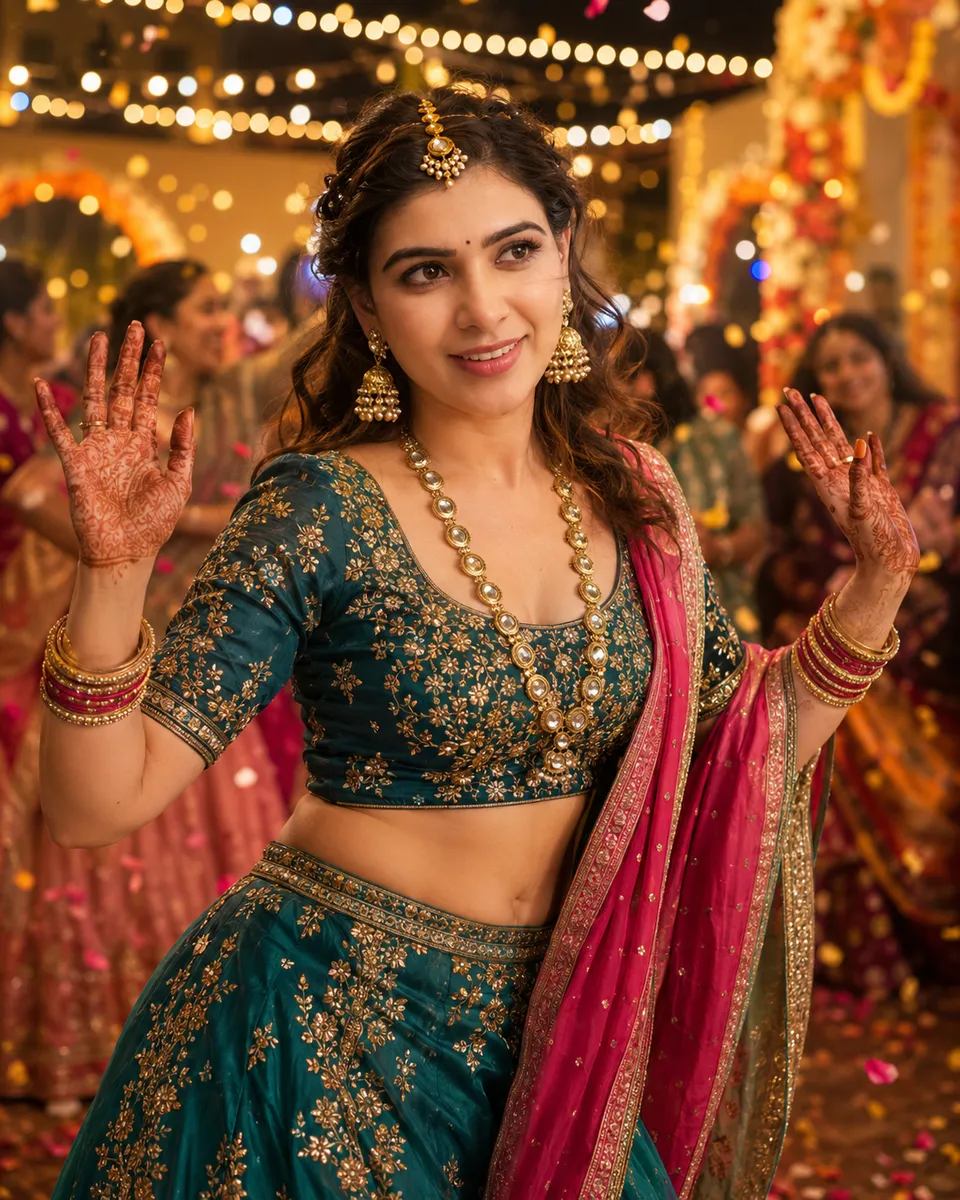
Set in a vibrant sangeet night, the image captures a joyful dancer amidst a semi-outdoor celebration. Warm fairy lights and marigold decorations create an enchanting atmosphere as she twirls in a flowing lehenga, exuding an infectious smile and a sense of movement.
A single 4:5 vertical photograph captured during a sangeet night in an Indian wedding home — late evening, around 9:45 p.m., on the night before the wedding ceremony. The setting is the family home's open courtyard or a hotel sangeet venue decorated for the celebration. The subject is the person in the uploaded photograph, captured mid-dance or just paused at the edge of the dance floor.

LOCK from the upload (carry over exactly, with no modification): the entire face — eye shape and spacing, exact eye colour, nose bridge profile and tip, lip shape and natural fullness, eyebrow shape, jawline, chin shape, hairline (including any small widow's peak), ear shape, skin tone, and every visible mole, freckle, scar, fine line, or beauty mark. Also carry over the natural hair — its actual colour, texture, length, and density. The hair can be styled for the scene (described below) but the hair itself is hers. Render imperfections that are present in the upload; do not invent ones that aren't. Critically: do not slim the face, do not enlarge the eyes, do not idealise.

REPLACE per scene (this is the crucial instruction): any earrings, necklaces, nose pins, rings, bracelets, bangles, or hair ornaments visible in the uploaded photograph are NOT carried over. They are removed entirely and replaced with only the scene-appropriate jewelry described below. If the upload shows different earrings than the scene calls for, the scene's earrings win — render the scene's, not the upload's.

Wardrobe — sangeet-night festive:
A flowing lehenga in a vivid jewel tone — pick ONE specific colour: deep teal with gold embroidery, magenta-pink with silver thread work, mustard-yellow with rose-pink mirror work, or deep coral with antique-gold embroidery. The lehenga has a fitted, embellished blouse with elbow-length sleeves and a moderately deep but tasteful neckline. The skirt has subtle volume — full enough to flare when she moves but not so wide that it dominates the frame. The dupatta is in a contrasting but complementary colour, draped loosely over one shoulder with the other end held in one hand (or partially fallen, the way dupattas naturally do during dance). The fabric is real silk or silk-blend — visible drape, slight wrinkles where it has been worn for two hours, the small imperfections of fabric that has been moving.

Scene jewelry (this replaces anything in the upload):
— Earrings: a pair of medium-sized jhumkas in antique-gold finish, bell-shaped with small pearl drops at the lower edge — they sway slightly with her movement. NOT studs, NOT modern minimal — sangeet-night jhumkas.
— Necklace: one statement piece — either a layered antique-gold chain set with small kundan stones, or a single long polki necklace falling to mid-chest. Not multiple necklaces; one piece doing the work.
— Bangles: a stack of glass and gold bangles on each wrist — six to eight per side, in colours that complement the lehenga (some matching, some contrasting), with one or two of them in gold or silver. They make a soft glassy sound when she moves.
— Maang tikka: a delicate gold pendant at the centre parting of the hair — small, refined, not the heavy bridal kind.
— Hands: dark red-brown mehndi visible on both hands, less elaborate than bridal mehndi but clearly present — done within the last two days. One or two simple rings on the fingers.
— Nose: no nose ring or nose pin (unless the wedding tradition specifically requires one — for most modern sangeets, omit it).

Hair styling: the natural hair from the upload, styled for the sangeet — pulled back into a low loose chignon or half-up half-down with the front sections framing the face, secured with a small gold or fresh-flower clip. A few jasmine or rose buds woven into the upper section if appropriate to the styling. A few strands have come loose from the dance — falling across the cheek, sticking slightly to the forehead with the warmth of the room.

Pose and moment — captured mid-celebration:
The subject is on or just at the edge of the dance floor. The body is in motion but the photograph has caught a half-second of stillness: one foot stepped forward, both hands raised in a classic Bollywood-dance gesture (the model picks the exact mudra-like position — hands at shoulder height, fingers spread loosely, the palms angled in a graceful dance position), the hips slightly turned to the right. Or alternatively — she has just laughed at someone off-frame and her head is thrown back slightly, one hand at the throat, the other holding the loose end of the dupatta. The model picks whichever moment reads strongest with the upload's face.

Expression — the celebration on her face:
A genuine wide laugh or a broad smile mid-laugh — not the closed-mouth smile of a portrait, the open expression of someone in the middle of *enjoying themselves*. Eyes either crinkled at the corners with the laugh or bright and locked on someone off-frame. The expression must be *joyful* — alive, present, slightly breathless. Read the upload's natural smile if it has one and amplify it slightly for the moment; if the upload shows a more reserved resting face, render a more inward but still warm celebration smile.

Setting and environment — the sangeet venue:
A semi-outdoor venue — perhaps the open inner courtyard of a family home, or a hotel ballroom with the doors open to a garden. Visible behind and around the subject:
— Strings of warm fairy lights overhead, hundreds of small yellow-white points stretching across the visible upper third of the frame.
— Marigold and rose garlands draped along the railings, doorframes, or strung as decorative ropes across the space — saffron and yellow and deep red.
— Several other family members on the dance floor behind and around the subject, all out of focus and in motion — recognisable as dancing women in sarees and lehengas, men in kurtas and shervanis, the older relatives clapping along at the edges. Their faces are not clearly visible; they are joyful blur.
— A few brass lamps or *diyas* placed along the floor edges, adding warm under-light.
— A small visible band corner or DJ booth at one edge of the frame, slightly out of focus.
— The floor itself: marble, wood, or fine carpet — reflecting the warm lights.

Atmospheric details:
— Marigold petals or rose petals in mid-air around the subject — someone has tossed a handful as part of the dance — small petals drifting through the frame, some caught in her hair, one or two on the shoulder.
— Slight motion blur on the background dancers and on the petals — the photograph has frozen the subject sharply but the world around her is moving.
— A faint shimmer of dust or haze in the air from the dance and the warm room.

Light — multi-source warm celebration:
— Primary key: the warm fairy lights overhead, providing a soft warm top-down ambient at roughly 2700K. Not harsh — they are diffused by the sheer number of bulbs.
— Secondary fill from the marigold-and-rose-lined edges: subtle warm bounce from the decorations and the lit walls.
— A directional accent from one side — perhaps a small stage uplight or a single warm lamp — catching one cheek and one shoulder more strongly than the other. This provides shape; the fairy lights alone would be too flat.
— Catchlights in the eyes from the multiple light sources — small bright points of warm light, slightly different positions in each eye.
— The skin reads warm and alive; the gold of the jewelry and the embroidery glints catching multiple lights at different angles.

Camera language: a 50mm prime lens at f/2.0, shot on a full-frame digital body, processed for warm filmic skin tones — the kind of work an Indian wedding photographer would produce (think Stories By Joseph Radhik, House on the Clouds, The Wedding Salad). ISO 1600, 1/200 shutter — fast enough to freeze the subject's face, slow enough to allow some motion blur in the background dancers and the petals. Subject distance roughly two metres. Three-quarter framing — from the top of the head with small headroom to mid-thigh, showing the lehenga's upper detail and the bangle-loaded wrists.

Colour treatment: rich, saturated, jewel-toned — the warm sangeet palette. Skin tones true to the upload, with the natural warming from the multiple warm light sources. The lehenga's colour fully saturated. The fairy lights and warm interior pushing the entire image toward gold-warm. Slight desaturation in the deep shadows; no crushing of blacks.

Skin handling: pores visible across the face despite the warm light. A small natural sheen at the temple and the upper cheekbone from the warmth of the room and the dancing — real perspiration just at the highlight points, not a sweaty face. Individual eyelashes resolved. The slight wet of the lower lip from speaking and laughing. Eyebrows defined but natural. A small natural flush at the cheeks from the dance.

Aspect ratio 4:5 vertical. No text, no caption, no wedding date overlay, no border, no watermark.
This image was generated with AI.
About this look
The scene is alive with the warmth of fairy lights overhead, bathing the courtyard in a soft, inviting glow. Marigold and rose garlands frame the setting, while the blurred figures of family and friends dance around, adding vibrancy to the moment. The subject stands poised on the edge of the dance floor, caught mid-laughter, with petals floating in the air around her, enhancing the festive spirit. The use of a 50mm lens creates a cinematic quality, focusing sharply on her joyful expression while subtly blurring the lively background.
How to use this prompt
To generate this image, upload a photograph of the subject's face, ensuring all features are clear for accurate rendering. The prompt expects a vertical 4:5 aspect ratio and locks the facial details while allowing for vibrant sangeet jewelry and attire. A good result will beautifully capture her mid-dance expression in a dynamic yet elegant pose. If the face appears overly slim or the smile isn't expressive, adjust the prompt's mood or pose details for a more authentic representation.
Tips to customize it
- Choose a lehenga color like deep teal or magenta-pink to enhance vibrancy.
- Opt for antique-gold jhumkas to match the festive theme.
- Consider a low chignon hairstyle adorned with jasmine flowers for authenticity.
- Ensure the setting includes fairy lights and floral decorations for a complete atmosphere.
More like this

Prompt Deck
Free on Google Play
Take the whole deck with you
Browse thousands of AI image prompts, customise them with your own details, and create — all from the Prompt Deck app.
- Tap to customise & copy
- Save your favourites
- Fresh prompts daily