 AI-generated
AI image prompt
Sabyasachi Heritage Editorial
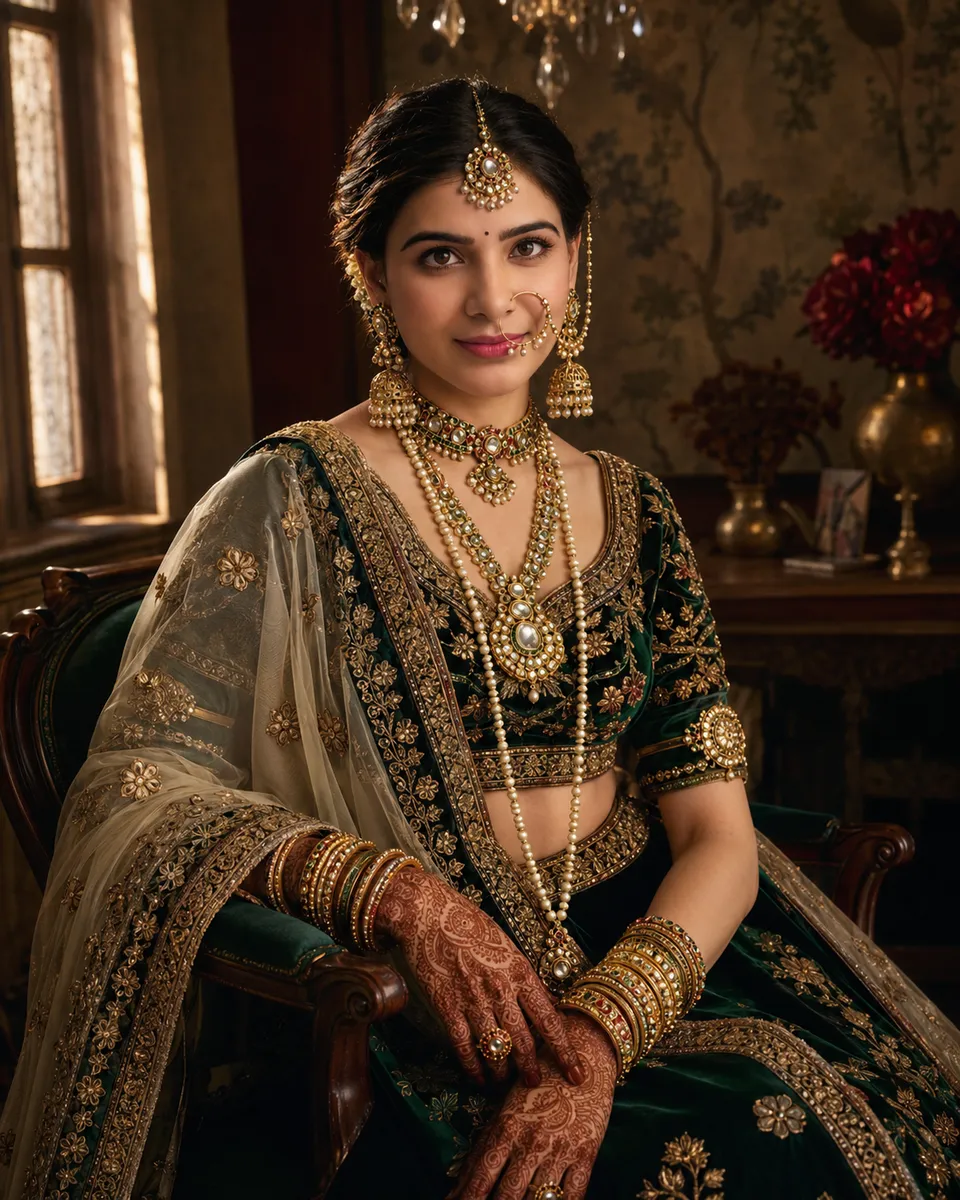
A poised woman gazes directly at the camera, adorned in luxurious Sabyasachi heritage attire within a richly decorated colonial-Indian interior. Captured in soft afternoon light, the image exudes a sense of elegance and cultural depth, showcasing intricate jewelry and traditional attire.
A single 4:5 vertical photograph in the visual language of Sabyasachi Mukherjee's heritage campaign photography — the kind of image that would run as a full-page editorial in *Vogue India* or *Harper's Bazaar India* with the headline "Sabyasachi Heritage: The Bride Reimagined." The subject is the person in the uploaded photograph, photographed inside a heritage colonial-Indian interior at late afternoon.

LOCK from the upload: the entire face — eye shape and spacing, exact eye colour, nose bridge profile and tip, lip shape and natural fullness, eyebrow shape, jawline, chin shape, hairline, ear shape, skin tone, and every visible mole, freckle, scar, fine line, or beauty mark. Also the natural hair — actual colour, texture, length, density. Hair will be styled for the editorial; the underlying hair is hers. Render imperfections that are in the upload; do not invent. The Sabyasachi house deliberately photographs *real faces* with distinctive features rather than cookie-cutter "model" faces — honour that. The user's nose-bridge, asymmetries, natural lip shape stay.

REPLACE from upload: any earrings, necklaces, bangles, rings, nose pins, or other jewelry visible in the uploaded photograph are NOT carried over. They are removed entirely and replaced with the Sabyasachi-style heritage jewelry described below. The upload's jewelry is irrelevant to the rendered image.

Wardrobe — Sabyasachi heritage maximalism:
A floor-length couture lehenga or saree-set in the brand's signature deep jewel palette. Pick ONE specific look:

Option A — the famous emerald velvet lehenga: a deep forest-green silk velvet blouse, fully embroidered with antique-gold zardozi work in dense floral motifs (peonies, lotuses, vines), with a matching velvet skirt embroidered down the panels. A long net dupatta in cream-ivory with heavy antique-gold zardozi at the borders and scattered embroidered flowers across the body of the dupatta. The fabric has the unmistakable weight of real silk velvet — it absorbs light, has a deep matte sheen, drapes with substantial body.

Option B — the deep wine Banarasi saree: a rich oxblood-burgundy Banarasi silk saree with full body of antique-gold zari weaving — peacocks, mango motifs, temple borders in metallic gold thread woven into the silk. A matching wine-and-gold blouse with subtle embroidery. The saree drapes with the heavy weight of authentic Banarasi silk — visible folds, real fabric tension.

Option C — the saffron-and-gold heritage anarkali: a deep saffron-yellow anarkali with full-skirt volume, embroidered throughout in antique gold and deep red with floral motifs. A long red-and-gold dupatta draped over both shoulders, the corners falling to either side.

Option D — the modern hand-blocked maximalist saree: a deep midnight-blue or aubergine raw-silk saree with hand-block-printed cream and gold motifs in dense patterns (peonies, peacocks, paisleys). A contrast cream blouse with heavy gold embroidery. Less traditional but unmistakably Sabyasachi.

The fabric in all options has real heritage textile weight. The colour is rich and unfaked — emerald that's an actual emerald, oxblood that's an actual oxblood. Slight visible weave texture. The embroidery is *visible* as raised three-dimensional work, not a printed pattern.

Scene jewelry (replaces anything in the upload — full Sabyasachi heritage):
— Earrings: a pair of substantial heritage earrings — Sabyasachi style. Choose between (a) long *jhumka* with multi-tier bell construction in antique gold with uncut polki centre and pearl drops, falling well below the jawline; (b) elaborate *karanphool* with a star-shape at the top and multiple chains and pearl drops hanging below; (c) large *kundan* earrings with a flat polki-stone face and small pearl outline. Whichever option, the earrings are the visual focal point of the upper portion of the face. They are heavy, sculptural, and read as heritage gold.
— Necklace: a layered set — the unmistakable Sabyasachi heritage layering:
  • A *choker* close to the throat in deep ruby or emerald enamelwork on antique gold base.
  • A *long Polki necklace* falling to mid-chest, with a central pendant of uncut polki stones with smaller stones around it.
  • A *raani haar* (the Queen's Necklace) — a long single strand of pearls or emerald beads with a small central pendant, falling to navel-level.
  Three layered pieces. The Sabyasachi house does this — three layered pieces, the layering itself the statement.
— Maang tikka: a substantial heritage tikka in antique gold with a central uncut polki stone, a chain disappearing into the parting. Not delicate; substantial.
— *Nath*: a heritage Bengali or Marathi nath — large hoop on the left nostril with a chain extending to the ear, multiple small pearl drops along the chain.
— Bangles: a substantial stack on each wrist — eight to twelve per side. Mix of plain heritage gold bangles, gold with stone-set work (ruby or emerald), and some with delicate enamelwork. Heritage gold tone with visible patina.
— Hands: rich red-brown bridal-style mehndi on both hands — dense, elaborate, recently applied. Multiple rings on the fingers in heritage gold.
— Arm cuffs (*baajuband*): a heavy gold cuff on each upper arm with deep enamel inlay.

Hair styling (using natural hair from upload):
The natural hair pulled back smoothly, centre-parted, with the parting visible from forehead to crown. Gathered at the back into a heavy low chignon or a thick braided bun at the nape — substantial heritage hair work, not a casual updo. A delicate floral or pearl accessory (a small Sabyasachi-style flower clip or a thin string of pearls) woven through the back. The hair has the suggestion of real hair oil — visible slight sheen at the parting and the temples. A few small wisps at the hairline frame the face naturally.

Pose and composition — editorial heritage portrait:
The subject is seated or standing in a heritage colonial-Indian interior:
(a) seated on an antique low-backed wooden chair upholstered in dark green or wine velvet, body angled three-quarter to camera, one hand resting on the chair's arm, the other in the lap, head turned slightly back to the lens;
(b) standing beside a tall heritage doorway or against a hand-painted wall mural, body slightly turned, one hand at the side holding the loose dupatta end, the other at the throat near the necklace or at the waist;
(c) seated on a low cushioned floor with a heritage rug beneath — knees folded to one side, the lehenga or saree pleats arranged around her, one arm resting along the floor, the other holding a small antique mirror or simply at the side.

The body language is *poised stillness* — the gravity of the editorial moment, neither stiff nor casual. Spine straight, chin level, shoulders open and grounded.

Expression — Sabyasachi editorial gaze:
The signature Sabyasachi expression — direct gaze at the camera, mouth softly closed, a quiet inward strength. There is no smile. There is no pout. The face is *composed* — the look of a woman who has been photographed before but who isn't performing for the camera. Read the upload's natural face — the Sabyasachi expression is the user's own face turned to its most still and present version. Eyes meeting the lens with the steadiness of someone unhurried. A small private knowingness in the gaze.

Setting — heritage colonial-Indian interior:
The space is unmistakably Indian heritage:
— High ceilings with exposed wooden beams (the dark heavy beams of colonial-Indian construction).
— A patterned tile or marble floor — geometric Bombay tile or Carrara marble, slightly worn from decades.
— Walls in a deep painted colour — perhaps a rich dark green, oxblood, or aubergine — providing colour contrast with the wardrobe and jewelry.
— A heritage chandelier overhead — brass or crystal, with multiple arms — visible at the upper edge of the frame, perhaps partially out of the frame's top.
— A hand-painted wall mural or wallpaper behind the subject in a heritage pattern — peacocks, floral motifs, or Indian botanical illustration. Or alternatively a rich brocade tapestry hung as a wallhanging.
— Antique furniture visible — a heritage carved wooden writing desk, an old velvet ottoman, a marble-topped console table with a few heritage objects (a brass *pandan* box, a silver tray, a bowl of fresh roses).
— A vase of dried or fresh flowers in deep colours — burgundy peonies, deep red roses, or saffron marigolds.
— A few small heritage details: a hand-bound book with a leather cover, a brass oil lamp (unlit), a vintage Bollywood film magazine on a side table.
— The whole interior has the deliberate-curation feeling of a Sabyasachi store or campaign location.

Light — heritage interior, single-source:
— The primary light is a large window to camera-left — likely a colonial-style arched window with mullions, providing soft directional warm afternoon light at around 3800K. The light is *substantial* — enough to be the dominant source, but soft and diffused by the window glass and any sheer curtains.
— The light falls across the left side of the subject — illuminating the cheek, the shoulder, the front of the lehenga or saree. The shadow side of the face is in soft warm shadow, with detail still visible, about three-quarter stop below the lit side.
— A secondary contribution from the heritage chandelier overhead if lit — a small warm top-down accent at 2700K, providing a faint warm highlight on the crown of the head and the upper edges of the shoulders.
— A tertiary ambient contribution from the warm bounce off the dark painted walls — providing a subtle warm fill on the shadow side.
— Catchlights in the eyes from the window light — large soft warm rectangular catchlights.
— The jewelry catches the window light intensely — every gold piece, every polki stone glittering.

Camera language: a 100mm prime lens at f/2.8, shot on a full-frame medium-format-equivalent camera (Fujifilm GFX 100S or Phase One IQ4) — the modern equivalent of the medium-format film cameras Sabyasachi's brand has historically photographed with. ISO 400, available light only. Subject distance roughly two metres. Three-quarter framing — top of head with a small headroom to the waist or low-hip, showing the heritage jewelry, the upper wardrobe detail, and one hand resting wherever the pose has it.

Colour treatment: rich, warm, jewel-toned editorial — the Sabyasachi colour science. Deep saturated wardrobe colours holding their full vibrancy. Skin tones true to the upload, warmed by the warm interior light. The gold of the jewelry and embroidery in *warm matte heritage gold* tones — never bright shiny modern gold. The interior's dark colours fully saturated. Shadows fall warm and rich. Overall: editorial luxury, not Instagram saturation.

Skin handling: pores visible across the face. The natural slight sheen at the cheekbones from the warm interior. Individual eyelashes resolved. The slight texture of the lip — natural, not glossed-over. Brow hairs visible. The mehndi pattern on the hand crisp and visible if the hand is in frame. The jewelry rests on the skin with real weight — the choker on the throat showing the slight indentation, the earrings pulling the earlobe slightly. The hair shows its real texture — not artificially smoothed.

Aspect ratio 4:5 vertical. No text on the image, no Sabyasachi logo, no editorial title, no border, no watermark.
This image was generated with AI.
About this look
Seated gracefully, the subject's body is angled slightly towards the camera, exuding a sense of stillness that embodies the essence of Sabyasachi's editorial style. The lighting bathes the scene in a warm, late-afternoon glow, enhancing the rich textures of the floor-length lehenga and the detailed embroidery of the jewelry. The carefully chosen heritage interior, featuring high ceilings and dark wooden beams, creates a striking backdrop that complements the deep jewel tones of the attire, while the ornate chandelier adds an element of grandeur to the composition.
Ideal for showcasing bridal elegance or celebrating cultural heritage, this image serves as a stunning centerpiece for fashion editorials or personal milestones like weddings and anniversaries. It's perfect for sharing on social media platforms like Instagram or as part of a personalized wedding invitation. Women looking to capture their strength and beauty in a traditional context will find this image resonates deeply, making it a cherished keepsake for years to come.
How to use this prompt
For optimal results, upload a clear photo of the subject's face, ensuring all facial features and natural hair are well-represented. The output will focus on recreating the subject's unique facial characteristics while transforming attire and jewelry into Sabyasachi-inspired heritage designs. Aim for a vertical 4:5 aspect ratio, and if the expression seems off, ensure the subject's gaze is direct and composed, capturing that signature Sabyasachi look.
Tips to customize it
- Choose a rich jewel tone for the attire, like emerald green or deep wine.
- Opt for a specific type of Sabyasachi jewelry, such as jhumka earrings or a layered necklace.
- Select a heritage interior with exposed wooden beams and a statement chandelier.
- Ensure the subject's hair is styled into a low chignon or thick braided bun for authenticity.
More like this

Prompt Deck
Free on Google Play
Take the whole deck with you
Browse thousands of AI image prompts, customise them with your own details, and create — all from the Prompt Deck app.
- Tap to customise & copy
- Save your favourites
- Fresh prompts daily