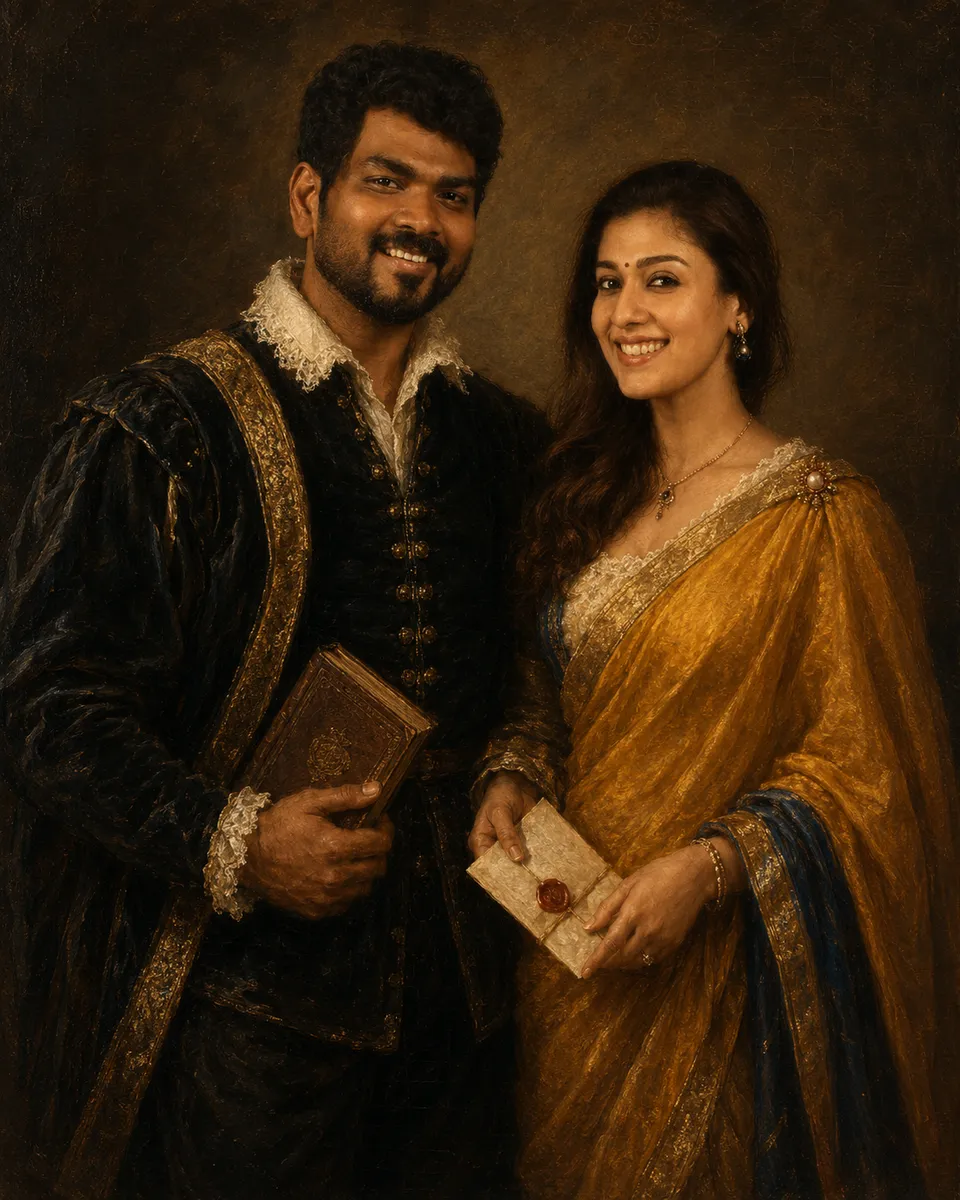
 AI-generated
AI image prompt
Renaissance Oil Painting, the Classical Portrait
A couple is depicted in a classical oil painting style, inspired by renowned European masters. The portrait captures their dignified expressions and intimate poses, showcasing rich colors and meticulous brushwork that reflect Renaissance artistry.
A single 4:5 vertical photograph showing what appears to be a HAND-PAINTED RENAISSANCE OIL PORTRAIT of a couple — in the style of European 16th-17th century portraiture (Holbein, Van Dyck, Rembrandt, Vermeer). The painting is photographed straight-on, showing the full canvas with the slight texture of oil-on-canvas visible. The visual register is the classical-European-master portrait, transposed onto a contemporary couple.

There are TWO uploaded photographs — Partner A (female) and Partner B (male).

LOCK Partner A: complete face structure, eyes, eyebrows, nose, lip shape, jawline, hairline, skin tone, all distinguishing features. The painterly style is applied AROUND her face, but the face itself must clearly be HERS — recognizable from her upload.
LOCK Partner B: same complete checklist. Hairline preserved EXACTLY. Facial hair preserved exactly.

ANTI-BLEND CLAUSE: each partner's face exclusively from their own upload. No drift toward generic Renaissance-portrait-faces.

LOCK IDENTITY, RE-RENDER THE REST (both partners): lock each partner's identity — bone structure, features and their spacing, permanent marks, and true relative complexion (never lightened). Do NOT lock the upload's lighting or tone — both faces are re-lit and re-rendered in the oil-painting style.

FACE-BODY INTEGRATION & REALISM (mandatory — applies to BOTH partners, within the painted medium):

1. ONE UNIFIED PAINTING, NOT A FACE-GRAFT. For each partner, head, neck, and body are painted as one coherent figure in the SAME oil-on-canvas treatment — no pasted-on seam or boundary at the jaw, chin, hairline, or neck, and no passage where the face is rendered more photographically than the surrounding figure. Both partners share one consistent brushwork, light, and palette — not a photo-face on a painted body.

2. TONE CONTINUITY (no two-tone problem). For each partner, the painted complexion runs consistently across face, neck, and shoulders — never lightened, no abrupt step at the jaw or neck. Each partner keeps their OWN complexion; the two are not averaged toward each other.

3. SCENE/MEDIUM-MATCHED LIGHTING. Both faces are lit by THIS painting's chiaroscuro and rendered in THIS painting's style — the same light direction, warmth, and shadow logic on both partners' faces AND bodies.

4. CORRECT HEAD-TO-BODY PROPORTION. Each head is anatomically sized to its body (about one-seventh to one-eighth of standing height). Do NOT enlarge either head. The two partners are in correct relative scale to each other.

5. HEAD POSE FOLLOWS THE BODY. Each head sits naturally on its neck, consistent with posture and viewing angle — no front-facing face on a turned body. Where the partners touch (a hand on an arm, shoulders close), the contact reads correctly.

6. NATURAL NECK & HAIRLINE TRANSITION. For each partner, jaw flows into neck, neck into shoulders, hairline into scalp — natural painted anatomy, no abrupt mask-edge.

CONCEPT-VS-FACE CLAUSE: the oil-painting style is rendered in the manner of the MASTER PORTRAITISTS (Holbein, Rembrandt, Velasquez) who were famed for capturing exact LIKENESS — not generic painted figures, but specific recognizable individuals. The brushwork and oil-on-canvas texture is the medium; the faces are RECOGNIZABLY the uploaded partners.

The portrait composition:

The painting is 4:5 vertical (the classical portrait aspect ratio).

Pick ONE composition style:

Style A (most iconic — formal husband-and-wife portrait, in the manner of Van Dyck):
- Both partners visible from the waist up, side by side, slightly facing each other.
- Partner B on the LEFT, Partner A on the RIGHT (the classical husband-and-wife position).
- Both with slight three-quarter body turn, their faces in three-quarter view — about 70% turned to the viewer.
- Dignified, slightly reserved expressions — the classical-portrait demeanor.
- Both holding small symbolic objects in their hands: a small book (representing learning), a small folded letter (representing intimacy), a small piece of jewelry, a small rose.

Style B (the Vermeer-inspired intimate moment):
- Both partners in soft directional light, in an intimate domestic moment. He looking at her, she looking down at her hands or at something between them. The intimate-moment of a Vermeer painting.

Style C (the Rembrandt-inspired chiaroscuro):
- Both partners emerging from deep dark shadow — only the faces and hands brightly lit, the rest of the figures dissolving into rich brown-black shadow. The dramatic Rembrandt-style chiaroscuro.

Default to Style A.

The painterly style and detail:

The MEDIUM: oil on canvas. Visible brushwork:
- The faces: HYPER-DETAILED, with the smallest brushstrokes used. The master portraitists used a fine sable brush for the faces — the lips, eyes, skin detail all rendered with photographic-painterly accuracy. The faces are nearly photographic in their detail.
- The wardrobe: medium-fine brushwork, with visible texture in the fabric (the slight visible weave of silk, the slight visible velvet pile). The brushstrokes follow the fabric folds.
- The background: looser, broader brushstrokes, almost abstract. The classical dark-warm-brown background of European portraits, with the slight visible canvas texture.

The CANVAS TEXTURE:
- Slight visible canvas weave underneath the paint — the linen texture catching the light.
- Tiny visible crackle pattern (craquelure) in the oldest-feeling areas (the dark background especially).

The COLOUR PALETTE: classical Renaissance/Baroque:
- Deep RICH browns, ochres, deep umbers in the background.
- Deep BURGUNDY, deep emerald-green, deep midnight-blue, deep gold-yellow in the wardrobe.
- Warm flesh tones in the faces — the master portraitists' signature glowing skin.
- Touches of pure white in the lace collars, the high catchlights on jewelry.
- The classical Old-Master colour temperature — warm, with deep shadows that retain rich colour (not muddy).

The wardrobe — Renaissance-classical:
- Partner A: a deep burgundy or emerald-green Renaissance-style dress with a high neckline, slight ruffled lace collar, with a small visible pearl necklace OR a gold pendant on a chain. The dress is rich heavy velvet OR silk. Long sleeves with slight visible decoration at the cuffs. Hair pulled back into a soft chignon, possibly with a small pearl or ribbon detail.
  - ALTERNATIVE Indian-fusion knob: a deep burgundy / emerald silk SAREE rendered in the Renaissance painterly style — the saree as if reinterpreted by a European master.
- Partner B: a deep dark coat (deep navy, deep burgundy, deep emerald) with a high collar (a Tudor-style ruff OR a Van-Dyck-style collar OR a simple white shirt collar). Visible buttons or gold trim. Possibly a small fur trim at the shoulder.
  - ALTERNATIVE Indian-fusion knob: a dark silk kurta with classical European painterly treatment.

Default to the European-classical wardrobe. The Indian-fusion knob is for the contemporary South-Asian-Renaissance-portrait register.

Jewelry — Renaissance:
- Partner A: pearl necklace, pearl drop earrings, a small ring on her finger with a single stone.
- Partner B: a heavy gold ring on his finger, possibly a small pendant on a chain visible at the collar.

Pose specifications:
- Both with slight three-quarter body turn.
- Slightly downcast or direct eye contact with the viewer — the classical-portrait gaze.
- Hands posed carefully — perhaps Partner A's hand resting on Partner B's arm, or both hands visible holding their symbolic objects.
- The slight intentional formality of historical portraits.

Setting — the painted background:
The background is the classical PAINTED DARK background of European portraits:
- Deep dark warm-brown OR deep dark green-brown — the "Old Master" background colour.
- The background is uniform and dark, with the slight visible brushwork — broader strokes, the background painted to recede behind the figures.
- Possibly a small architectural detail in the deep background — a small column edge, a small drape of curtain, a small visible distant landscape through a small "window" (the classical Renaissance landscape-through-window detail).
- A small visible inscription / date in one corner — painted in calligraphic Latin-style letters ("MDCCCXLI" or a similar date) — the classical-portrait dated-painting touch.

The painting's frame (if visible at edges):
- The edges of the composition show the slight visible edge of a HEAVY GILT ORNATE GOLD FRAME — only barely visible at the very edges of the 4:5 composition, suggesting that this is an actual oil painting in a museum-quality frame.
- The gold frame has the visible carved baroque ornamentation, slightly aged.

Atmospheric details:
- The slight visible age-glow of an old oil painting — the warm yellowing of old varnish in the highlights.
- The slight visible crackle in the dark areas.
- The light glinting off the gilt frame edge.

Light — painterly chiaroscuro:
- Primary key: dramatic directional light from one side (typically the upper-left, the classical Renaissance light source) — strong warm light catching one side of the faces, modeling them with the classical chiaroscuro.
- The opposite side of the faces in soft shadow — but the shadow retains the warm depth of master oil painting (not deep black).
- A subtle fill from a secondary cooler source — providing the slight cool reflection on the shadow side.
- Catchlights in the eyes — the classical master-portrait small white highlight in each eye.
- The lit side of the faces glows with the warm flesh tone characteristic of master portraiture.

Camera language: the image IS the painting photographed straight-on. The "camera" is a fine-art-reproduction camera capturing the painted canvas. The composition has the slight visible imperfections of a photograph of a painting (very slight micro-grain from the photograph, very subtle reflection off the varnished surface, the slight visible canvas texture).

Aspect ratio 4:5 vertical.

Colour treatment: classical Renaissance/Baroque oil painting palette — deep warm browns, rich burgundy and emerald, warm glowing flesh tones, deep shadows that retain warm colour, the slight age-yellow of old varnish. The image has the *Renaissance-master-portrait* tonal register.

Skin handling: even in the oil-painting style, the faces have the HYPER-REALISTIC LIKENESS of master portraiture — eyes, lips, jaw, all faithful to the uploads. Friends should immediately recognize both partners through the painterly treatment.

Aspect ratio 4:5 vertical. The painted inscription/date is part of the painting composition. The frame edge is barely visible at the composition edges. No additional text, no additional border, no watermark.This image was generated with AI.
About this look
Expressions convey a serene intimacy, with each partner positioned slightly toward one another, embodying the elegance of formal European portraiture. The oil-on-canvas texture enhances the depth of the figures, while the chiaroscuro lighting casts warm shadows, creating a sense of unity between their faces and bodies. The brushwork is hyper-detailed for the faces, ensuring each feature is rendered with stunning accuracy, while the background remains dark and atmospheric to emphasize the subjects.
This artwork is perfect for commemorating significant milestones like anniversaries or engagements. It can be shared in various formats, from printed canvases to digital invitations, making it a versatile choice for couples looking to celebrate their bond in a timeless manner. The classic styling resonates well with art enthusiasts and those who appreciate the beauty of historical portraiture, ensuring it stands out in any collection or social media feed.
How to use this prompt
Upload clear photographs of both individuals, ensuring that their faces are well-lit and shown from the front. The prompt requires locking their distinct features and identities, so make sure the images clearly display their bone structure, skin tones, and hairlines. A successful result will show both partners rendered in a rich oil-painting style, with appropriate lighting throughout. If the faces appear too generic or blended, adjust the locking parameters to reinforce individuality.
Tips to customize it
- Choose deep burgundy or emerald green for Partner A's dress to enhance the regal feel.
- Select a dark navy or burgundy for Partner B's coat to maintain the classic aesthetic.
- Consider adjusting the lighting direction to achieve a more dramatic chiaroscuro effect.
- Incorporate symbolic objects like a small book or rose to add personal meaning to the portrait.
More like this

Prompt Deck
Free on Google Play
Take the whole deck with you
Browse thousands of AI image prompts, customise them with your own details, and create — all from the Prompt Deck app.
- Tap to customise & copy
- Save your favourites
- Fresh prompts daily