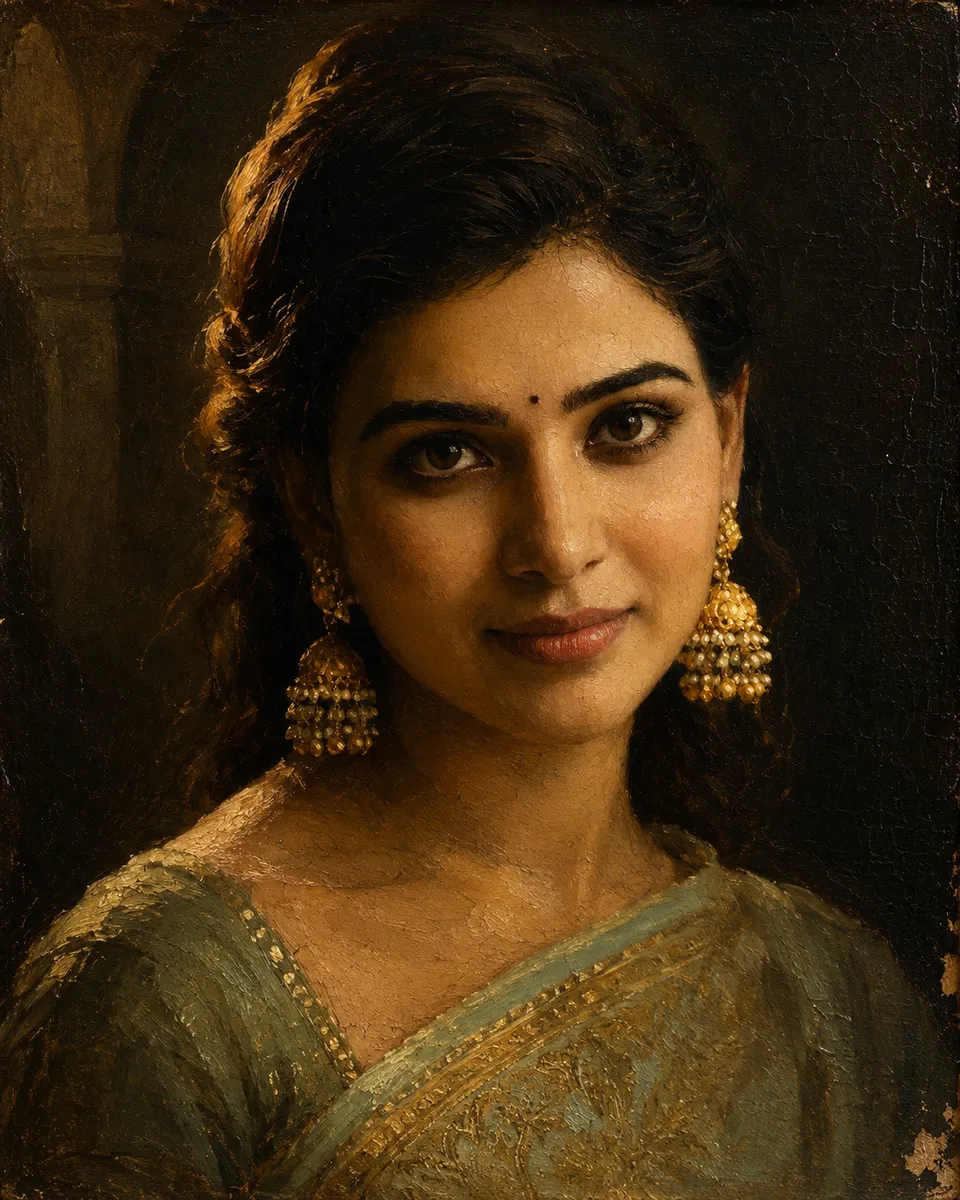
 AI-generated
AI image prompt
Renaissance Oil Portrait
Set within the hushed ambiance of a European museum, a masterfully rendered oil portrait captures a man in Renaissance attire. The painting, echoing the techniques of Caravaggio, showcases deep shadows and warm tones, creating an intimate and timeless atmosphere.
A single 4:5 vertical image rendered as a photograph of a Renaissance-era oil painting — specifically in the lineage of Caravaggio's portraits from the early 1600s, or the smaller intimate portraits of the Dutch Golden Age (Vermeer, Frans Hals) of a few decades later. The subject of the painting is the person in the uploaded photograph; the artefact in the image is the painting itself, four hundred years old, in a small museum or church somewhere in Europe.

Identity — the face inside the painting must be the actual face in the upload. The eye shape and spacing, the nose bridge profile and tip, the lip shape, the jawline, the hairline, the skin tone (as it would appear under candlelight and oil pigment), and any visible moles, freckles, or beauty marks. The painterly medium is allowed to soften the rendering — brushstrokes will smooth the smallest skin detail, oil pigment will warm the colour palette — but the underlying structure of the face must be the upload's structure, not an averaged Renaissance idealisation. Avoid the model's tendency to give every Renaissance subject the same elongated neck, the same idealised nose, the same heavy-lidded eyes. The point of this prompt is the user, rendered as if a master had painted them — not a generic Renaissance portrait substituted for them.

The painting itself — what it would look like in life:
— Oil paint on stretched linen canvas, the canvas weave faintly visible through the thinner layers of paint in the background.
— Built up in classical layers: an underdrawing in dark umber, a dead-colouring in muted earth tones, then glazes of pigment over translucent layers — Venetian red, lead-tin yellow, lapis-blue in the deep shadows, lead white only in the highest highlights. The lit side of the face has visible impasto where the master built up the brightest planes (cheekbone, bridge of the nose, the highlight on the lower lip). The shadow side is smooth and glazed, with no impasto.
— Visible brushwork directional and assured — the model can see individual brush strokes if they look closely, especially on the garment and the background. Skin brushwork is finer but still visible; it is not the airbrushed surface of digital portraiture.
— The varnish has yellowed over four centuries — the whole image carries a warm amber cast that wasn't there when it was painted, particularly visible in the highlights (where lead white has now turned cream) and in the whites of the eyes (which now read as a soft warm grey).
— Fine craquelure across the entire surface — the network of small cracks in the dried oil, slightly finer in the face, slightly coarser in the dark background. The cracks follow the actual physics of oil drying — radiating, branching, never gridded.
— A faint patina of candle smoke darkening the upper corners of the canvas more than the centre.
— One small loss or repair if the model wants — a tiny area of inpainting near an edge, slightly mismatched in tone, visible to the eye but not distracting.

Composition: a three-quarter portrait. The subject from the top of the head to mid-chest. The face turned roughly twenty-five degrees away from the viewer with the eyes returning to the viewer — the classic "looking back at you" Renaissance composition. The shoulders are squared but slightly turned. One hand may be visible at the lower edge, resting at the throat or holding the edge of a garment — at the model's discretion.

Background: a deep umber-black, almost featureless, with the suggestion of architectural depth in the upper-left — perhaps the corner of a stone arch, or the suggestion of a brocade curtain, rendered with the loose painterly suggestion of a master rather than as a detailed setting. The background is what isolates the figure; it is purposefully empty.

Wardrobe — period-correct but not costume-y:
Option A (universal masculine): a dark velvet doublet in deep oxblood or charcoal, the collar of a fine linen chemise just visible above the doublet's high neckline. A simple thin gold chain might be visible. No ruff, no jewels, no medals — this is an intimate portrait, not a court portrait.
Option B (universal feminine): a dark silk-velvet bodice in deep emerald or forest-green, low cut with a fine linen chemise filling the neckline. A single strand of pearls at the throat, or a small enamelled cross on a thin gold chain. Hair pulled back smooth from the forehead and gathered behind in a low knot, with a fine ribbon or a small jewelled clip — only one piece of hair-ornament, never multiple.
Option C (South Asian fusion — particularly interesting for Indian users): the Mughal-court parallel of the same era — a fine muslin jama in cream or pale rose for masculine, or a deep velvet choli with embroidered border for feminine, with a strand of pearls or an emerald earring. The styling shifts the geographic reference from Florence to Agra, but the lighting language and painterly treatment remain identical.

Pose, expression, and gaze: the subject is utterly still. The shoulders are at rest. The head is slightly tilted, the chin slightly lowered, the eyes meeting the viewer's gaze directly with the unguarded steadiness of someone who has been sitting for the painter for two hours and has stopped performing. Mouth softly closed, lips natural. The expression is not happy and not sad — it is interior, the look of a person thinking something the painter will never know. No smile. No frown. The Mona Lisa stillness.

Light — Caravaggio chiaroscuro: a single light source from the upper-left of the painting, high and out of frame, the way light would fall from a small high window in a Roman palazzo around 1605. The light is warm — the colour of an oil lamp or natural sunlight diffused through a north-facing window in winter, around 3200K. It catches the upper plane of the face — forehead, the cheekbone closer to the light, the upper edge of the nose — and falls quickly into deep warm shadow on the opposite side. The shadow is not black; it is the deepest reddish-brown of glazed umber, with the form of the face just visible inside it. The transition between light and shadow happens across the bridge of the nose in a single soft falloff. The whites of the eyes catch the light. The lower lip catches a small highlight. Everything else is in shadow.

Camera language (this is the photograph OF the painting, remember): the painting is photographed straight-on, in a museum or studio environment, with a 50mm lens at f/8 to capture detail across the surface. The camera is colour-calibrated to render the painting accurately — the warm amber varnish is preserved, the craquelure is sharp, the canvas weave at the edges is visible. Lighting on the painting itself is even and museum-grade — soft and frontal, calibrated to reveal the painting without creating any reflective glare on the varnish.

Skin handling inside the painting: the skin texture you would see in a real master's portrait — a soft graded transition from light to shadow, with brushwork visible on close inspection. Pores are not visible the way they are in a photograph — they are *suggested* through the paint's texture rather than rendered. Eyelashes are painted as fine dark lines, not individual hairs. The eyes have catchlights painted in single tiny dots of lead white. The lips are built up in glazes — slightly translucent at the edges, more saturated at the centre. Any visible moles, freckles, or beauty marks in the upload are *painted in* — small deliberate marks of darker pigment, the way a master would record a sitter's actual face.

Aspect ratio 4:5. No text, no caption, no museum label, no frame visible, no signature unless it's a small painted signature in the lower corner of the painting itself (at the model's discretion, but kept ambiguous and short — initials only, not a full name).
This image was generated with AI.
About this look
In a softly lit space, the portrait stands out against a nearly featureless dark umber-black background, evoking a sense of depth and isolation around the subject. The light source from the upper-left illuminates the man’s face, accentuating his features with a warm glow while casting rich shadows that reveal the meticulous brushwork and layers of oil paint. The texture of the canvas is evident, with the faint weave visible beneath the layers, and the slight craquelure adds to the painting's historical authenticity, creating a sense of age and character that draws viewers in.
How to use this prompt
To create a striking portrait, upload a clear photograph of the subject's face, ensuring it captures the desired expression and angle. The prompt expects distinct facial features, such as eye shape and skin tone, to be rendered with attention to detail. For the best results, ensure the subject's gaze is direct and engaging, and consider adjusting the lighting in your photo if the final image appears flat or lacks depth.
Tips to customize it
- Select a dark velvet garment in deep oxblood or forest-green for a classic look.
- Opt for a low-cut bodice with a fine linen chemise for a feminine touch.
- Experiment with the light direction to enhance the chiaroscuro effect.
- Consider using a small decorative element in the wardrobe, like a pearl necklace or a single hair clip.
More like this

Prompt Deck
Free on Google Play
Take the whole deck with you
Browse thousands of AI image prompts, customise them with your own details, and create — all from the Prompt Deck app.
- Tap to customise & copy
- Save your favourites
- Fresh prompts daily