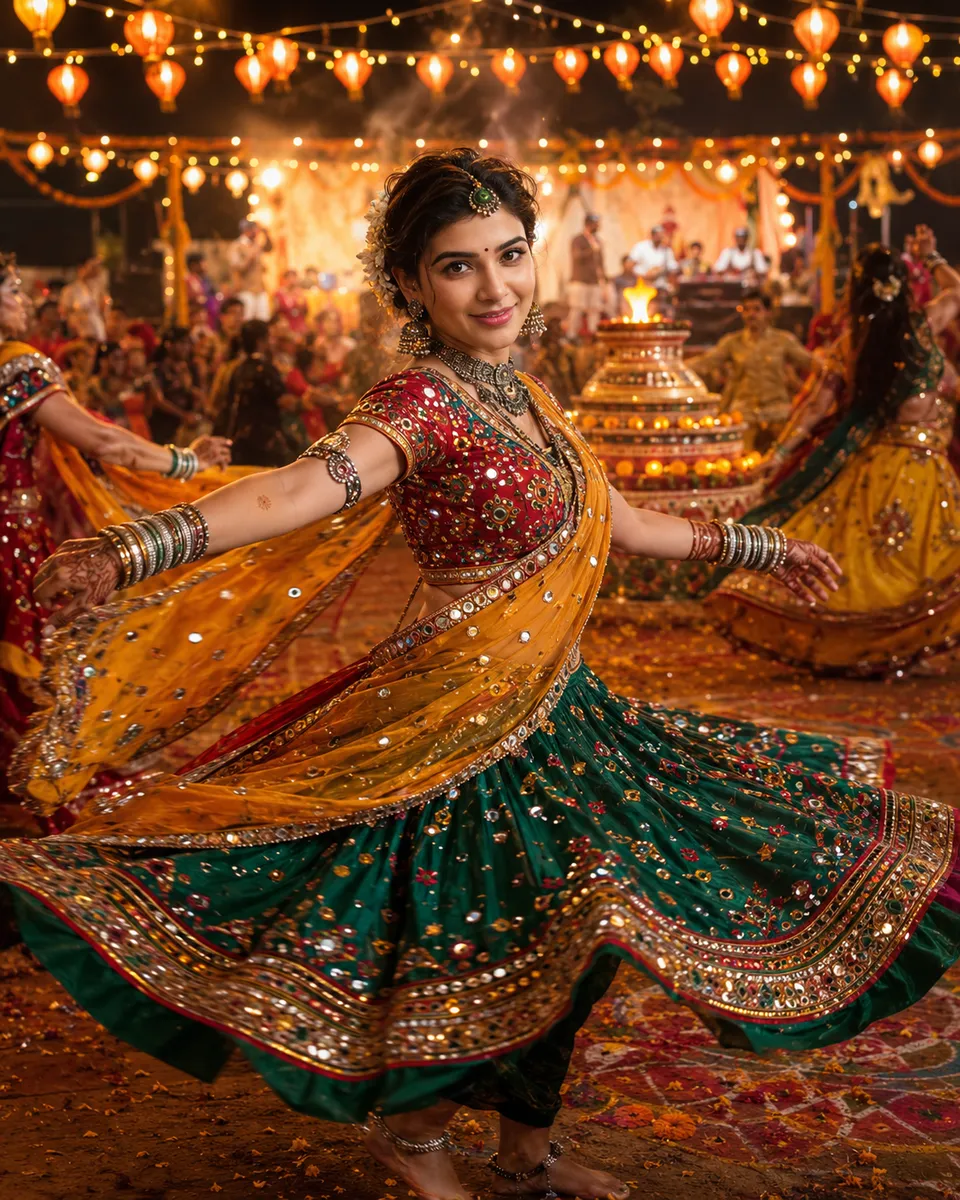
 AI-generated
AI image prompt
Mehrangarh Fort, Jodhpur, Late Afternoon
A regal portrait showcases a woman adorned in a heritage Rajasthani lehenga, accentuated by intricate gota patti work and traditional jewelry. Set against the backdrop of Mehrangarh Fort during late afternoon, the warm light enhances the rich colors of her attire and the blue cityscape beyond, evoking a sense of cultural elegance.
A single 4:5 vertical photograph captured at Mehrangarh Fort in Jodhpur, around 5:30 p.m. on a clear afternoon — late spring, when the air is hot but the light is starting to soften. The subject is the person in the uploaded photograph, photographed on one of the fort's stone balconies (specifically a jharokha balcony with a view of the blue city below) or in one of its inner sandstone courtyards. The visual register is heritage Rajput portraiture in the lineage of contemporary Indian photographers like Vasundhara Sharma or Tarun Khiwal.

LOCK from the upload: the entire face — eye shape and spacing, exact eye colour, nose bridge profile and tip, lip shape and natural fullness, eyebrow shape, jawline, chin shape, hairline, ear shape, skin tone, and every visible mole, freckle, scar, fine line, or beauty mark. Also the natural hair — actual colour, texture, length, density. Hair will be styled for the scene; the underlying hair is hers. Render imperfections that are in the upload; do not invent. The user is not a Rajput princess archetype; she is herself, photographed in a Rajput setting.

REPLACE from upload: any earrings, necklaces, bangles, rings, nose pins, or other jewelry visible in the uploaded photograph are NOT carried over. They are removed entirely and replaced with the heritage Rajasthani jewelry described below. The upload's accessories have no bearing on the rendered image's jewelry.

Wardrobe — heritage Marwar / Rajasthani Rajput lehenga:
A floor-length heritage lehenga in the Rajasthani Rajput tradition. The colour: deep saffron-orange, deep oxblood-red, or deep forest-green with extensive *gota patti* work — the traditional Rajasthani metallic ribbon work that creates intricate floral and geometric patterns across the fabric. The lehenga's body is in real silk or fine cotton-silk blend, with the heavy gota work giving it visible weight.

The lehenga has three pieces:
— *Choli* (blouse): a fitted blouse with short sleeves, deeply embroidered with gota patti at the chest and shoulders, with a modest deep round or square neckline. The blouse has the visible structure of traditional Rajput tailoring.
— *Ghagra* (skirt): a fully gathered floor-length skirt with subtle volume — not the extreme volume of Garba's chaniya, but substantial enough to flare around the legs. The ghagra has the gota patti work running in vertical panels and around the hem.
— *Odhni* (long dupatta-equivalent): a long, fine fabric — silk or cotton — in a contrasting jewel tone with heavily embroidered borders. The odhni is draped over the head like a royal *ghungat* veil with the corners falling forward over both shoulders. This is the specifically Rajput head-covering — the woman of the family is a *purdah*-style covered figure in the formal portrait.

The colour palette of the wardrobe: saffron + dark green, oxblood + saffron, deep green + oxblood — the saturated Rajputana jewel-tone palette.

Scene jewelry (replaces anything in the upload — heritage Rajasthani):
— Earrings: large heritage *karanphool jhumka* in oxidised silver or antique-gold with deep red ruby, dark green emerald, or uncut polki stones. The earrings have the multi-tier construction of Rajput heritage jewelry — a star or flower-shape at the top, a series of small bells or pearl drops below.
— Maang tikka: a substantial gold or oxidised-silver maang tikka at the centre parting with a central uncut polki stone, often with a small pendant drop. The Rajput tikka is larger than the Mughal one.
— *Borla*: a small bell-shaped gold pendant at the centre of the forehead just below the parting — a Rajasthani signature piece, distinct from the maang tikka. Round and slightly raised.
— Necklace: a layered set — a *aad* (high choker close to the throat) in heavy gold with deep enamelwork (red, green, deep blue) in floral patterns, plus a longer pearl-and-gold necklace falling to mid-chest. Heritage construction, slightly worn-looking.
— *Nath* (nose ring): a heritage Marwari nath — a large gold ring on the left nostril with a chain extending up to the ear's hair, hung with small pearl drops. This is the specifically Rajputana nath, larger than the Mughal style. (If the user prefers no nath, use the no-nath knob.)
— *Hathphool* (hand jewelry): an ornamental gold piece on each hand connecting a ring on the middle finger to a bracelet at the wrist with delicate chains across the back of the hand. Visible if framing supports it.
— Bangles: a stack of heritage gold bangles on each wrist (six to eight per side) — some plain, some with traditional Rajasthani patterns.
— Anklets and toe rings: visible if framing supports.

Hair styling (using natural hair from upload):
The natural hair pulled into a low elegant braid down the back (the heritage Rajput braid) or alternatively into a low chignon at the nape. If braided, decorated with a thin strand of gold or pearls woven through. The *odhni* veil is draped over the head from the parting, partially covering but not concealing the hair. The hair is smooth, oiled slightly with traditional hair oil (visible slight sheen), with the natural hairline preserved.

Pose and composition — heritage portrait:
The subject stands at the *jharokha* balcony or in the sandstone courtyard. The body is angled approximately 25 degrees away from the camera, the head turned back toward the lens. One hand may rest on the carved stone railing of the balcony, the other at the side or holding the loose end of the odhni. The spine is upright, the shoulders open, the chin level. The body language is *regal stillness* — the carriage of someone who is conscious of her ancestry without being burdened by it.

Alternative pose: seated on a low stone bench in the courtyard, the lehenga arranged around her feet, hands folded in her lap, gaze direct at the camera with the calm of a formal portrait sitting.

Expression — heritage royal poise:
A serene closed-mouth expression or a small contemplative smile (read the upload). The face holds the *gravity* of the setting — quiet, present, slightly inward. The eyes meet the camera with the steadiness of someone whose family has held this fort for fifteen generations (whether or not they actually have). There is the trace of an ancestral bearing without performed nobility. No smile-for-camera. No theatrical regalia.

Setting — Mehrangarh Fort or Umaid Bhawan:
The architectural backdrop is what makes this image work:
— Behind the subject (visible to one side): the red-sandstone walls of Mehrangarh Fort — massive, weathered, the specific deep red-brown of Rajasthani sandstone. Carved jharokha balconies and stone screens visible.
— If on a balcony: visible through the *jharokha* lattice and over the railing, Jodhpur's Blue City spread out below — hundreds of small flat-roofed houses painted in shades of indigo, ultramarine, and pale blue, the entire city a mosaic of cool blues. The Thar Desert visible in the distance beyond the city, the deeper warm browns of arid land. The combination of warm sandstone foreground + cool blue city + warm desert distance is the unmistakable visual signature.
— If in a courtyard: the floor of polished marble or red sandstone, carved stone columns visible at the edges, the patterns of carved jali screens casting intricate shadow patterns across the floor and walls.
— A few details that anchor the location: a small bronze cannon visible at one edge of the balcony, carved peacock motifs in the stone work, painted miniatures or murals on the upper portion of the wall if the courtyard view supports it.

Atmospheric details:
— Warm dust haze in the air — the late afternoon dust of Rajasthan, catching the warm light.
— A few small birds (perhaps swallows or sparrows) flying past in the deep background — depth and scale indicators.
— A faint smell-suggestion of sandalwood or rose attar in the air, suggested by a small thin column of incense smoke rising from somewhere out of frame.
— The slight movement of the odhni in the warm afternoon breeze.

Light — Rajasthan golden hour:
— The primary key is the late afternoon sun coming from camera-back-right at a low angle (around 20 degrees up), warm gold at 3200K. The light is *strong directional* — Rajasthan's clear desert air produces sharp, vivid directional sunlight.
— The light hits the right side of the subject — painting the cheek, the shoulder, the front of the lehenga's gota patti work in warm gold. The work catches and reflects the light intensely, the metallic ribbons glittering.
— The shadow side of the face falls into deep warm shadow with detail still visible. The bounce from the warm sandstone walls fills the shadow side significantly — half a stop down from the lit side rather than the more typical stop-and-a-half.
— A separate warm bounce from the marble or sandstone floor below adds soft warm uplight to the underside of the chin.
— The Blue City below remains in cooler shadow (the houses are facing different directions and most are in shadow at this hour) — creating the colour-temperature contrast that makes Jodhpur photographs so striking.
— Catchlights in the eyes from the open sky — large, warm, alive.

Camera language: an 85mm prime lens at f/2.5, shot on a full-frame digital body, processed for warm filmic skin tones with the contemporary Indian editorial colour science. ISO 200, available light only. Subject distance roughly three metres. Three-quarter or full-length framing — full-length if the architectural view is included, three-quarter if focusing on the subject and jewelry. The model picks based on what serves the upload's face best.

Colour treatment: rich, warm, saturated. The sandstone reds, the gota gold, the saffron/oxblood lehenga colour, the cool indigos of the city below, the deep warm browns of the distant desert — all at full saturation but with editorial restraint, never blown out. Skin tones true to the upload, warmed by the golden hour. The shadows fall warm — Rajasthan shadows are never cool.

Skin handling: pores visible. The warm directional light reveals every facial texture. A slight natural sheen at the cheekbone from the warm climate. Individual eyelashes resolved. The gota patti work catches the light in small reflective points across the lehenga and the odhni's borders. Mehndi visible on the hands (subtle elegant patterns, semi-faded).

Aspect ratio 4:5 vertical. No text, no caption, no location overlay, no border, no watermark.
This image was generated with AI.
About this look
The carefully chosen attire plays a pivotal role in establishing the photograph's heritage aesthetic. The lehenga, with its deep saffron-orange and detailed gota patti work, contrasts beautifully with the warm tones of Mehrangarh Fort. Captured at a jharokha balcony, the composition features the subject poised at an angle, her serene expression and traditional jewelry echoing the grace of Rajputana lineage. The warm afternoon light softens the scene, highlighting the textures of both her clothing and the fort's sandstone, while the blue city below adds depth and vibrancy to the visual narrative.
How to use this prompt
To achieve this striking portrait, upload a clear photograph of the subject’s face, ensuring all details like eye color and hair texture are visible. The prompt will render her into a heritage Rajput attire with specific jewelry, omitting any existing accessories from the upload. Aim for a vertical 4:5 aspect ratio to properly frame the subject against the iconic backdrop, and if the details seem off, adjusting the uploaded image for clarity can help refine the results.
Tips to customize it
- Experiment with the lehenga color, choosing from deep saffron-orange, oxblood-red, or deep forest-green.
- Select a contrasting jewel tone for the odhni to enhance visual appeal.
- Focus on capturing the natural hair's texture to ensure a more authentic representation in the final image.
- Position the subject in the courtyard for a different ambiance than the balcony setting.
More like this

Prompt Deck
Free on Google Play
Take the whole deck with you
Browse thousands of AI image prompts, customise them with your own details, and create — all from the Prompt Deck app.
- Tap to customise & copy
- Save your favourites
- Fresh prompts daily