 AI-generated
AI image prompt
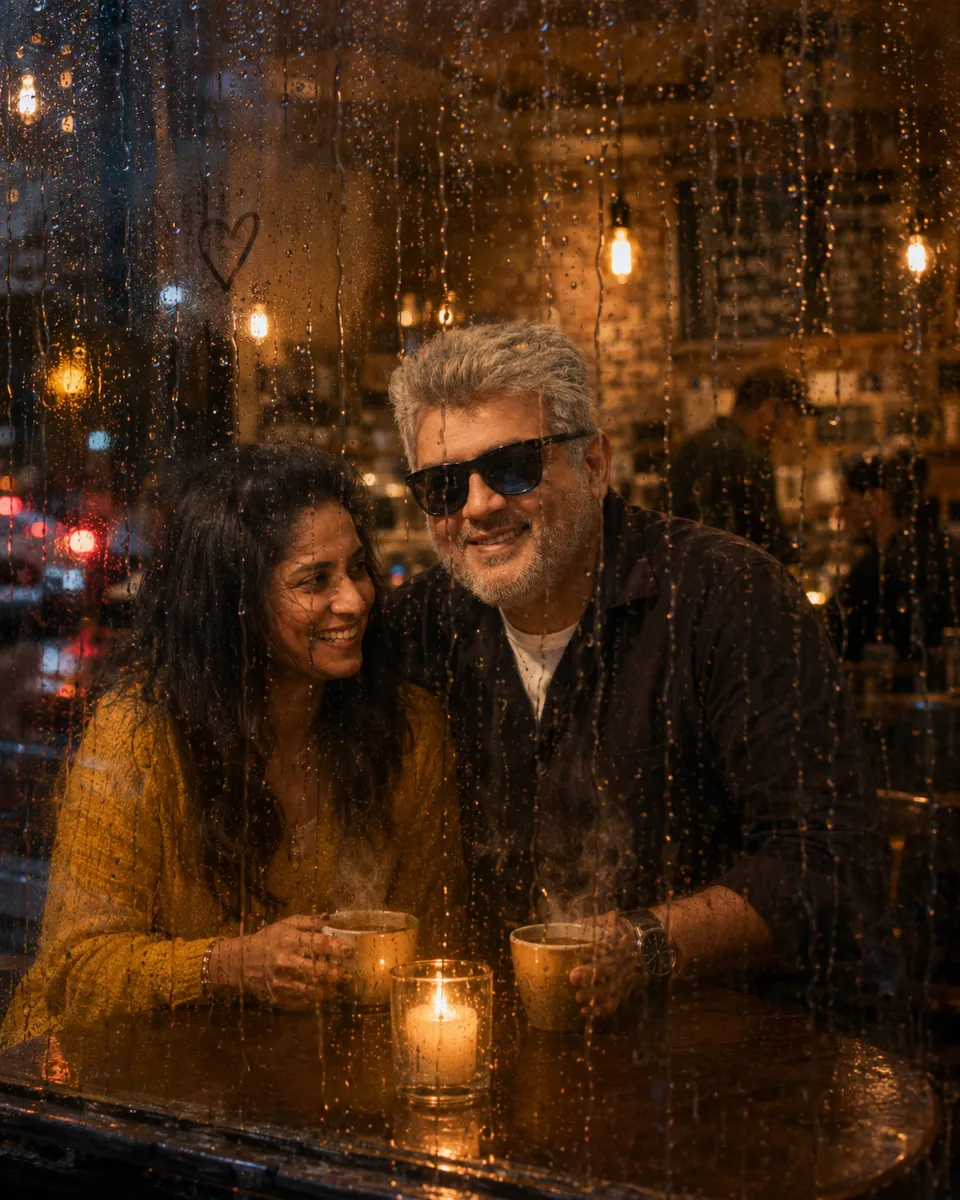
Through the Rain-Streaked Window
A romantic cinematic portrait captures a couple seated in a warm café, viewed through a rain-streaked window. The soft, painterly distortion of the raindrops contrasts beautifully with the intimate glow of the café's interior, evoking a sense of warmth amidst a cool, rainy evening.
A single 4:5 vertical photograph viewed THROUGH A RAIN-STREAKED WINDOW — the camera is positioned OUTSIDE on a rainy evening street, looking through a wet glass window into a warm-lit café interior where a couple is seated at a small table. The visual register: cinematic-voyeuristic rain-painterly observation. Time: dusk, around 7 p.m., the rain is falling steadily.

There are TWO uploaded photographs — Partner A (female) and Partner B (male).

LOCK Partner A: complete face checklist. Even through the rain-streaked window distortion, her face is recognizable.
LOCK Partner B: complete checklist. Hairline preserved EXACTLY. Facial hair preserved exactly.

ANTI-BLEND CLAUSE: faces stay distinct, each from its own upload.

LOCK IDENTITY, RE-LIGHT THE REST (both partners): lock each partner's identity — bone structure, features and their spacing, permanent marks, and true relative complexion (never lightened). Do NOT lock either upload's lighting or absolute skin tone — both faces are RE-LIT by THIS scene (the warm café interior seen through the wet glass).

FACE-BODY INTEGRATION & REALISM (mandatory — applies to BOTH partners):

1. ONE CONTINUOUS PHOTOGRAPH, NOT A FACE-GRAFT. For each partner, the head, neck, and body are one person in a single exposure — no visible seam, edge, halo, or pasted-on boundary at the jaw, chin, hairline, or neck; the face is not sharper or brighter than the body (beyond the rain-streak softening, which falls on the whole figure equally). Both partners belong to the SAME photograph — one light, one grain, one grade — not two cut-outs placed side by side.

2. SKIN-TONE CONTINUITY (no two-tone problem). For each partner, the complexion of face, ears, neck, shoulders, and hands is ONE consistent skin tone — their true complexion everywhere, never lightened, with no tonal step at the jawline or neckline. Each partner keeps their OWN complexion; the two are not averaged toward each other.

3. SCENE-MATCHED LIGHTING. Both faces are RE-LIT by THIS scene — the same warm interior key, direction, colour temperature, and shadow pattern fall on both partners' faces AND bodies, consistent with where each one sits. Catchlights and skin highlights match the environment for both.

4. CORRECT HEAD-TO-BODY PROPORTION. Each head is anatomically sized to its own body (about one-seventh to one-eighth of standing height). Do NOT enlarge either head. The two partners are in correct relative scale to each other (natural height/build difference from the uploads).

5. HEAD POSE FOLLOWS THE BODY. Each head sits naturally on its neck, consistent with that partner's posture and the camera angle — no front-facing face on a turned body. Where the partners touch (leaning in across the table), the contact is physically real and correctly occluded.

6. NATURAL NECK & HAIRLINE TRANSITION. For each partner, jaw flows into neck, neck into shoulders, hairline into scalp — soft natural anatomy, real shadow under the chin, no abrupt mask-edge.

CONCEPT-VS-FACE CLAUSE: the rain-streaked window distortion is APPLIED as a foreground effect — the window itself has the rain streaks and water droplets — but the partners' faces are SOFTLY VISIBLE through it. The distortion is artistic, not destructive — both partners remain recognizable through the wet glass.

The composition layers:
The image is composed in THREE LAYERS, front to back:

LAYER 1 (foreground — the wet window glass):
- The window glass with VISIBLE rain — vertical streaks of rain water sliding down the glass, small water droplets clinging at various points, occasional small horizontal smears where rain has pooled.
- The droplets and streaks act as small lenses — distorting and slightly magnifying the warm light beyond.
- The rain-streaks have the painterly watercolour quality — soft-edged, organic.
- A few small details on the window glass — possibly a small handwritten message in fog (someone earlier drew a small heart), possibly small reflections of street lights behind the camera (the camera-side street is dark but with small warm lights).

LAYER 2 (middle — the café interior visible through the window):
- The couple is seated at a small wooden café table, framed by the window.
- Partner B on the LEFT, Partner A on the RIGHT (the conventional framing).
- Both partners are visible from chest up, leaning in slightly toward each other.
- A small candle in a glass holder on the table between them — warm yellow flame visible, the candle is the brightest point of the interior.
- Two small coffee cups on the table — visible warm steam.
- Both with soft warm smiles — Partner A is laughing at something Partner B has said, Partner B is leaning forward listening with a soft warm smile.
- Their bodies are slightly distorted by the rain-streaks — some streaks crossing their faces, others passing through empty space.

LAYER 3 (background — the deep café interior):
- The warm-lit café interior visible behind the partners — exposed brick walls, hanging Edison bulbs (small warm bulbs), a barista counter in soft focus, other patrons in the very deep blur.
- Warm yellow tungsten lighting throughout — the warm interior glow that contrasts with the cool blue exterior rain.

Wardrobe:
- Partner A: a soft warm-coloured top (a cozy cream sweater, a soft mustard cotton kurti, a soft rust cotton blouse). Real natural fabric.
- Partner B: a warm-coloured top (a deep blue knit sweater, a deep maroon flannel shirt, a warm-cream button-down).
- Both in casual-evening wear — the soft-warm contrast with the cool wet exterior.

Hair styling:
- Partner A: long hair flowing or partly pulled back. Natural texture preserved.
- Partner B: natural hair, slightly tousled. Hairline preserved.

Jewelry — minimal:
- Partner A: small studs, fine chain, possibly small bracelet.
- Partner B: a simple watch.
- Both: wedding/engagement rings visible if appropriate.

Setting — café in rainy city evening:
The environmental anchors:
- The café visible through the window — warm interior, contrasting with the cool blue rain outside.
- The exterior visible at the edges of the composition: a wet city street, small reflections of street lights and neon on the wet pavement, possibly a small umbrella visible on the street (suggesting another pedestrian).
- A small visible café sign in the corner of the window (could be in Tamil/Hindi/English script — "Café Coffee Day", "Brew Café", or a fictional name).
- Small visible details on the window itself — the slight age of the glass, a small handwritten menu or chalkboard visible inside the café.

Atmospheric details:
- Visible RAIN falling on the street outside — small thin diagonal lines of rain visible against the dark exterior background.
- Visible warm steam from the coffee cups inside.
- Visible warm light from the candle and the hanging bulbs INSIDE.
- The slight visible coolness of the rain outside, the warmth of the café inside.
- A small wet puddle visible on the street below the window, reflecting the warm café light.

Light — interior warm vs exterior cool:
- INTERIOR (the warm café behind the window):
  - The candle on the table at around 2000K — small warm flame, the brightest interior point.
  - Hanging Edison bulbs in the background at around 2400K — providing warm tungsten fill.
  - The light catches the partners' faces with the warm intimate café-glow.
- EXTERIOR (the camera position, in the rain):
  - The cool blue dusk light at around 7000K — providing the cool exterior temperature.
  - Distant street lights reflected on the wet pavement.
- The CONTRAST between the warm interior and the cool exterior is dramatic — the iconic Wong Kar-Wai "warm inside / cool outside" composition.

Camera language: 50mm or 85mm prime at f/2 — the rain-streaks on the foreground window in sharp focus, the partners through the glass in slightly soft focus (the focus plane is on the window, the partners are slightly behind), full-frame digital, processed for warm filmic cinema colour science. ISO 1600 (the low-light rainy evening).

The composition has the cinematic-voyeuristic quality — as if the viewer is a passerby pausing on the street to look in.

Slight handheld feel — the natural cinematic composition.

Colour treatment: cool-warm split palette — cool blue rainy exterior, warm yellow-orange café interior. The contrast is the visual heart of the composition. The image has the *Wong-Kar-Wai-cinematic-rain* tonal register.

Skin handling: through the rain-streaked window, the partners' skin and features are visible but with the soft painterly distortion. Both still recognizable.

Aspect ratio 4:5 vertical. No text overlay (apart from the small café signage visible IN the scene). No border, no watermark.
This image was generated with AI.
About this look
Presented in a vertical format, the photograph artfully layers three elements: the rain-streaked window, the couple enjoying a moment together, and the inviting café interior. The distinct rain droplets act as a natural filter, softening the couple's features while enhancing the warm lighting from the café. The composition balances the cool exterior with the cozy atmosphere inside, utilizing a shallow depth of field that draws focus to the couple while allowing the rain to remain sharp in the foreground. This cinematic approach creates a voyeuristic feel, inviting viewers into a private moment shared between two people in love.
Ideal for romantic occasions, this artwork serves as a charming keepsake for couples celebrating anniversaries, engagements, or simply capturing their shared moments. It thrives on social media platforms like Instagram or Facebook, where couples can share their unique story while appreciating the artistic representation of their bond. The blending of warm and cool tones, combined with the intimate setting, makes it perfect for those who want to convey love and warmth during a rainy evening.
How to use this prompt
To create this artwork, upload two distinct photos of the couple—one of each partner—ensuring that you capture their unique features and expressions well. The prompt expects these images to retain a natural look, with the rain-streaked window acting as a foreground effect. Aim for a 4:5 aspect ratio to maintain focus on the couple, ensuring their identities are locked while allowing for scene-matched lighting that conveys the warmth of the café. If the faces appear too distorted or unclear, check the uploaded images for clarity and adjust lighting settings to enhance visibility through the rain effects.
Tips to customize it
- Select a warm color palette for both partners' outfits to enhance the cozy atmosphere.
- Choose a backdrop that suggests a café setting with elements like exposed brick and soft lighting.
- Adjust the rain effect to vary the intensity of the streaks for a more dramatic or subtle look.
- Consider the time of day; dusk lighting will enhance the romantic feel and contrast with the rain.
More like this

Prompt Deck
Free on Google Play
Take the whole deck with you
Browse thousands of AI image prompts, customise them with your own details, and create — all from the Prompt Deck app.
- Tap to customise & copy
- Save your favourites
- Fresh prompts daily