 AI-generated
AI image prompt
Pongal Morning, Thai 1st
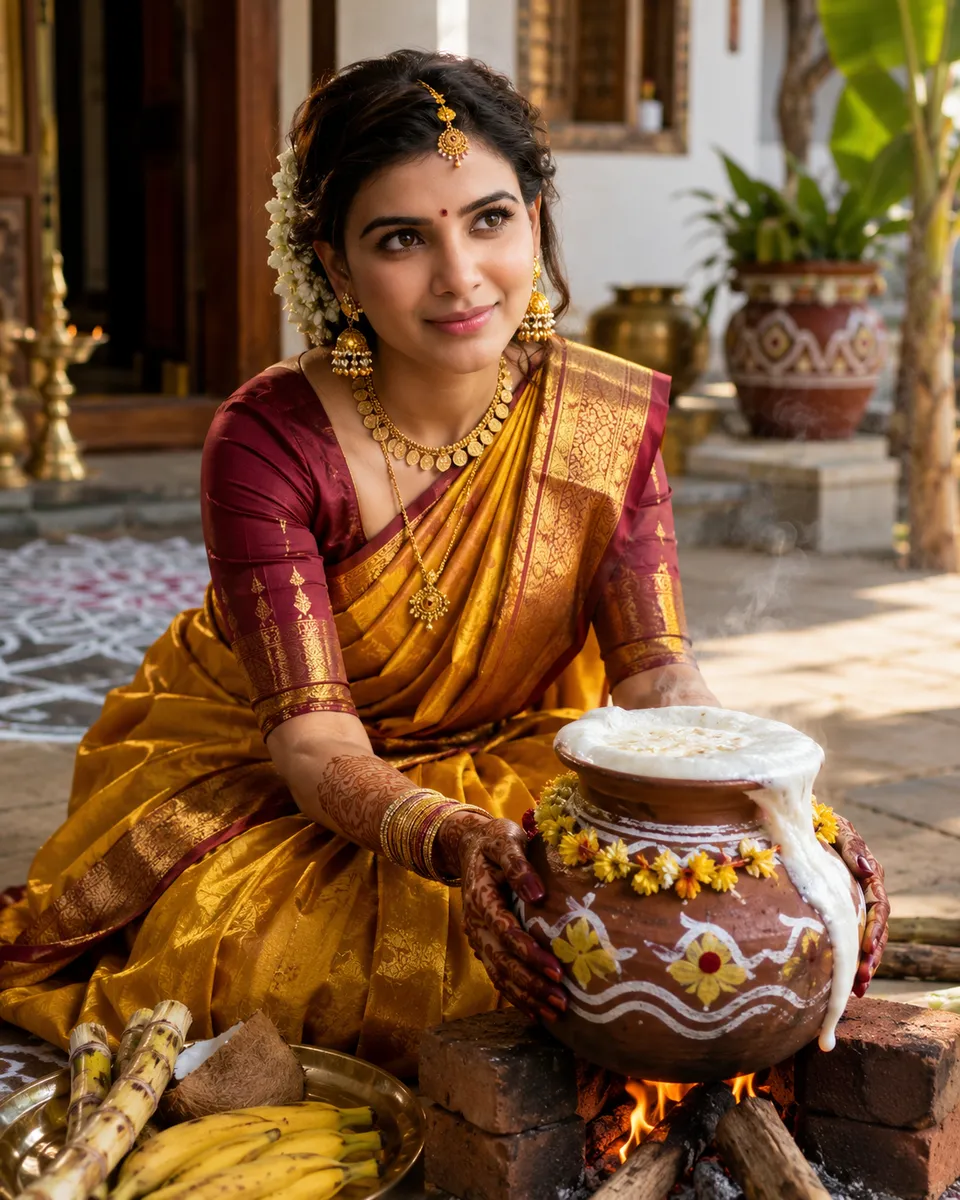
The vibrant mustard-yellow saree with a deep red border captures the essence of Pongal morning, complemented by traditional jewelry and the warmth of cooking. Set in a Tamil courtyard, the scene evokes a rich cultural celebration filled with joy and familial rituals.
A single 4:5 vertical photograph captured on the morning of Thai Pongal — January 14th at around 7:15 a.m., the second day of the Tamil four-day Pongal festival. The setting is the open *thinnai* veranda or front courtyard of a traditional Tamil home — could be a Madras (Chennai) heritage home, a Madurai-region rural home, or a Tanjore brick-and-tile village home. The subject is the person in the uploaded photograph, captured beside the cooking *Pongal Paanai* (the festival clay pot).

LOCK from the upload: the entire face — eye shape and spacing, exact eye colour, nose bridge profile and tip, lip shape and natural fullness, eyebrow shape, jawline, chin shape, hairline, ear shape, skin tone, and every visible mole, freckle, scar, fine line, or beauty mark. Also the natural hair — actual colour, texture, length, density. The hair will be styled traditionally for the morning ritual; the underlying hair is hers. Render imperfections that are in the upload; do not invent. Critically: this is a domestic ritual moment, not a styled photo-shoot — the face should look like a real Tamil woman performing her family's annual Pongal cooking, not an idealised festival model.

REPLACE from upload: any earrings, necklaces, bangles, rings, nose pins, or other jewelry visible in the uploaded photograph are NOT carried over. They are removed entirely and replaced with the scene-appropriate Tamil traditional jewelry described below.

Wardrobe — traditional Tamil Pongal-morning saree:
A traditional South Indian silk or fine cotton saree appropriate to the morning ritual. The Pongal saree is bright, fresh, festive — but practical (cooking is happening). Pick ONE specific colour:
— Bright mustard-yellow Kanjeevaram with a deep red border and gold zari work (the most traditional Pongal colour combination).
— Deep red Kanjeevaram with a gold border and small mango-motif weave throughout.
— Bright saffron-orange Kanjeevaram with a maroon and gold border.
— Bright lime-green Kanjeevaram with a deep red border and zari work.

The blouse: a matching deep-colour silk blouse with three-quarter sleeves and a modest neckline. The saree is draped in the traditional Tamil-Brahmin style — pleats neat at the waist, the pallu pinned at the LEFT shoulder and falling down the back. The fabric is *real silk Kanjeevaram* with visible weave, real weight, and the slight crispness of a saree being worn for the first time today.

Scene jewelry (replaces anything in the upload — Tamil Pongal-morning):
— Earrings: traditional Kerala/Tamil temple-style *jhumkas* in antique gold with small pearl drops — substantial heritage-style, the kind a Tamil mother passes down. NOT modern minimal, NOT studs.
— Necklace: a heritage *kasu mala* (gold coin necklace) close to the throat, possibly with a slightly longer simple gold chain pendant below. The South Indian classical two-piece layering.
— Bangles: a stack of plain gold bangles on each wrist — six per side — the classic thin South Indian gold bangle stack. Plus a few thin glass bangles in colours matching the saree.
— Maang tikka: a small classical gold maang tikka at the centre parting with a small pendant. Optional based on whether the upload's hair styling supports it.
— Bindi: a large round red bindi at the centre of the forehead — the standard Tamil-Brahmin daily-festival bindi.
— Toe rings (*metti*) on both feet — visible if the framing supports.
— Hair flower: a fresh strand of mullai (jasmine) flowers woven through the bun or braid — the morning-fresh flowers, fragrant and visible.
— Hands: rich red-brown mehndi on both hands and forearms — applied two days earlier for the festival, fully developed. The patterns are dense traditional South Indian work.
— Nose: no nose ring (most Tamil-Brahmin traditional women don't wear nose rings for this festival).

Hair styling (using natural hair from upload):
The natural hair smoothly oiled with traditional coconut oil (very slight sheen), centre-parted, gathered at the back into a traditional low bun (*kondai*) at the nape. The jasmine garland woven around the bun completely. The hairline is clean — the morning's careful preparation visible. A few small wisps may have escaped from the work of cooking — slight imperfection, real.

Pose and composition — the Pongal moment:
The subject is at or near the Pongal Paanai (the festival pot). The model picks ONE of these moments:

(a) Crouched or seated on the ground beside the pot, both hands at the pot's base (touching the warm clay), looking up at the boil-over moment — the rising milk just at the rim of the pot, perhaps just starting to overflow in a small white stream. The expression a mix of joyful anticipation and ritual reverence ("Pongalo Pongal!" being called).

(b) Standing beside the pot, body angled three-quarter to camera, one hand at the side, the other hand reaching toward the pot or holding a small piece of sugarcane. The face turned to camera with a soft welcoming expression — the *Pongal hostess* mode.

(c) Kneeling at the freshly-drawn kolam at the doorstep, the body slightly turned away from the camera, finishing the last lines of the kolam with the rice flour. Head turned partially back over the shoulder to look at the camera. This emphasizes the kolam-making ritual.

(d) Standing in the courtyard beside the pot with a small bowl of jaggery in one hand and a small wooden ladle in the other — about to add ingredients to the pot. The mid-cooking moment.

The body language is *ritual-engaged* — present in the activity, unhurried, with the slight purposeful quality of someone performing an annual sacred practice. Spine upright but not stiff. Shoulders open.

Expression — Pongal-morning joy:
A genuine warm smile — the small private joy of performing a ritual that means home, family, and the start of a good year. Read the upload's natural face — render the warm version of it lifted by the festival's quiet anticipation. Eyes alive with the morning's freshness and the practical attention to the pot. Not a wide camera-smile — the *settled* warmth of someone in the middle of doing something meaningful.

The face has the slight natural flush of the cooking fire's warmth. There may be the small smile or laugh of the *Pongalo Pongal!* call being made.

Setting — the Tamil Pongal courtyard:
The environment is unmistakably Tamil rural-or-traditional:
— The Pongal Paanai (the festival pot): a new clay pot, about 25-30cm tall, decorated with thick yellow turmeric paste applied around its body, a small piece of fresh ginger or a small lime tied at the top, and a single piece of sugarcane standing upright tied around the pot or leaning against it. The pot sits on three small bricks or a small clay hearth (the *adupu*) with a small wood fire burning beneath.
— A young coconut frond (*kuruthola*) tied around the pot's neck.
— The pot's contents: white milk and the new rice (raw rice grains visible at the bottom), with a bubbling boil-over starting at the rim.
— The *kolam* at the doorstep: a substantial floor design in white rice flour, perhaps 3-4 feet in diameter, with red brick powder accents — geometric and floral patterns combining. Fresh, recently drawn. The kolam is the visual signature of the morning.
— Sugarcane stalks (3-4 stalks) leaning against the wall — green and tall, sometimes with small leaves at the tops.
— A traditional brass *koylakkalam* (large vessel) nearby holding water or milk for the pot.
— Small banana leaves laid out for serving later — visible at the edge of the courtyard.
— A small brass *paavai* (small idol of Goddess Lakshmi) or a framed picture of a deity near the pot — the religious anchor of the ritual.
— Small piles of yellow turmeric, red kumkum, and small clay diya lamps placed around the pot — offerings.
— Banana leaves and marigold flowers placed at the doorway and around the pot.
— The architectural backdrop: traditional Tamil home wall — perhaps red oxide floor, perhaps painted wall in cream or white, perhaps a wooden carved door frame, perhaps a tiled veranda roof visible at the upper edge.

Atmospheric details:
— A thin column of smoke or steam rising from the pot — visible against the morning light. The moisture in the steam catches the light and reads as warm white wisps.
— The smoke from the small wood fire — thin, drifting.
— A small spider's web with morning dew at the edge of the courtyard if rendered subtly.
— Marigold petals scattered on the courtyard floor near the kolam.
— A small bird (perhaps a koel or a sparrow) just visible at the edge of the frame — the morning ambient life.

Light — Tamil Pongal-morning sun:
— The primary light is the early-morning sun coming through the courtyard's open side from camera-back-left at a low angle (around 20 degrees above horizon), warm gold at around 3500K. The directional warm of mid-morning Tamil sun.
— The light catches the right side of the subject — illuminating the cheek, the shoulder, the saree's pallu. The gold zari and the gold jewelry catch the warm light and *sparkle*.
— A secondary contribution from the fire under the pot — providing warm under-light from below, catching the lower part of the saree and the underside of the chin if the subject is bent forward.
— The shadow side of the face falls into warm shadow with ambient bounce from the warm-toned floor and walls. Half-stop down from the lit side.
— Catchlights in the eyes from the morning sun and the small fire — multiple warm catchlights.
— The kolam at the doorstep catches the warm light brilliantly — the white rice flour glows.

Camera language: a 50mm prime lens at f/2.5, shot on a full-frame digital body, processed for warm filmic skin tones — the colour science of contemporary Tamil-cinema-style cultural editorial (think Tamil Wedding Stories' Pongal portraits, or *Penmai* magazine's traditional features). ISO 400, available light. Subject distance roughly two metres. Three-quarter framing — from above the head with small headroom to mid-thigh, showing the saree's upper pallu, the jewelry, and the Pongal pot and kolam in the lower portion of the frame.

Slight handheld feel — the photographer is shooting from slightly above (the subject is bent down at the pot).

Colour treatment: deeply saturated warm Tamil colours. The saree's bright colour fully saturated. The gold of the jewelry and the zari warm and abundant. The kolam's white rice flour reads as warm cream-white. The marigold orange, the turmeric yellow, the red kumkum — all at their natural festive saturation. Skin tones true to the upload, warmed by the morning sun. Tamil cultural-photography palette.

Skin handling: pores visible across the face. The slight natural sheen at the cheekbones from the cooking fire's warmth. Individual eyelashes resolved. The mehndi pattern crisp on the hands and forearms. The fresh jasmine flowers individually rendered with their small green stems. Real warmth, real engagement, real morning.

Aspect ratio 4:5 vertical. No text, no caption, no festival name overlay, no border, no watermark.This image was generated with AI.
About this look
The choice of a bright mustard-yellow saree, accented with a deep red border, symbolizes the festive spirit of Pongal, while the traditional Tamil jewelry adds a touch of heritage. The clay pot, adorned with turmeric paste and fresh sugarcane, is the centerpiece of the composition, reflecting the ritual's significance. Framed in a traditional Tamil courtyard setting, the lighting enhances the warmth of the morning, with soft natural light illuminating the subject's joyful expression and meticulous attention to the bubbling pot. Careful attention is given to the arrangement and balance of elements, creating a harmonious and engaging visual narrative.
Ideal for celebrating the Pongal festival, this portrait captures the intimate moment of preparing the special dish, embodying the spirit of tradition and family. Perfect for sharing on social media or during family gatherings, it resonates with anyone who cherishes cultural rituals. Suitable for Tamil women or families wishing to commemorate this important festival, the image encapsulates a moment of joy, reverence, and connection to heritage, making it a treasured keepsake for years to come.
How to use this prompt
Select a clear portrait of a Tamil woman engaged in the Pongal cooking ritual. Ensure that her face and hair are visible, with details of any natural imperfections included. The prompt will require you to specify the saree color and style, as well as the pose (crouched, standing, or kneeling). If the image lacks warmth or the subject's expression feels off, adjust the lighting settings or facial expression to enhance the joyful atmosphere of the festival.
Tips to customize it
- Choose a saree color like bright mustard-yellow or deep red for a traditional look.
- Opt for fresh jasmine flowers in the hair for an authentic Pongal touch.
- Select a pose that shows engagement with the cooking pot for a more dynamic image.
- Ensure the backdrop includes a freshly drawn kolam to highlight the cultural significance.
More like this

Prompt Deck
Free on Google Play
Take the whole deck with you
Browse thousands of AI image prompts, customise them with your own details, and create — all from the Prompt Deck app.
- Tap to customise & copy
- Save your favourites
- Fresh prompts daily