 AI-generated
AI image prompt
Polaroid Wall, Twelve Moments on a String
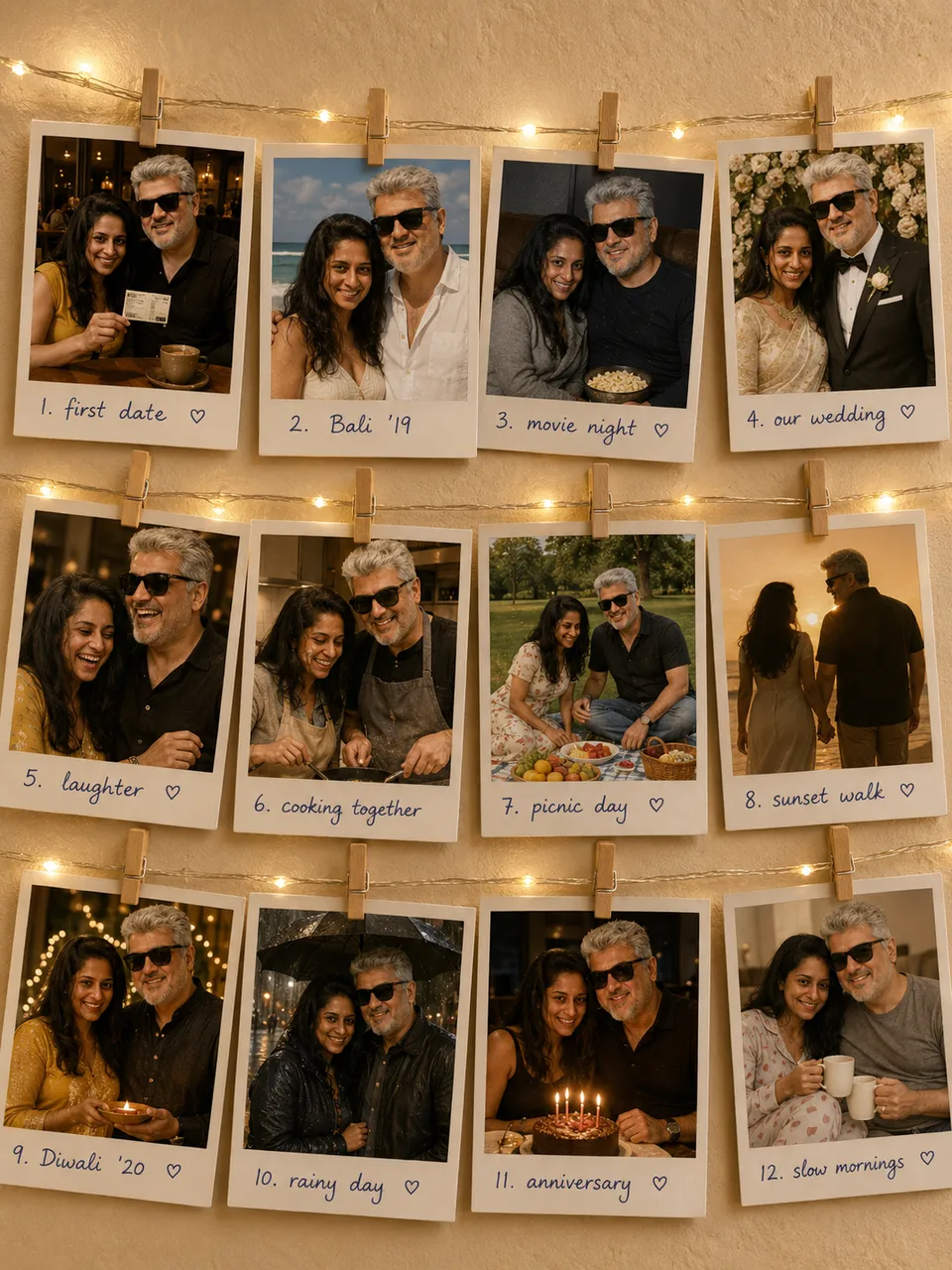
A heartwarming display of twelve polaroids captures the essence of a couple's journey through various cherished moments. Each snapshot hangs from a string of fairy lights against a textured cream wall, exuding a nostalgic and cozy ambiance.
A single 4:5 vertical photograph showing TWELVE INDIVIDUAL POLAROID PHOTOGRAPHS of the same couple, clipped to a string of warm fairy lights that runs across a textured cream-coloured wall. The composition is the polaroid-memory-wall — a collage of twelve different polaroids showing twelve different moments of one couple's relationship over time. Captured: the polaroid-wall photographed straight-on with a smartphone, in a warm-lit room around 7 p.m.

There are TWO uploaded photographs — Partner A (female) and Partner B (male). The same two partners appear in ALL TWELVE polaroids.

LOCK Partner A: complete face checklist, natural hair, natural skin tone, all marks — preserved across all twelve polaroids.
LOCK Partner B: complete checklist. Hairline preserved EXACTLY across all twelve polaroids. Facial hair preserved exactly.

ANTI-BLEND CLAUSE: each partner's face exclusively from their own upload, in EVERY one of the twelve polaroids.

LOCK IDENTITY, RE-LIGHT THE REST (both partners): lock each partner's identity — bone structure, features and their spacing, permanent marks, and true relative complexion (never lightened). Do NOT lock either upload's lighting or absolute skin tone — both faces are RE-LIT by each polaroid's own scene.

FACE-BODY INTEGRATION & REALISM (mandatory — applies to BOTH partners, in every polaroid):

1. ONE CONTINUOUS PHOTOGRAPH, NOT A FACE-GRAFT. For each partner, the head, neck, and body are one person in a single exposure — no visible seam, edge, halo, or pasted-on boundary at the jaw, chin, hairline, or neck; the face is not sharper or brighter than the body. Both partners belong to the SAME photograph — one light, one grain, one grade — not two cut-outs placed side by side.

2. SKIN-TONE CONTINUITY (no two-tone problem). For each partner, the complexion of face, ears, neck, shoulders, and hands is ONE consistent skin tone — their true complexion everywhere, never lightened, with no tonal step at the jawline or neckline. Each partner keeps their OWN complexion; the two are not averaged toward each other.

3. SCENE-MATCHED LIGHTING. Both faces are RE-LIT by each polaroid's scene — the same key-light direction, colour temperature, intensity, and shadow pattern fall on both partners' faces AND bodies, consistent with where each one stands.

4. CORRECT HEAD-TO-BODY PROPORTION. Each head is anatomically sized to its own body (about one-seventh to one-eighth of standing height). Do NOT enlarge either head. The two partners are in correct relative scale to each other (natural height/build difference from the uploads).

5. HEAD POSE FOLLOWS THE BODY. Each head sits naturally on its neck, consistent with that partner's posture and the camera angle — no front-facing face on a turned body. Where the partners touch, the contact is physically real and correctly occluded.

6. NATURAL NECK & HAIRLINE TRANSITION. For each partner, jaw flows into neck, neck into shoulders, hairline into scalp — soft natural anatomy, real shadow under the chin, no abrupt mask-edge.

CONSISTENCY CLAUSE: it is the SAME couple in all twelve polaroids — same Partner A, same Partner B, recognizable across all twelve moments. They may have slightly different hair styling or different wardrobe per moment, but they are clearly the same two people.

CONCEPT-VS-FACE CLAUSE: the polaroid aesthetic (slightly faded warm colour, slight grain, white border, slight blur) is APPLIED ON TOP of the faces — the underlying facial features remain recognizable from the uploads.

The twelve polaroids — composition:
The polaroids are arranged in a 3-row by 4-column grid (12 polaroids total), each polaroid roughly 2 inches by 2.5 inches in the composition. Each polaroid is clipped to the string of fairy lights with a small wooden clothespin. The polaroids hang at slightly different angles — some slightly tilted, some perfectly straight, some overlapping at the corners (the natural casualness of a memory wall).

Each polaroid has the iconic POLAROID FORMAT — a square or slightly-rectangular image area with a wide white border at the bottom (the iconic polaroid white space). Some polaroids may have a small handwritten note in the white border in casual blue pen (a date, a name, "first date", "Bali", "<3").

The twelve scenes — specifications (the model picks twelve, each distinct):

POLAROID 1 (first-date register): Both partners in casual evening wear, sitting at a small café table. The cinema-ticket and a small coffee cup beside. Both with playful smiles. Warm interior.

POLAROID 2 (vacation register): Both at a beach or travel destination — matching outfits, sunglasses, the slight wind-tousle. Bright outdoor light.

POLAROID 3 (mundane domestic register): Both on a couch in cozy clothes, watching a movie. The TV glow on their faces. Casual.

POLAROID 4 (wedding-day register): Both in wedding attire (saree-and-veshti OR Western-tux-and-gown — match the couple's tradition). Formal portrait.

POLAROID 5 (laughing-candid register): Both mid-laugh at something off-camera. Genuine candid moment.

POLAROID 6 (cooking-together register): Both in the kitchen, cooking something. Aprons, slight flour on Partner A's cheek.

POLAROID 7 (picnic-park register): Both on a picnic blanket in a park, food spread between them.

POLAROID 8 (sunset-walk register): Both walking together at sunset, silhouetted. Warm bronze light.

POLAROID 9 (festival-celebration register): Both at a festival (Diwali, Onam, Christmas) — festive wardrobe, lights around.

POLAROID 10 (rainy-day register): Both under a shared umbrella, wet streets. The intimate rain moment.

POLAROID 11 (anniversary-cake register): Both at a small candle-lit table with a cake between them. Birthday/anniversary moment.

POLAROID 12 (quiet-morning register): Both in pyjamas/casual home wear, sharing a morning coffee. The slow Sunday-morning moment.

(If the wardrobe should reflect a specific cultural register — Tamil, Punjabi, Kerala, etc. — adapt all twelve consistently. Default is the contemporary urban Indian/global couple register.)

The string of fairy lights:
- Warm yellow LED fairy lights (the small bulb-style, not bright Christmas lights) — about 20-30 small warm bulbs visible along the string.
- The string runs across the wall horizontally, with slight droop between each clothespin (gravity).
- The lights are slightly out of focus where they're between the polaroids — providing the warm bokeh-and-glow.

The wall:
- A textured cream or pale-beige wall — visible texture (slight stucco, slight grain). The wall has the warm domestic feel.
- Possibly: a few small wall details — a small framed picture nearby, a small plant, a small clock — in the deep blur.

The clothespins:
- Small wooden clothespins (natural wood colour or pastel-painted) clipping each polaroid to the string.

Atmospheric details:
- Soft warm glow from the fairy lights catching the polaroids.
- The slight visible warmth of an evening-lit room.
- A few small details — a small piece of washi tape on one polaroid, a small dried flower tucked behind one polaroid, a small ribbon on the string.

Light — warm interior evening:
- Primary light source: the fairy lights themselves at around 2400K — providing warm warm bokeh and glow.
- A secondary contribution from a soft ceiling lamp or table lamp at around 3000K — providing soft ambient fill on the wall.
- The polaroids glow softly with the warm light.

The individual polaroid lighting:
- Each polaroid has its own SCENE LIGHTING (the lighting in the scene depicted) — some bright outdoor, some warm indoor, some cool sunset, some dark night.
- The polaroid's white border catches the warm fairy-light glow.

Camera language: the whole composition is photographed by a smartphone (about 26mm equivalent) at approximately f/2 — the polaroids on the wall in sharp focus, the wall texture in sharp focus, the fairy lights slightly out-of-focus (their bokeh shimmer). Slight handheld feel — about 1 degree off-level.

Aspect ratio 4:5 vertical.

Colour treatment: warm cozy palette — cream wall, warm fairy-light glow, the slight faded warm-tinted polaroid aesthetic across all twelve images. Each polaroid has the iconic SLIGHTLY-FADED polaroid colour science — slight magenta in shadows, slight yellow in highlights, low contrast, slight grain. The image has the *memory-wall-warm* tonal register.

Skin handling: each polaroid has natural skin texture for both partners. The polaroid aesthetic adds slight grain but the faces remain recognizable as the uploaded partners.

Aspect ratio 4:5 vertical. No text overlay (apart from the small handwritten notes IN the polaroid white borders). No border, no watermark.
This image was generated with AI.
About this look
Celebrating love and shared experiences, the layout of twelve polaroids creates a dynamic visual narrative. Each image is meticulously framed within its white border and clipped to the string of warm fairy lights, which softly illuminate the photographs. The variety in scenes—from casual moments at home to festive celebrations—enhances the collage's charm. The warm lighting and subtle bokeh create an inviting environment, highlighting the intimacy of each moment while maintaining a cohesive aesthetic across all images.
How to use this prompt
To create this memory wall effect, upload two photographs of the couple—one of each partner—ensuring that both are well-lit and clear. The prompt will arrange twelve polaroids in a grid format, with each image showcasing different moments of their relationship. Ensure that the expressions and poses reflect the intended scenes. If results appear mismatched, check the lighting consistency across the polaroids and adjust as necessary to maintain a natural look.
Tips to customize it
- Adjust the colour temperature of the lighting to evoke different moods in each polaroid.
- Incorporate handwritten notes in the white space of the polaroids for a personal touch.
- Experiment with the angle of the polaroids to create a more dynamic and casual appearance.
- Consider adding a small decorative element, like a dried flower, to enhance the collage's charm.
More like this

Prompt Deck
Free on Google Play
Take the whole deck with you
Browse thousands of AI image prompts, customise them with your own details, and create — all from the Prompt Deck app.
- Tap to customise & copy
- Save your favourites
- Fresh prompts daily