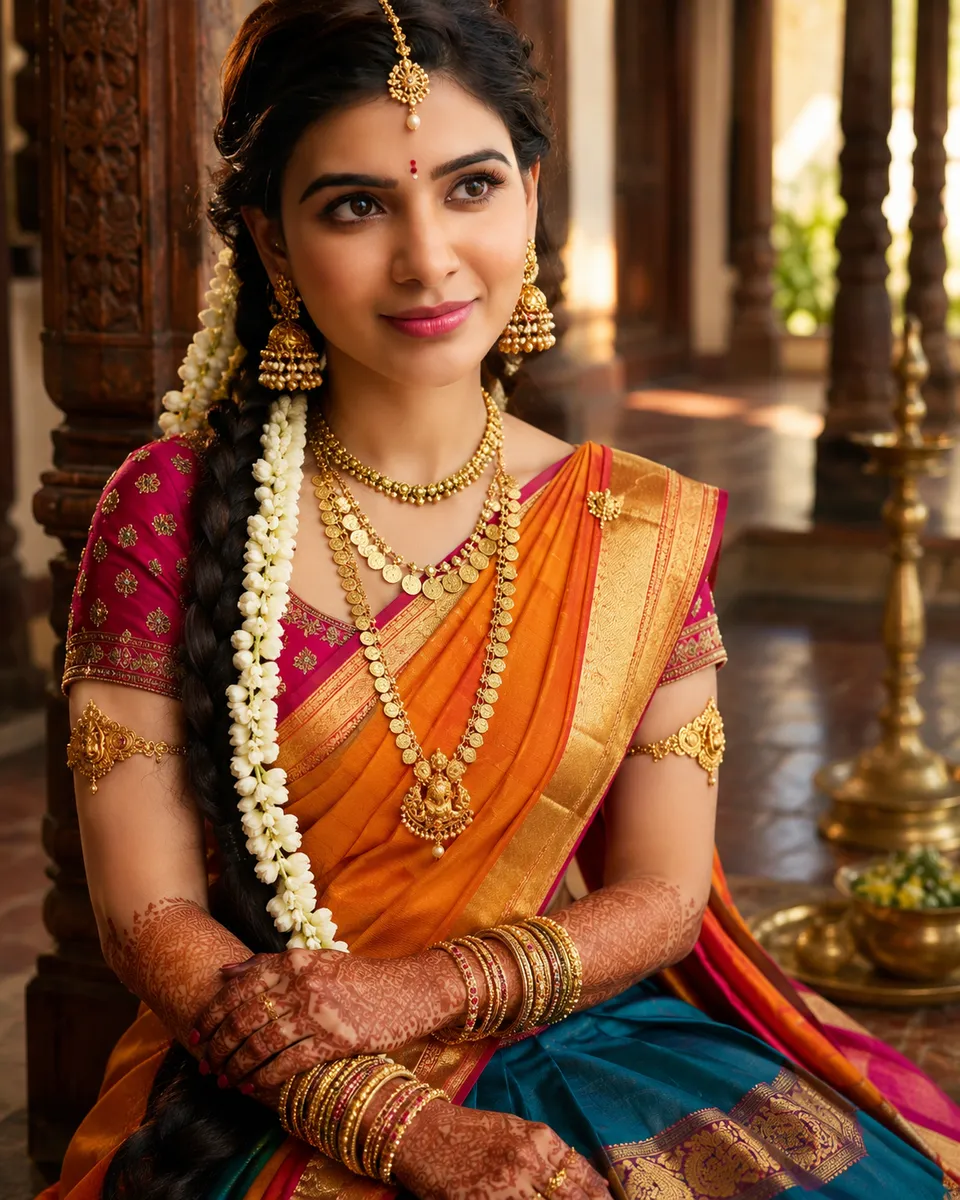
 AI-generated
AI image prompt
Pavadai-Davani, the Half-Saree Year
Set in a timeless Tamil heritage venue, a woman dressed in a stunning pavadai-davani showcases the rich cultural aesthetics of South India. The deep jewel tones of her attire, complemented by traditional gold jewelry, create a cinematic and celebratory atmosphere that honors the beauty of Tamil heritage.
A single 4:5 vertical photograph capturing the heritage Tamil aesthetic of the *pavadai-davani* (the South Indian half-saree). The setting is a traditional Tamil home or a heritage venue (a Chettinad mansion, an old Madras-style home, a heritage temple courtyard) at late afternoon, around 5 p.m. The subject is the person in the uploaded photograph, photographed in the heritage half-saree styling.

LOCK from the upload: the entire face — eye shape and spacing, exact eye colour, nose bridge profile and tip, lip shape and natural fullness, eyebrow shape, jawline, chin shape, hairline, ear shape, skin tone, and every visible mole, freckle, scar, fine line, or beauty mark. Also the natural hair — actual colour, texture, length, density. The hair will be styled in the traditional pavadai-davani long-braid; the underlying hair is hers. Render imperfections that are in the upload; do not invent. Critically: do not de-age the upload to fit the "young girl in half-saree" archetype — the pavadai-davani is increasingly worn by women of all ages for cultural events. Render the actual age, just adorned in the heritage styling.

REPLACE from upload: any earrings, necklaces, bangles, rings, nose pins, or other jewelry visible in the uploaded photograph are NOT carried over. They are removed entirely and replaced with the Tamil pavadai-davani traditional jewelry described below.

Wardrobe — the three-piece pavadai-davani:
The three traditional pieces of a heritage Tamil half-saree:

PIECE 1 (Pavadai — the skirt): a floor-length silk skirt in a deep saturated jewel-tone — pick ONE: deep peacock-blue, deep emerald green, deep magenta-pink, deep saffron-orange, deep mustard-yellow, or deep maroon. The skirt has a contrasting wide border (3-4 inches) in gold zari work, often with a traditional temple-pattern, peacock-pattern, or mango-motif. The pavadai is gathered at the waist with sufficient volume to flare slightly when walking, falling cleanly to the ankles. The fabric is real Kanjeevaram silk with visible weave, real weight, and the slight shimmer of authentic silk.

PIECE 2 (Choli — the blouse): a fitted matching silk blouse in a contrasting jewel-tone (if the pavadai is peacock-blue, the blouse is magenta; if emerald, the blouse is saffron; if maroon, the blouse is mustard). The blouse has short sleeves (cap-style or just below the shoulder), a modest round or sweetheart neckline, and is fully embroidered with gold zari work — peacock motifs at the back, floral patterns at the front, gold border at the sleeves.

PIECE 3 (Davani / Voni — the half-saree drape): the most distinctive piece — a long rectangular fabric panel (about 2 metres long, 1 metre wide) in a third contrasting jewel-tone with a heavy gold border (gold zari embroidery on all four sides). The davani is draped across the chest from the left hip up to the right shoulder, then over the right shoulder with the loose end falling down the back — pinned at the right shoulder with a small ornate gold *kuchu* (decorative tassel) or a small gold brooch. The drape style is the classical Tamil half-saree style — distinct from a saree's pallu.

The colour palette is *jewel-tone trinity* — three saturated colours in conversation:
— Peacock-blue pavadai + magenta blouse + saffron-orange davani
— Emerald green pavadai + maroon blouse + mustard davani
— Saffron-orange pavadai + peacock-blue blouse + magenta davani
— Maroon pavadai + emerald blouse + saffron davani
— Deep mustard pavadai + magenta blouse + peacock davani

Each combination is traditional and recognisably South Indian. The fabric in all three pieces is *real silk* with visible weave.

Scene jewelry (replaces anything in the upload — Tamil pavadai-davani heritage):
— Earrings: traditional Tamil *jhumkas* in antique gold with bell-shape construction and small pearl drops — substantial heritage-style. Or alternatively, traditional Tamil long *karanphool* earrings with a flower-shape at the top and chains/pearls dropping below. These earrings are the visual anchor of the upper face.
— Necklace: layered Tamil traditional gold necklaces (the half-saree traditionally allows more layered jewelry):
  • A *netchu* or simple gold chain close to the throat.
  • A *kasu mala* (gold coin necklace) below it.
  • A longer *manga malai* (mango pendant necklace) at mid-chest.
  Three layered pieces, all in heritage antique-gold tone.
— Bangles: a substantial stack on each wrist — eight to twelve per side. Mix of plain gold bangles, gold bangles with traditional stone-set work (small red coral, small pearls), and a few thin glass bangles in colours matching the wardrobe. The bangles make a soft sound when she moves.
— Maang tikka: a delicate gold maang tikka at the centre parting with a small uncut polki stone and a small pearl drop chain disappearing into the hairline.
— Bindi: a large round red bindi at the centre of the forehead — slightly elaborate (perhaps with two small white *gobi* dots framing it).
— Hair flowers: a substantial garland of fresh white jasmine (*malli poo*) woven through the long braid at the back — the jasmine extends down the braid's length, the white fragrant flowers fresh and visible against the dark hair.
— Hands: rich red-brown traditional South Indian mehndi on both hands and forearms — dense, intricate patterns with peacocks, paisleys, and floral motifs. This is the heritage half-saree look, fully prepared.
— Nose: NO nose ring (most traditional Tamil pavadai-davani styling doesn't include a nose ring).
— Arms: a *vanki* (V-shaped armlet) on each upper arm in gold — distinctive Tamil heritage armlet.
— Feet: simple gold or silver toe rings (*metti*) — visible if the framing supports.

The jewelry register is *full Tamil heritage* — abundant but classical, recognisably traditional South Indian.

Hair styling (using natural hair from upload):
The natural hair smoothly oiled with traditional coconut hair oil (visible slight sheen at the temples and the parting), centre-parted, gathered at the back and braided into a thick long traditional braid (*jadai*) extending from the crown of the head down the back. The braid is decorated:
— A *paranda* (long decorative tasselled hair extension) tied at the end of the braid — traditional gold metallic threads with pearls or small bells at the tip.
— The fresh jasmine garland woven through the upper third of the braid.
— Small gold ornaments (*chootti* — flower-shaped gold pieces) on either side of the parting at the front of the head.

The hair is *fully Tamil heritage* — meticulously styled, smooth, the kind of styling that takes a mother or grandmother's help.

Pose and composition — the heritage portrait:
The subject is standing or seated in the traditional setting. The model picks ONE:

(a) Standing tall in the home's courtyard or against a traditional wall — body slightly off-axis from camera, both hands joined together in front of her at chest level (the traditional Tamil *vanakkam* greeting pose), head slightly bowed but eyes meeting the camera with a soft smile. The classical heritage portrait pose.

(b) Seated on a low traditional wooden stool or step, body angled three-quarter to camera, the pavadai skirt arranged around her, hands resting in the lap or one hand on the side, head turned to camera with a soft expression.

(c) Standing in the courtyard near a brass *kuthuvilakku* (oil lamp) — one hand reaching out to touch or light the lamp wick, the other hand at the side. The ritual-moment composition.

(d) Caught in a small movement — perhaps adjusting the davani at the shoulder, or lifting a flower garland from a brass tray. The active-traditional moment.

The body language is *graceful and grounded* — the carriage of a Tamil woman in heritage attire who knows what she's wearing and what it means.

Expression — heritage Tamil traditional:
A small natural genuine smile — neither wide nor reserved, the soft warmth of being beautifully traditionally dressed for an occasion that matters. Read the upload's face and render it lifted by quiet pride in the heritage moment. Eyes either meeting the camera directly or looking down at the work she's doing (joining hands, adjusting davani). Not a wide camera-smile; the calm warmth of *being beautifully herself*.

Setting — traditional Tamil heritage interior or courtyard:
The environmental anchors:
— A traditional Tamil home setting — either the inner courtyard (*nadumuttam*) of a Chettinad mansion, the veranda (*thinnai*) of a Madras heritage home, or the courtyard of a Tamil temple precinct.
— Architectural details: dark teak wooden carved doorframes, polished red oxide floor or Athangudi tiled floor (the geometric coloured Chettinad floor), pillared columns of carved stone or polished wood, possibly a glimpse of an old wooden window with carved details.
— A brass *kuthuvilakku* (multi-tiered standing oil lamp) lit or unlit on a small platform nearby.
— A brass *uruli* (shallow ceremonial bowl) with floating jasmine and rose petals on a small table.
— A small *kolam* visible at the doorstep or on the floor.
— Traditional decorative elements: a strung garland of mango leaves (*thoranam*) hanging from a doorway, marigold and rose flower garlands.
— A glimpse of traditional South Indian art on the wall — a Tanjore painting, a Madhubani painting, or a small carved wooden deity.
— A few books or musical instruments visible in the soft-focus background — suggesting cultural education and refinement.

Atmospheric details:
— A faint thin column of incense smoke (*agarbatti*) rising in the air — the traditional sandalwood or jasmine fragrance suggested.
— Soft warm dust catching the afternoon light.
— Small marigold or jasmine petals scattered on the floor near the subject.
— A faint slight breeze visible — small movement in the davani's loose end at the back.

Light — Tamil afternoon warm:
— The primary light is the warm afternoon sun coming through an open courtyard or open doorway at 30-45 degrees from camera-side, at around 3500K — warm directional Tamil sun.
— The light catches the side of the subject — illuminating the cheek, the shoulder, the silk's gold zari border, the gold jewelry. The gold elements catch the warm light intensely and *glow*.
— A secondary contribution from the warm bounce of the red oxide or Athangudi tile floor below — providing subtle warm uplight.
— A tertiary contribution from any visible brass lamps in the setting — small warm point-sources adding accent.
— Catchlights in the eyes from the warm afternoon sky and the warm room — multiple alive points.

The contrast across the face is moderate — three-quarter stop between lit and shadow sides. The shadows are warm, never cool — Tamil interior shadows have warmth.

Camera language: an 85mm prime lens at f/2.5, shot on a full-frame digital body, processed for warm filmic skin tones — the colour science of contemporary Tamil heritage editorial photography. ISO 400, available light. Subject distance roughly three metres. Three-quarter to full-length framing — depends on the chosen pose. Include enough of the pavadai's volume and the davani's drape to show the wardrobe completely.

Colour treatment: deeply saturated jewel-tones — the unmistakable South Indian heritage palette. The three pavadai-davani colours holding full saturation against each other. The gold of the jewelry and zari catching light. Skin tones true to the upload, warmed by the Tamil afternoon. The interior reads in warm terracotta-and-cream tones. Tamil-heritage colour register throughout.

Skin handling: pores visible across the face. The warm directional light reveals every facial texture. A slight natural sheen at the cheekbones from the climate. Individual eyelashes resolved. The fresh jasmine flowers individually visible. The mehndi pattern crisply rendered on the hands and forearms. The natural hair texture preserved.

Aspect ratio 4:5 vertical. No text, no caption, no border, no watermark.
This image was generated with AI.
About this look
Surrounded by the intricate architecture of a traditional Tamil home, the scene captures the essence of South Indian culture. Late afternoon light bathes the courtyard, casting a warm glow that highlights the textures of the silk pavadai-davani. The subject's pose reflects grace and tradition, whether standing with hands in a vanakkam greeting or seated with a soft smile, creating a strong visual narrative that resonates with heritage. The specific choice of colors in the attire enhances the cultural richness, while the delicate jewelry adds a layer of authenticity to the portrait.
How to use this prompt
Upload a clear image of the subject's face, ensuring it captures the unique features such as eye shape and hair texture. The prompt expects you to select a jewel-tone color combination for the pavadai, choli, and davani that reflects traditional Tamil aesthetics. A successful result will present the subject adorned with traditional Tamil jewelry, while maintaining their natural age and features. If the outcome doesn't meet expectations, consider adjusting the hair texture for a more realistic appearance.
Tips to customize it
- Choose a peacock-blue pavadai for a vibrant look that stands out against a heritage backdrop.
- Opt for a warm saffron-orange davani to create a striking contrast with the blouse and skirt.
- Ensure the lighting mimics the soft golden hour glow for an inviting ambiance.
- Select a three-quarter pose to highlight the intricate details of the pavadai-davani draping.
More like this

Prompt Deck
Free on Google Play
Take the whole deck with you
Browse thousands of AI image prompts, customise them with your own details, and create — all from the Prompt Deck app.
- Tap to customise & copy
- Save your favourites
- Fresh prompts daily