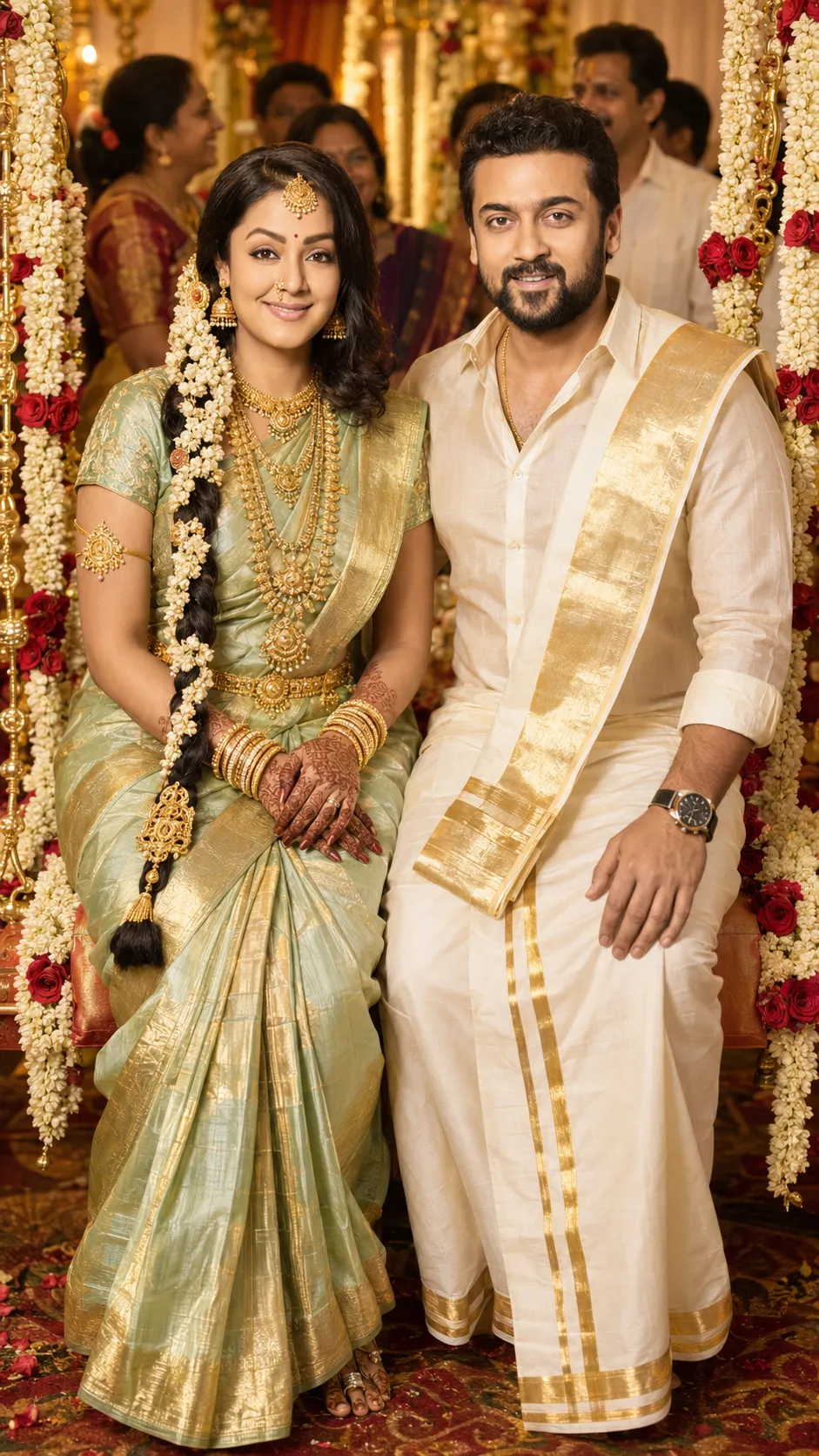
 AI-generated
AI image prompt
Oonjal, the Pre-Wedding Swing Ceremony
A Tamil couple sits on a beautifully adorned swing during their pre-wedding ceremony, surrounded by warm golden light and family members in soft focus. The scene captures a vibrant blend of tradition and intimacy, highlighted by floral garlands and ceremonial attire.
A single 4:5 vertical photograph of a Tamil couple seated on the decorated *oonjal* (traditional wedding swing) during their pre-wedding ceremony, captured in the late afternoon around 5 p.m. The wedding-hall is alive with family members in soft focus, the swing is heavy with garlands of jasmine and rose, and the warm golden light fills the space. The visual register is the lyrical-ceremonial Tamil pre-wedding moment.

There are TWO uploaded photographs — Partner A (female) and Partner B (male).

LOCK Partner A: complete face checklist, natural South Indian skin tone preserved, natural hair texture, all marks.
LOCK Partner B: complete checklist. Hairline preserved EXACTLY. Facial hair preserved exactly.

ANTI-BLEND CLAUSE: each partner's face exclusively from their own upload.

LOCK IDENTITY, RE-LIGHT THE REST (both partners): lock each partner's identity — bone structure, features and their spacing, permanent marks, and true relative complexion (the natural South Indian range — never lightened, never fairness-treated). Do NOT lock either upload's lighting or absolute skin tone — both faces are RE-LIT by THIS scene.

FACE-BODY INTEGRATION & REALISM (mandatory — applies to BOTH partners):

1. ONE CONTINUOUS PHOTOGRAPH, NOT A FACE-GRAFT. For each partner, the head, neck, and body are one person in a single exposure — no visible seam, edge, halo, or pasted-on boundary at the jaw, chin, hairline, or neck; the face is not sharper or brighter than the body. Both partners belong to the SAME photograph — one light, one grain, one grade — not two cut-outs placed side by side.

2. SKIN-TONE CONTINUITY (no two-tone problem). For each partner, the complexion of face, ears, neck, shoulders, and hands is ONE consistent skin tone — their true South Indian complexion everywhere, never lightened, with no tonal step at the jawline or neckline. Each partner keeps their OWN complexion; the two are not averaged toward each other.

3. SCENE-MATCHED LIGHTING. Both faces are RE-LIT by THIS scene — the same key-light direction, colour temperature, intensity, and shadow pattern fall on both partners' faces AND bodies, consistent with where each one stands. Catchlights and skin highlights match the environment for both.

4. CORRECT HEAD-TO-BODY PROPORTION. Each head is anatomically sized to its own body (about one-seventh to one-eighth of standing height). Do NOT enlarge either head. The two partners are in correct relative scale to each other (natural height/build difference from the uploads).

5. HEAD POSE FOLLOWS THE BODY. Each head sits naturally on its neck, consistent with that partner's posture and the camera angle — no front-facing face on a turned body. Where the partners touch (cheek-to-cheek, leaning, an arm around a shoulder), the contact is physically real and correctly occluded.

6. NATURAL NECK & HAIRLINE TRANSITION. For each partner, jaw flows into neck, neck into shoulders, hairline into scalp — soft natural anatomy, real shadow under the chin, no abrupt mask-edge.

ANTI-GRAFT CLAUSE: faces do not drift toward Tamil cinema actors.

REPLACE from both uploads: any jewelry — replaced with the pre-wedding traditional accessories below.

The bride's wardrobe — pre-wedding Tamil silk:
- A traditional Kanjivaram silk saree in a different colour than the wedding day — typically a softer/cooler colour: pista green, mango yellow, peacock blue, or lavender. The pre-wedding oonjal-saree is the second-most-precious saree of the trousseau.
- Real woven Kanjivaram silk with heavy gold zari pallu and gold border. Visible weight, slight stiffness.
- Draped in the Madisar / pin-pleat style.
- A matching silk blouse with gold zari work.

The bride's jewelry — full pre-wedding ornamental:
- The complete temple-jewelry set similar to the wedding day but slightly less heavy:
  - Multiple gold haram necklaces of varying lengths.
  - Large temple-jewelry jhumkas.
  - The *netti chutti* (forehead ornament) with the chandra-sun motif.
  - A *vanki* (V-shaped armlet) on the upper arm.
  - Multiple thin gold bangles (8-10 per wrist).
  - A *mookuthi* nose ring.
  - The thaali necklace (if the ceremony is post-engagement) or just the gold chain (if pre-thaali).
  - Toe rings (*metti*) visible below the saree.
- The mookuthi-pullaakku double-nose-ring style if Tamil-traditional.

The bride's hair:
- Hair plaited into a long braid, HEAVILY garlanded with jasmine (mallipoo) cascading down. Small orange kanakambaram flowers interspersed.
- The *jadanagam* (snake-shaped hair ornament) at the centre of the braid.
- The small *kunjalam* (tassel) at the end of the braid.
- Hairline preserved.

The bride's makeup and hands:
- Soft natural makeup — kohl, natural-red lip.
- Skin tone preserved exactly.
- THE MEHNDI ON HER HANDS — visible. Intricate traditional South Indian mehndi (slightly different from North Indian — more open negative-space patterns, often with the groom's name hidden in the design). Both palms covered with the deep brown-red mehndi paste / dried-mehndi pattern, extending up to the wrists. The pattern is dense at the palms, more sparse at the wrists, with mango motifs and small flowers.
- Visible: a small kumkumam mark at the centre of the forehead.

The groom's wardrobe — pre-wedding Tamil silk:
- A traditional silk veshti (dhoti) in cream or off-white with gold zari border. Pleated and pinned at the waist.
- An ANGAVASTRAM matching the bride's saree colour or in cream — silk with gold zari border, draped across the chest, going over the left shoulder.
- Below the angavastram: a simple cream silk shirt OR bare-chested with the poonal visible (depending on family tradition).
- The pre-wedding register is slightly less austere than the wedding day — could include a small silk shawl or thin Mysore-silk shirt above the veshti.

The groom's jewelry:
- The sacred thread (poonal).
- A simple gold chain at the neck.
- A small gold ring.
- A small gold bracelet on the right wrist.
- A *vibhooti* mark across the forehead with a small kumkum dot at the centre.

The groom's hair:
- Natural hair, slightly oiled.
- Hairline preserved.
- Facial hair preserved.

Pose and composition — oonjal-seated ceremony:
The couple is seated TOGETHER on the oonjal (the wooden swing). The oonjal is decorated with cascading garlands of fresh jasmine and rose, with small mango leaves at the corners. The swing is held by four thick teak chains (or brass chains) hanging from the ceiling.

Pick ONE pose:

(a) Both seated side by side on the oonjal — the bride on the right, the groom on the left (the traditional position). The bride's saree is draped beautifully around her, the groom in his veshti and angavastram. Both with soft warm expressions. A small heavy garland of jasmine connects them (a single garland draped around both their shoulders). The slight swing of the oonjal visible.

(b) Mid-ceremony candid — the family women (mother, aunts) on either side of the oonjal are throwing handfuls of rice and yellow flowers at the couple in the iconic *arati* moment. The bride and groom both half-smiling, the rice grains visible mid-air. The motion-blur and the falling rice add atmospheric movement.

(c) The bride alone on one side of the oonjal looking at the groom with a soft warm shy expression, the groom looking at her with a soft warm expression. The small ceremonial moment between them.

(d) The bride showing the groom her mehndi-decorated hands. The groom holding her hands with his own — a quiet intimate inspection of the ceremonial mehndi. Heads close together.

Default to pose (a).

The oonjal — specifications:
- A traditional Tamil oonjal — a rectangular wooden plank (about 4 feet by 2 feet) made of teak/rosewood, polished and carved at the edges.
- The plank is suspended by four thick teak or brass chains from the ceiling above.
- The oonjal is HEAVILY decorated:
  - Garlands of jasmine (mallipoo) cascading down the chains.
  - Garlands of red rose interwoven with the jasmine.
  - Small mango leaves tied at the corners.
  - Small *poo-koodai* (flower baskets) hanging from the chains.
  - A *kalasam* (small decorated pot with coconut and mango leaves) at the foot of the oonjal.
- The plank itself may have a soft silk-and-velvet cushion (deep red or maroon) for the couple to sit on.

Setting — wedding-hall pre-ceremony:
The environmental anchors:
- A traditional South Indian wedding hall or family-home courtyard.
- A *naatu*-style wooden pillared hall or marble-floored courtyard.
- *Thoranam* (mango-leaf garland) hung across the doorway in the deep background.
- *Kolam* (rice-flour rangoli) visible on the floor.
- Brass *nilavilakku* (oil lamps) burning at the corners of the oonjal.
- A small wooden *peetam* (low table) beside with small ceremonial items (a brass *kindi* water-pot, a small turmeric tray, a small *thamboolam* with betel leaves).
- Family members (women in colourful sarees, children) visible in soft focus around the oonjal — singing, clapping, throwing rice and flowers.
- A traditional *nadaswaram* musician visible in the deep blur (the South Indian wedding-music instrument).

Atmospheric details:
- Falling rice and yellow turmeric-coloured rice (*arati* rice) visible in the air around the oonjal — mid-shower.
- Small jasmine and rose petals on the floor and on the oonjal.
- The slight visible smoke of incense (sandal/jasmine) in the air.
- The slight breeze ruffling the garlands.
- The slight visible warmth of the ceremony.

Light — warm wedding-hall afternoon:
- Primary key: warm afternoon light from a large window or open mandapam side at around 4000K — directional, catching the couple from one side.
- A secondary contribution from the brass lamps (nilavilakku) — small warm flames adding atmospheric fire-light at around 2800K.
- A tertiary contribution from soft ceiling-bulbs / decorative lights — providing fill.
- Catchlights in all four eyes — warm.
- The silk wardrobe (the saree, the angavastram) catches the warm light — the gold zari glows.

Camera language: 50mm or 85mm prime at f/2.8, full-frame digital, processed for warm filmic colour science. ISO 400.

Three-quarter or full-length framing — including the oonjal, the garlands, the ceremony context.

Slight handheld feel — the natural wedding-photography composition.

Colour treatment: warm Tamil-pre-wedding palette — pista/peacock/mango saree, cream-and-gold groom wardrobe, the bright white jasmine, the deep red rose, the warm wood of the oonjal, the rice grains in the air. Skin tones natural South Indian. The image has the *Tamil-wedding-lyrical* tonal register — soft, ceremonial, warmly lit.

Skin handling: pores visible. Natural soft skin texture. The slight wedding-day glow on both. Eyes alive with the ceremony. The mehndi on the bride's hands clearly visible.

Aspect ratio 4:5 vertical. No text, no caption, no border, no watermark.
This image was generated with AI.
About this look
Surrounded by the rich cultural elements of a Tamil pre-wedding ceremony, the couple is positioned on an intricately decorated oonjal. The late afternoon light casts a warm glow, enhancing the vivid colors of the couple’s attire and the floral arrangements. Jasmine and rose garlands drape elegantly from the swing, while the soft focus of family members in the background adds an atmosphere of celebration and warmth. The composition draws the viewer’s eye to the couple, creating a sense of intimacy amidst the vibrant decor.
This photograph is ideal for capturing the essence of a Tamil pre-wedding celebration, making it perfect for sharing on social media or in wedding albums. With its cinematic style, it can evoke emotions tied to significant moments leading up to the wedding, showcasing the couple's love and the involvement of their families. This image is tailored for couples looking to highlight their cultural heritage during significant ceremonies, celebrating love within a traditional context.
How to use this prompt
Upload two clear photographs of the couple, ensuring each photo captures their face from the front with good lighting. The prompt expects the faces to be locked in terms of identity but allows for scene-matched lighting and skin tones. Aim for a warm golden light atmosphere around 5 p.m. for optimal results. Should the final image appear mismatched in skin tones or lighting, adjust the lighting settings or upload new reference images with better illumination.
Tips to customize it
- Experiment with different saree colors like pista green or peacock blue for the bride.
- Consider using a cream or off-white veshti for the groom to maintain tradition.
- Adjust the light direction to enhance the golden hour effect for more warmth.
- Incorporate elaborate mehndi designs with mango motifs for a personal touch.
More like this

Prompt Deck
Free on Google Play
Take the whole deck with you
Browse thousands of AI image prompts, customise them with your own details, and create — all from the Prompt Deck app.
- Tap to customise & copy
- Save your favourites
- Fresh prompts daily