 AI-generated
AI image prompt
Onam Day, Kasavu Saree
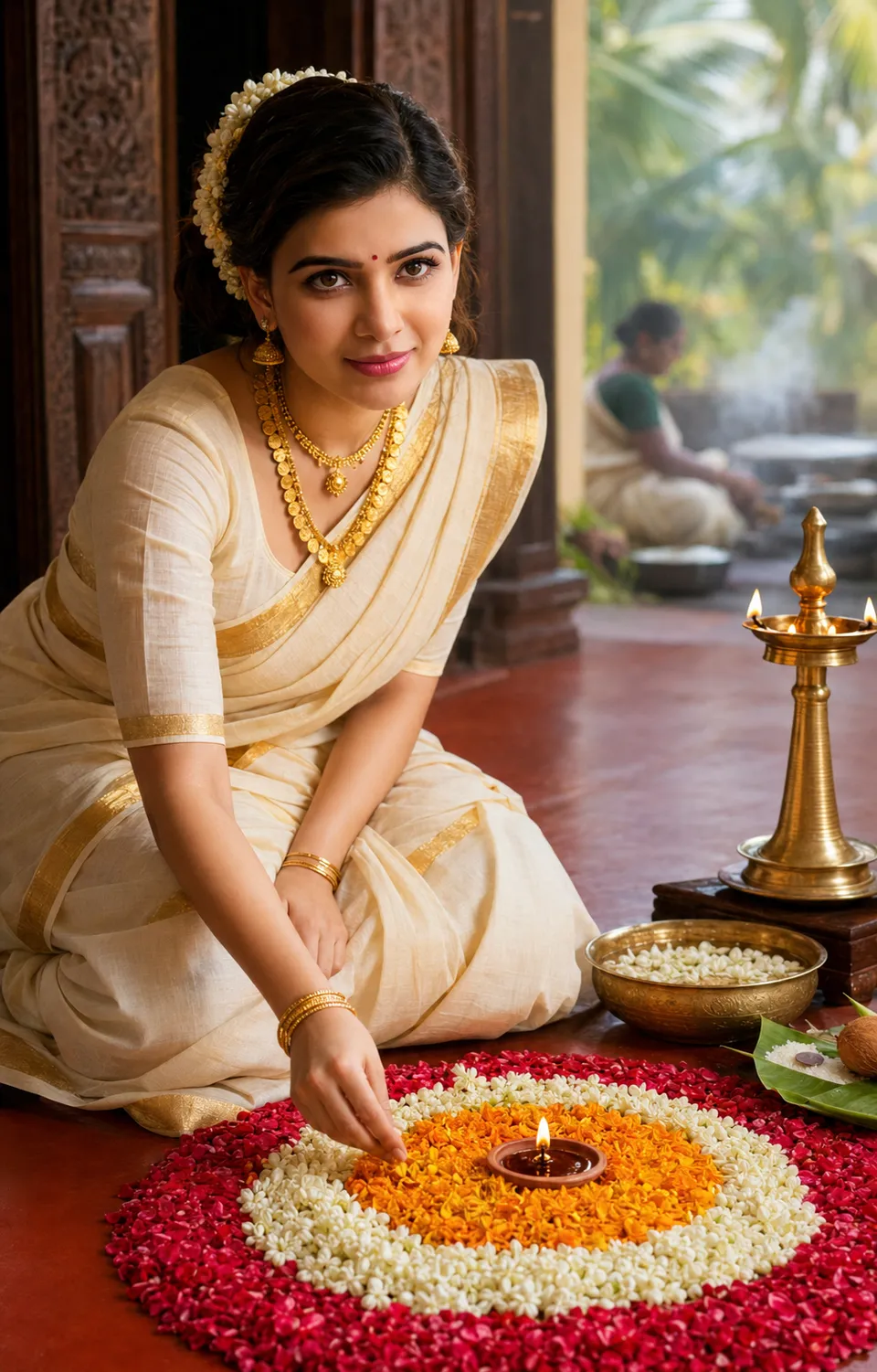
A serene portrait captures a woman adorned in a traditional kasavu saree, standing beside a vibrant pookalam during the Onam festival. The warm morning light enhances the intricate details of her attire and the floral arrangement, creating a joyful and culturally rich atmosphere.
A single 4:5 vertical photograph captured on the morning of Thiruvonam — the main day of the Kerala harvest festival of Onam — in a traditional Kerala home or temple courtyard. The time is around 8:30 a.m. The subject is the person in the uploaded photograph, photographed in or beside the *nadumuttam* (central courtyard) of a *nalukettu* home, or alternatively beside the *pookalam* (flower carpet) at the front doorstep.

LOCK from the upload: the entire face — eye shape and spacing, exact eye colour, nose bridge and tip, lip shape, eyebrows, jawline, chin, hairline, ear shape, skin tone, every visible mole, freckle, scar, or beauty mark. Also the natural hair — its actual colour, texture, length, density, and natural growth pattern. The hair will be styled for the scene (see below) but the hair itself is hers. Render imperfections that are in the upload; do not invent.

REPLACE from upload: any earrings, necklaces, bangles, nose pins, rings, hair ornaments, or other jewelry visible in the uploaded photograph are NOT carried over. They are entirely removed and replaced with only the scene-appropriate Kerala-traditional jewelry described below. Whatever is in the upload is irrelevant to the rendered image's jewelry; the scene's specifications win.

Wardrobe — the traditional Kerala Onam kasavu set:
A *kasavu mundu-veshti set* (the Kerala traditional two-piece saree) in pure cream-white handwoven cotton with the iconic broad *kasavu* zari border in pure gold thread — the border is approximately 3-4 inches wide at the lower edge with the gold woven in a delicate temple-pattern or simple geometric design. The blouse is a matching cream-white cotton with elbow-length sleeves and a simple round neckline, with a small matching kasavu border at the sleeve cuffs and the neckline. The fabric drapes naturally with the slight body of real handloom cotton — visible drape, small natural creases at the pleats, the gold thread of the border catching the light. The saree is draped in the traditional Kerala *Mundum Neriyathum* style — the lower piece (mundu) wrapped from the waist down, the upper piece (neriyathu) draped over the left shoulder with the pallu falling down the back.

Scene jewelry (this entirely replaces anything in the upload):
— Earrings: traditional Kerala gold *jhumkas* in a smaller, more refined size than North Indian ones — bell-shaped with a small pearl or red coral drop at the bottom, antique-gold finish. The jhumkas should look like family heirloom Kerala jewelry, not modern costume.
— Necklace: one or two layered Kerala gold pieces — a simple *kasu mala* (gold coin necklace with small medallion-shaped coins) closest to the throat, perhaps with a slightly longer *manga malai* (mango-shaped pendant necklace) below it. The gold is matte-warm with a slight patina.
— Bangles: a small stack of plain gold bangles on each wrist — three to four per side — the simple thin Kerala gold bangles, no stones, no elaborate design.
— Hair ornament: a string of fresh white jasmine flowers (*mulla poo*) woven around the bun or braid at the crown of the head — fresh, fragrant, visibly real flowers with small green stems and unopened buds among the open ones.
— Forehead: a simple round red bindi at the centre of the forehead — small, traditional, just a dot — not the elaborate Bharatanatyam-stage bindi or the heavy bridal kind.
— Nose: no nose ring or nose pin unless culturally traditional to her specific community.

Hair styling (using the natural hair from the upload):
The natural hair pulled back and gathered into a low traditional Kerala bun (*kondai*) at the nape of the neck, with the jasmine garland woven around it. The hair is centre-parted with the parting visible from forehead to crown. A few small loose strands at the temples and the hairline framing the face naturally — not perfectly slicked back, but neatly oiled (the slight sheen of traditional coconut oil).

Pose and composition — the Onam morning moment:
The subject is standing or seated near the *pookalam* — a large circular flower carpet that has been arranged at the courtyard floor or just inside the front doorstep. The pookalam is approximately three to four feet in diameter, composed of concentric rings of fresh flowers: marigold orange at the centre, jasmine white in a ring around it, rose petals red in the outer ring, with a small terracotta lamp (*nilavilakku*) lit at the very centre. The pookalam is the bright anchor of the lower half of the frame.

The subject is angled toward the pookalam, either:
(a) seated cross-legged on the floor beside it, leaning slightly forward, one hand reaching out to gently adjust a few flowers — caught in the gesture;
(b) standing beside it with both hands joined in a *namaskaram* (greeting gesture), looking down at the flowers;
(c) walking past it toward the camera with the pookalam to one side, having just lit the central lamp, with one hand still slightly extended toward the lamp.

The model picks whichever moment works best for the upload's face. The body is relaxed, the spine straight, the shoulders open. There is a quiet purposeful grace to the body language — this is a familiar morning routine, performed with care.

Expression: a peaceful contentment — the small inner warmth of someone who has just completed a ritual that matters to them and is in the middle of the most joyful day of their year. A small natural smile if the upload's resting face supports it, otherwise a quiet calm expression. Eyes either looking down at the pookalam or up at the camera with a gentle acknowledgement. Not a wide camera-smile; the smaller, more genuine smile of someone present in their own moment.

Setting — the Kerala home or courtyard:
The architectural and environmental details that anchor this as Kerala:
— Behind the subject, partially visible: the red oxide floor of a traditional Kerala home (the polished red lateritic floor that is the signature of Kerala domestic architecture).
— A wooden carved door or doorframe in the dark teak wood of Kerala homes, perhaps with traditional carvings.
— The central courtyard's opening to the sky visible at the upper edge if the subject is in a *nalukettu* — a clear morning sky.
— A brass *nilavilakku* (multi-tiered standing oil lamp) lit on a small wooden platform beside the pookalam.
— A small brass *uruli* (shallow ceremonial bowl) filled with water and floating jasmine flowers nearby.
— A small banana-leaf-wrapped offering visible at the edge of the pookalam — coconut, rice, and a coin.
— In the soft-focus background: hints of the kitchen activity beyond — perhaps a glimpse of the steam from cooking, a glimpse of a banana-leaf being prepared for the *sadya* meal, an elderly female relative just visible making preparations.
— Outside through any visible window or open door: green coconut palms, the soft tropical morning light, perhaps a small backyard with banana plants.

Light — Kerala mid-morning, soft and warm:
— The primary light source is the soft directional morning sunlight coming through the open courtyard or the open front door — a single warm directional ambient at around 4500K. The light is *humid* — the slight haze of Kerala's coastal morning air softens the contrast.
— A secondary contribution from the lit brass lamps in the courtyard — warm 2200K, providing accent warmth in the lower edge of the frame and on the side of the face closest to the pookalam.
— A tertiary very subtle bounce from the red oxide floor — adding a faint warm uplight that catches the underside of the chin and the lower jaw.
— The contrast across the face is gentle but present — about three-quarter stop between lit and shadow side. Soft, not flat.
— Catchlights in the eyes from the morning sun above and the lamp on one side.

Atmospheric detail:
— Light morning mist or warm haze in the air, especially visible where shafts of sunlight come through the courtyard.
— A small wisp of incense or *agarbatti* smoke visible in the air rising from somewhere out of frame.
— The slight visible humidity of Kerala mornings — a faint sheen on the lit surfaces.

Camera language: a 50mm prime lens at f/2.5, shot on a full-frame digital body, processed with the warm-natural colour science of contemporary Indian editorial photography (think *The Voice of Fashion* feature on Kerala traditions, or *Vogue India*'s Onam features). ISO 400, available light only, no flash. Subject distance roughly two metres. Three-quarter framing — from above the head with small headroom to mid-thigh, showing the kasavu border at the bottom of the saree and the pookalam in the lower frame.

Colour treatment: warm cream and gold dominate the palette, with the pookalam's flowers (marigold orange, jasmine white, rose red) providing the saturated colour anchors. Skin tones true to the upload, warmed slightly by the morning light. The kasavu gold catches and reflects without going hot. The red oxide floor reads as a deep warm red-orange. The greens of any visible foliage are saturated but not Photoshop-bright.

Skin handling: pores visible across the face — the soft directional natural light reveals texture beautifully. Individual eyelashes resolved. Small natural sheen on the cheekbones from the morning humidity (very subtle). The slight warm-coral flush at the cheek-tips that warm climates produce. The natural eye-bag area visible if present in the upload (do not erase). The jasmine garland's individual flowers crisply rendered with their small green stems showing.

Aspect ratio 4:5 vertical. No text, no caption, no festival name overlay, no border, no watermark.
This image was generated with AI.
About this look
Captured in a vertical format, this artwork emphasizes the beauty of tradition through its meticulous details. The soft, warm morning light bathes the scene, highlighting the delicate textures of the kasavu saree and the intricate patterns of the pookalam. The subject's relaxed pose, whether seated or standing, showcases a natural grace, with gentle shadows adding depth and warmth. The framing includes elements of a Kerala home, enhancing the cultural context with elements like the red oxide floor and traditional wooden doors.
This portrait is ideal for celebrating Onam, making it a cherished keepsake for family gatherings or social media sharing. Its photorealistic style allows for a personal touch, capturing not just the attire but also the essence of the festival. Perfect for women looking to commemorate their heritage, it serves as a beautiful reminder of the rituals and joy associated with this harvest festival.
How to use this prompt
To create a compelling image, upload a clear photograph of the subject's face, ensuring all facial details are visible. The result will feature them in a kasavu saree and traditional Kerala jewelry, styled with a jasmine hair ornament. Expect the final piece to have a 4:5 aspect ratio, capturing the serene ambiance of Onam. If the lighting or colors appear off, adjust the warmth settings in your editing tool for a more authentic look.
Tips to customize it
- Adjust the color of the pookalam flowers for a unique touch, perhaps incorporating different hues of marigold or rose.
- Experiment with the pose by choosing either a seated or standing position to convey different moments of the Onam celebration.
- Choose a backdrop that reflects the traditional Kerala architecture for authenticity, like a nalukettu or a serene courtyard.
- Modify the jewelry details to personalize with specific familial styles or preferences for added significance.
More like this

Prompt Deck
Free on Google Play
Take the whole deck with you
Browse thousands of AI image prompts, customise them with your own details, and create — all from the Prompt Deck app.
- Tap to customise & copy
- Save your favourites
- Fresh prompts daily