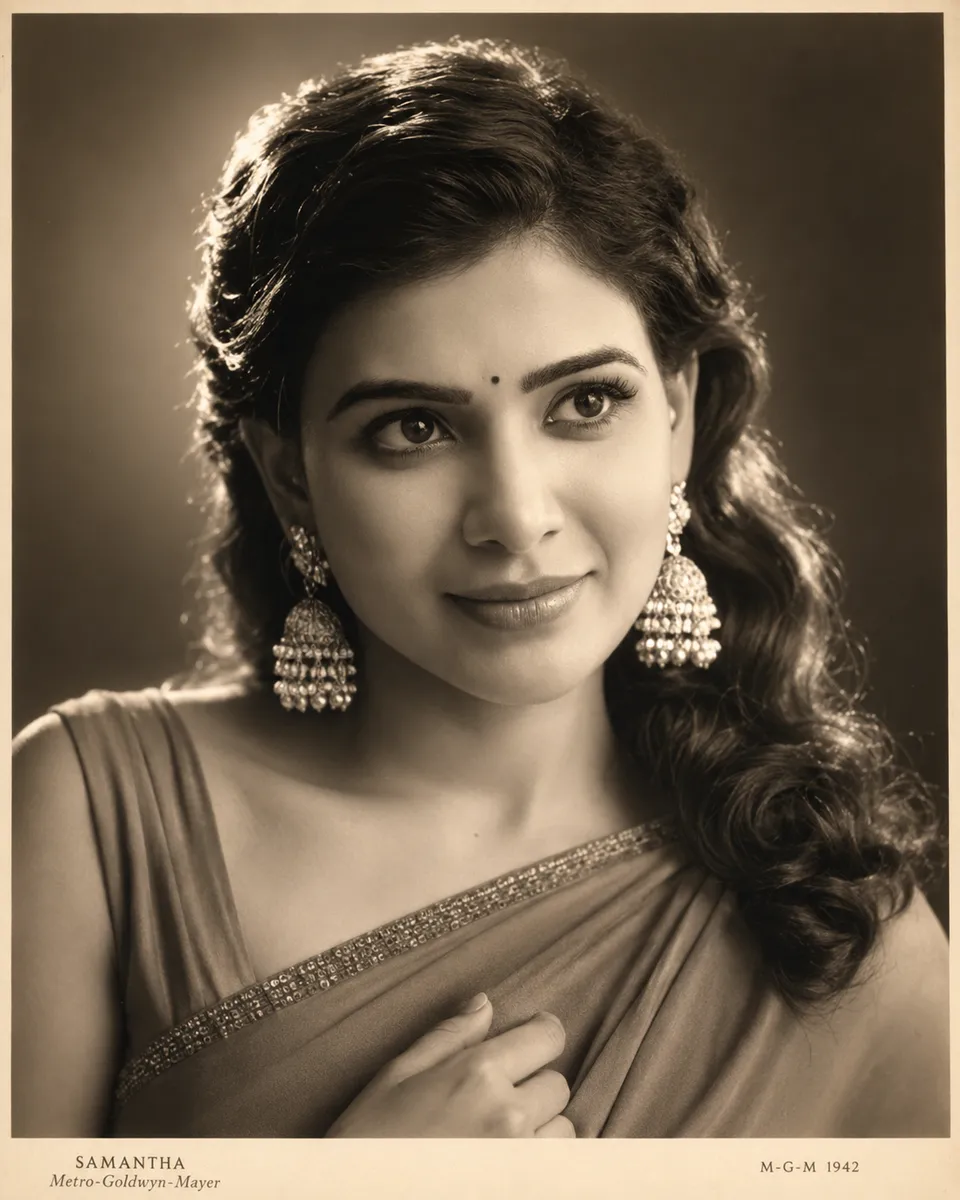
 AI-generated
AI image prompt
Old Hollywood, 1942
Soft, sepia-toned lighting envelops the subject in a nostalgic aura, reminiscent of classic 1940s glamour photography. The image captures a striking male portrait styled with meticulous detail, featuring a tailored suit and a composition that exudes timeless elegance and charisma.
A single 4:5 vertical photograph, presented as a 1942 MGM studio publicity still — a silver gelatin print on fibre paper, lightly sepia-toned with age, the kind of glossy 8x10 a fan might have received in the mail after writing to the studio. The subject of the portrait is the person in the uploaded photograph, photographed in the Clarence Sinclair Bull tradition of MGM glamour portraiture.

Face — the immovable centre. Carry over from the upload, intact and unstylised: the exact eye shape and spacing, the actual eye colour (which in monochrome will read as a specific luminance — not a generic dark glamour eye), the nose bridge profile and tip, the lip shape and natural fullness, the jawline, the chin shape, the hairline, the ear shape if visible, the skin tone (translated into monochrome through luminance rather than hue), and every visible mole, freckle, scar, or beauty mark. Render what is present in the upload; do not invent. Importantly: do not narrow the face into a 1940s Hollywood ideal, do not arch the eyebrows past where they are in the upload, do not redraw the lip line, do not slim the nose. The glamour comes from the lighting and the styling, not from altering the face. A Golden Age studio could make any face beautiful; the genre's whole power was that it didn't change who you were, it changed how you were lit.

The hair, the makeup, the wardrobe — the three things this era built carefully:

Hair (feminine subject): set in soft finger-waves close to the temple on one side, with a controlled curl falling over the opposite shoulder. The hair is shaped, not piled — sculptural rather than voluminous. Single defined parting on the side, no fringe.
Hair (masculine subject): hair brilliantined back smoothly with a single-pronounced left part, the front section sculpted into a slight wave above the forehead. The sides combed close to the head. The era's pomade gives it a controlled wet-shine.

Makeup (feminine): the specific Max Factor 1942 face — a translucent foundation that lets the actual skin tone read through, a single darker-than-neutral lip in a deep painted shape (the era's "bow lip" — natural lip line emphasised, not a hard cupid's bow), a soft eyebrow drawn with definition along the natural shape, light eye shadow in the crease, and lashes lengthened with mascara but not exaggerated. Importantly: this is *photographic makeup*, designed to read under hot studio lights and disappear in the final print. Subtle, not heavy.
Makeup (masculine): only what the era's male actors wore — a faint matte powder to control shine, the brow slightly defined, nothing else.

Wardrobe (feminine): a single piece — either (a) a heavy silk evening gown in bias-cut crepe, a colour that reads as deep mid-tone in monochrome (emerald, sapphire, or burgundy), draped at the shoulder, with one cascading fold of fabric falling across the bodice; or (b) a tailored white silk blouse with a high neck and softly gathered shoulders, open at the throat, paired with a long string of pearls knotted at chest-level (the Lana Turner look). Pick whichever the model judges as reading stronger against this face and the lighting. No prints, no patterns, no metallic shine on fabric.
Wardrobe (masculine): a sharply tailored 1940s dark double-breasted suit with peaked lapels, white shirt with a stiff collar, dark tie with a small Windsor knot, a folded white pocket square just visible at the breast pocket. A small white carnation at the lapel if the model wishes — at its discretion.

Jewelry (feminine): one strand of cultured pearls, OR a single Art Deco brooch at the shoulder, OR a single jewelled earring visible on the side closer to the camera. Never more than one piece. The era's restraint.

Pose: three-quarter angle, the subject facing thirty degrees off-axis with the head turned slightly back toward the lens. The shoulder closer to the camera is dropped a quarter-inch lower than the far shoulder. The chin is *just* lifted — not posed-up like a modeling angle, but raised the slight amount the era's glamour photographers always asked for. One hand may be visible at the lower edge of the frame, resting against the upper chest or the side of the face — at the model's discretion, but only one hand and not bringing attention to itself.

Expression — the specific Old Hollywood mood: a slight upturn at the corner of the mouth, neither a smile nor a smoulder, the look of someone who has been told three times to "give me thoughtful" and on the fourth try has finally relaxed into it. The eyes are returning to the lens with the steadiness of someone who knows they will be looked at. Mouth softly closed unless the upload's resting face carries an open small smile — in which case preserve it.

Light — the Hollywood three-point system of the era, made precise:
— Key light from camera-left at thirty degrees off-axis, fifteen degrees above eye line. A 1000W tungsten Fresnel narrow-focused to a hard light, partially diffused through a single layer of silk in front of the lens. The shadow under the nose is a clean short triangle. The shadow on the far side of the face is one and a half stops below the key — deep, but with form visible inside.
— Fill light from camera-right at sixty degrees, soft and broad, half the intensity of the key. Just enough to keep the shadow side from going black.
— Hair light from above and slightly behind, throwing a controlled highlight along the top of the hair, separating it from the dark backdrop. This light is one of the era's signatures — the bright halo along the hair is what makes a Hollywood still read as a Hollywood still.
— Optional: a kicker light from camera-right behind, painting a thin rim along the cheekbone or the shoulder. The model decides if it serves the face.

Background: a graduated dark backdrop — deepest at the lower edges, lifting slightly to a mid-grey at the upper centre behind the head. Painted muslin or a hand-airbrushed canvas backdrop, the texture barely visible. No environmental cue — no chair, no flowers, no architectural detail. The era's portraits placed the subject in pure tonal space.

Surface and tonality — this is where the era's photographs sit:
— Render as a silver gelatin contact print on heavy fibre paper, lightly sepia-toned (warm-tone developer or a light selenium tone over the years), photographed straight-on under museum-grade even lighting.
— The tonal range carries the image — deep velvet shadows that are not pure black, brilliant highlights that are not pure white, and a vast graduated mid-tone in between. Specifically: the deepest shadow under the jaw at Zone II, the brightest highlight on the cheekbone at Zone IX, with the face occupying the full middle range. Nothing crushed, nothing blown.
— Visible fine grain — the controlled grain of medium-format Plus-X or Tri-X film at box speed, photographed on an 8x10 plate camera and contact-printed. Not the heavy grain of pushed film, not the grainless smoothness of digital.
— Slight age signature: a very faint warmth across the whole image from the paper's natural ageing, a barely-perceptible slight loss of contrast in the highlights where the silver has slightly oxidised. Not damage, not stains — just the patina of an eighty-year-old print that has been kept carefully.

Camera language inside the brief: a large-format 8x10 view camera, a single soft-focus portrait lens (a Pinkham & Smith Visual Quality Series IV or a Kodak Portrait f/4.5), the camera positioned roughly two metres from the subject. Slight image softness from the soft-focus lens — not blur, but a gentle bloom in the highlights where the lens deliberately failed to resolve perfectly. This is the Hollywood glamour signature.

Aspect ratio 4:5 vertical. No text on the image, no signature, no studio logo, no border, no caption, no watermark. The image is the print itself, photographed close enough that the paper's edge is not visible.
This image was generated with AI.
About this look
Illuminated by the iconic three-point lighting system, this portrait showcases a key light that captures the subject's features with precision, creating distinct shadows and highlights. The soft fill light balances the shadows, while a gentle hair light accentuates the hairstyle, adding depth and separation from the dark backdrop. The graduated background, transitioning from deep tones to mid-grey, enhances the subject's presence, ensuring the focus remains squarely on the face. The overall composition embodies the essence of Old Hollywood glamour, with a slight upward lift of the chin and a carefully curated expression that invites viewers in without losing the mystery.
How to use this prompt
To achieve optimal results, upload a high-quality photograph of the subject’s face for accurate detailing of features and skin tone. The prompt requires a vertical aspect ratio of 4:5, and you should consider the hairstyle, wardrobe, and expression to align with the Old Hollywood aesthetic. Fine-tune the lighting options if the highlights or shadows appear too harsh or soft, ensuring a balanced tonal range that captures the vintage essence.
Tips to customize it
- Choose a deep emerald or burgundy for the wardrobe to enhance the monochrome effect.
- Ensure the hair is styled in soft waves or a slick back for authenticity.
- Opt for a slight smile or neutral expression that embodies thoughtful elegance.
- Set the background to a graduated dark tone for a classic portrait feel.
More like this

Prompt Deck
Free on Google Play
Take the whole deck with you
Browse thousands of AI image prompts, customise them with your own details, and create — all from the Prompt Deck app.
- Tap to customise & copy
- Save your favourites
- Fresh prompts daily