 AI-generated
AI image prompt
Navaratri Kolu, the Third Evening
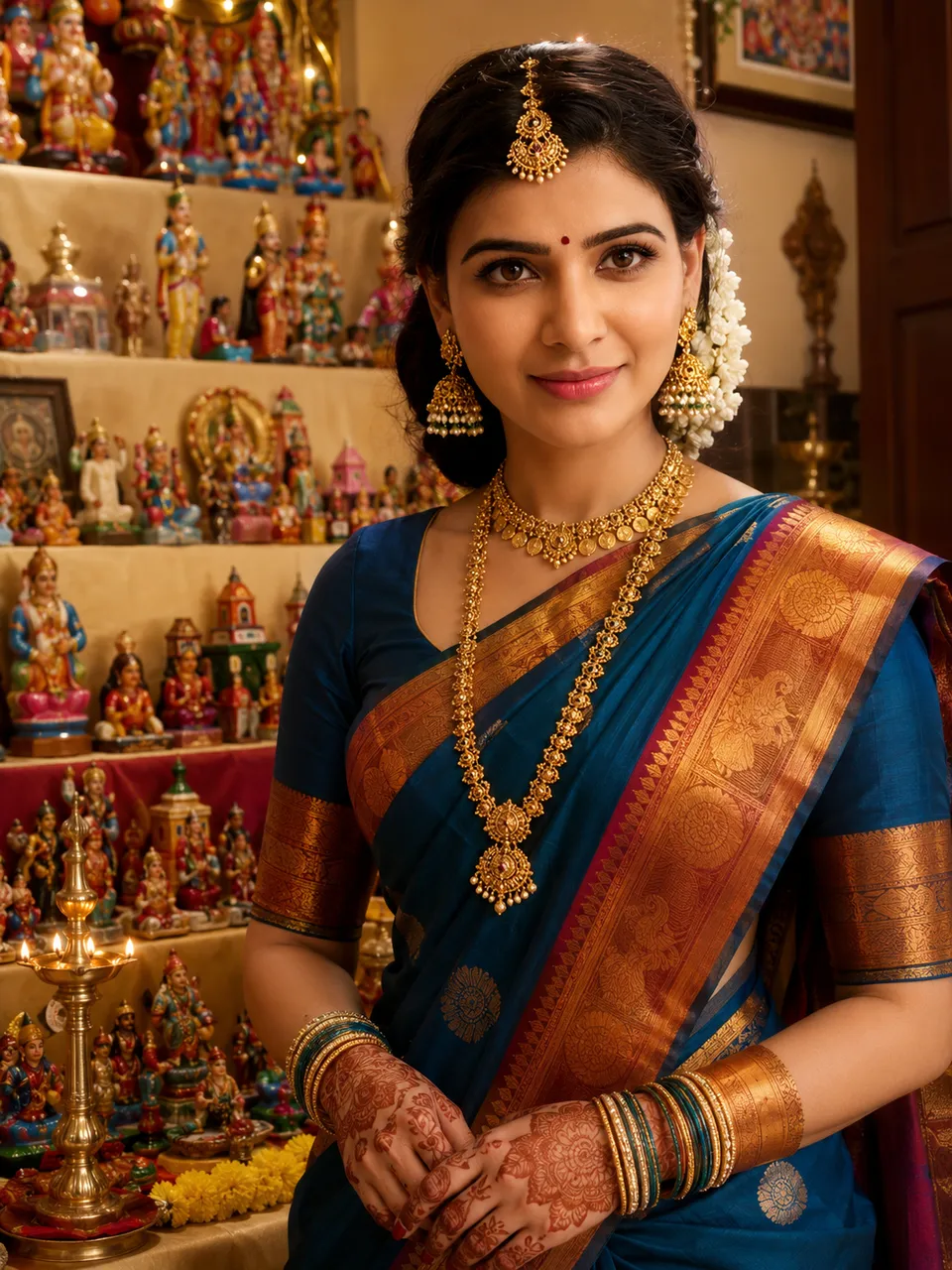
Captured during the Navaratri Kolu, a woman in a vibrant silk saree stands in a warmly lit traditional Tamil home, embodying the spirit of hospitality and celebration. The image conveys a rich cultural heritage, showcasing intricate jewelry and the festive decor of the Kolu display, all set against a cinematic backdrop.
A single 4:5 vertical photograph captured during the Navaratri Kolu — specifically on the third evening of the nine-night festival (around the day of Saraswati Puja or Durga Puja) at approximately 7:30 p.m. The setting is the inner room or living area of a traditional Tamil home where the Kolu is displayed. The subject is the person in the uploaded photograph, captured in the Kolu room.

LOCK from the upload: the entire face — eye shape and spacing, exact eye colour, nose bridge profile and tip, lip shape and natural fullness, eyebrow shape, jawline, chin shape, hairline, ear shape, skin tone, and every visible mole, freckle, scar, fine line, or beauty mark. Also the natural hair — actual colour, texture, length, density. The hair is styled traditionally for the festival. Render imperfections that are in the upload; do not invent.

REPLACE from upload: any earrings, necklaces, bangles, rings, nose pins, or other jewelry visible in the uploaded photograph are NOT carried over. They are removed entirely and replaced with the Tamil Navaratri-festive jewelry described below.

Wardrobe — Navaratri Kolu festive saree:
A traditional Tamil silk saree appropriate to Navaratri evening — festive, jewel-toned. Pick ONE:
— A deep peacock-blue Kanjeevaram silk with saffron-and-gold border and traditional weave patterns.
— A deep emerald-green Kanjeevaram with deep red-and-gold border.
— A deep saffron-orange Kanjeevaram with deep maroon-and-gold border.
— A rich mustard-yellow Kanjeevaram with deep purple-and-gold border.
— A deep wine-burgundy Kanjeevaram with cream-and-gold border.

(NOTE: Navaratri has specific colour rotations for each day — but this prompt simply picks a festive jewel-tone appropriate to a Tamil Kolu evening.)

The blouse: a matching deep-colour silk blouse with three-quarter sleeves and a modest neckline. The saree drapes in the traditional Tamil-Brahmin style — pallu pinned at LEFT shoulder.

The fabric is *real Kanjeevaram silk* with visible weave. The saree is the wardrobe of welcoming-visitors-to-Kolu, festive and proper.

Scene jewelry (replaces anything in the upload — Tamil Navaratri festive):
— Earrings: substantial heritage Tamil *jhumkas* in antique gold with small pearl drops.
— Necklace: layered Tamil heritage set — a *kasu mala* close to the throat, plus a longer *manga malai* at mid-chest. Two layered pieces.
— Bangles: a substantial stack on each wrist — six to eight gold bangles per side, plus a few thin glass bangles in colours matching the saree.
— Maang tikka: a heritage gold maang tikka at the centre parting.
— Bindi: a large round red bindi at the centre of the forehead, possibly with small white *gobi* dots around it.
— Hands: rich red-brown traditional mehndi on both hands — applied for the festival.
— Hair: a fresh jasmine garland (*malli poo*) woven around the bun.
— Toe rings — visible if framing supports.
— NO nose ring (Tamil Brahmin tradition).

The jewelry register is *Tamil Navaratri-festive* — substantial heritage, festival-appropriate.

Hair styling (using natural hair from upload):
The natural hair smoothly oiled, centre-parted, gathered into a low traditional bun (*kondai*) at the nape with the fresh jasmine garland woven around it. The hair has festive-precision styling.

Pose and composition — the Kolu room moment:
The subject is in the Kolu room. The model picks ONE moment:

(a) Standing beside the Kolu — body angled slightly toward the Kolu (which is visible to one side of the frame), one hand gesturing toward the display, head turned to camera with a soft welcoming smile. The "this is our Kolu" moment.

(b) Seated on a small low stool in front of the Kolu — body facing the Kolu but turned partially to the camera, perhaps with a small brass plate of sundal in front of her, ready to offer to visitors. The hostess-with-the-tray moment.

(c) Bent slightly forward to adjust a figurine on one of the lower steps — body engaged with the Kolu, head turned slightly to the camera. The Kolu-tender-care moment.

(d) Standing in *namaskaram* (hands joined in welcome) in front of the Kolu — the traditional welcoming gesture as a visitor enters, body angled, head slightly bowed but eyes meeting the camera. The welcoming-the-visitor moment.

The body language is *festival-hostess-warm* — engaged, present, the slight pride of someone showing the family's heritage display.

Expression — Kolu-evening warmth:
A genuine warm welcoming expression — the soft hospitality of a Tamil woman welcoming Kolu visitors. The expression is *open and present* — the small smile of someone happy to have visitors and happy to show the family's traditions.

Eyes meeting the camera with warmth — alive with the festival energy. A small natural smile, possibly slightly wider than the everyday smile.

Setting — the Kolu room:
The environmental anchors:
— The Kolu itself — the dominant visual feature of the room:
  • A stepped display of 7 or 9 wooden steps, covered with a clean cotton or silk cloth (often saffron, deep red, or cream).
  • Each step has carefully-placed figurines.
  • Common Kolu figurines: small clay or wooden dolls of Hindu deities (Krishna, Rama, Lakshmi, Saraswati, Durga, Ganesha), miniature scenes (village scenes, marriage scenes), traditional dolls (the *Marapaachi* couple — wooden bride-and-groom doll, the family heirloom), small wooden animals, miniature musical instruments, miniature household objects.
  • Some figurines are ninety years old (passed down four generations) and have the patina of heritage — slight wear, slight age, original paint colours.
  • The topmost step (the most sacred) has the principal deity (Saraswati for Saraswati Puja day, Durga for Durga Puja day, Lakshmi for Lakshmi Puja day).
— Around the Kolu:
  • A lit brass *kuthuvilakku* (oil lamp) at the base — the lamp lit for the evening's offerings.
  • A small wooden table or platform with a tray of *sundal* (lentil-coconut snack), a small bowl of *tamboolam* items (betel leaves, areca nut, small fruits, a small gift for visitors).
  • A small framed *Mother Goddess* image or a *Kalasham* (decorated water pot) at the side.
  • A few fresh flowers arranged in a small brass bowl.
  • A small carpet or rangoli (kolam) drawn on the floor at the base of the Kolu display.
— The room setting: a traditional Tamil home interior with carved wooden door frames, painted walls, perhaps a wooden floor or red oxide floor. Warm-coloured curtains. Soft warm interior lighting.
— A glimpse of another room visible at the edge of the frame — perhaps the kitchen where the next snack is being prepared.

Atmospheric details:
— Warm haze in the air from the lit lamps and the warm room.
— Thin column of camphor or incense smoke rising from the puja area.
— A few marigold or rose petals scattered on the floor near the Kolu.
— The slight smell-suggestion of *sundal* and warm spices.

Light — Kolu room evening:
— Primary: the warm brass oil lamps lit around the Kolu and the room — warm 2200K-2700K from multiple points.
— A secondary warm key light from a small pendant lamp overhead.
— A tertiary contribution from any visible candles or *agarbatti* (incense holders).
— Catchlights in the eyes from the multiple warm light sources.
— The gold of the jewelry and the saree's zari catches multiple lights.

The face is *well-lit with multiple warm sources* — multi-key warm illumination. The contrast across the face is gentle.

Camera language: a 50mm prime lens at f/2.0, shot on a full-frame digital body, processed for warm filmic skin tones — the colour science of Tamil home-festival photography. ISO 1600, available warm light. Subject distance roughly two metres. Three-quarter framing — top of head with small headroom to mid-thigh, including the Kolu display in the side or background.

Slight handheld feel — the photographer is in the home moving with the family.

Colour treatment: deeply saturated Tamil-festive palette. The deep saree colour, the warm lamps, the colourful Kolu figurines, the cream cotton steps. Skin tones true to the upload, warmed by the lamps. The image is *Navaratri-Kolu-warm* — alive with the festival.

Skin handling: pores visible. The slight natural sheen from the warm room. Individual eyelashes resolved. The mehndi pattern crisp. The jasmine in the hair real. The Kolu figurines in the background fully visible with their colourful traditional paint.

Aspect ratio 4:5 vertical. No text, no caption, no festival name overlay, no border, no watermark.
This image was generated with AI.
About this look
The traditional Tamil silk saree, adorned with a rich jewel tone and intricate patterns, acts as a centerpiece in this portrait. Styled in the classic Tamil-Brahmin drape, with the pallu pinned elegantly, it highlights the subject's grace. The layered jewelry, including heritage jhumkas and a maang tikka, complements the vibrant saree while the warm, multi-source lighting enhances the festive atmosphere. The composition captures the subject's welcoming demeanor, framed to include the Kolu display, which serves as both a focal point and a cultural symbol of the festival.
This image is perfect for sharing during the Navaratri season, celebrating the rich traditions of Tamil culture. It suits occasions where heritage and family gatherings are highlighted, such as community events, social media posts, or personal albums documenting the festival's spirit. The warm hospitality reflected in the subject's expression makes it ideal for inviting viewers into the intimate setting of a Tamil home during this nine-night celebration.
How to use this prompt
Supply a clear portrait photo for the subject, ensuring the entire face is visible as the prompt locks specific facial features. Choose a festive saree color from the options provided and consider the pose you want to capture—whether standing, seated, or in a welcoming gesture. The final image should depict a warm, inviting atmosphere with the Kolu display visible, embodying the essence of the festival. If the lighting appears too harsh or flat, adjust the warmth or exposure settings in the image processing.
Tips to customize it
- Select a deep peacock-blue saree for a striking contrast against warm backgrounds.
- Consider an angle that captures both the subject and the Kolu display for a richer narrative.
- Use warm lighting sources to enhance the festive atmosphere and create depth in skin tones.
- Incorporate a few decorative elements like fresh flowers or a brass plate of sundal for added authenticity.
More like this

Prompt Deck
Free on Google Play
Take the whole deck with you
Browse thousands of AI image prompts, customise them with your own details, and create — all from the Prompt Deck app.
- Tap to customise & copy
- Save your favourites
- Fresh prompts daily