 AI-generated
AI image prompt
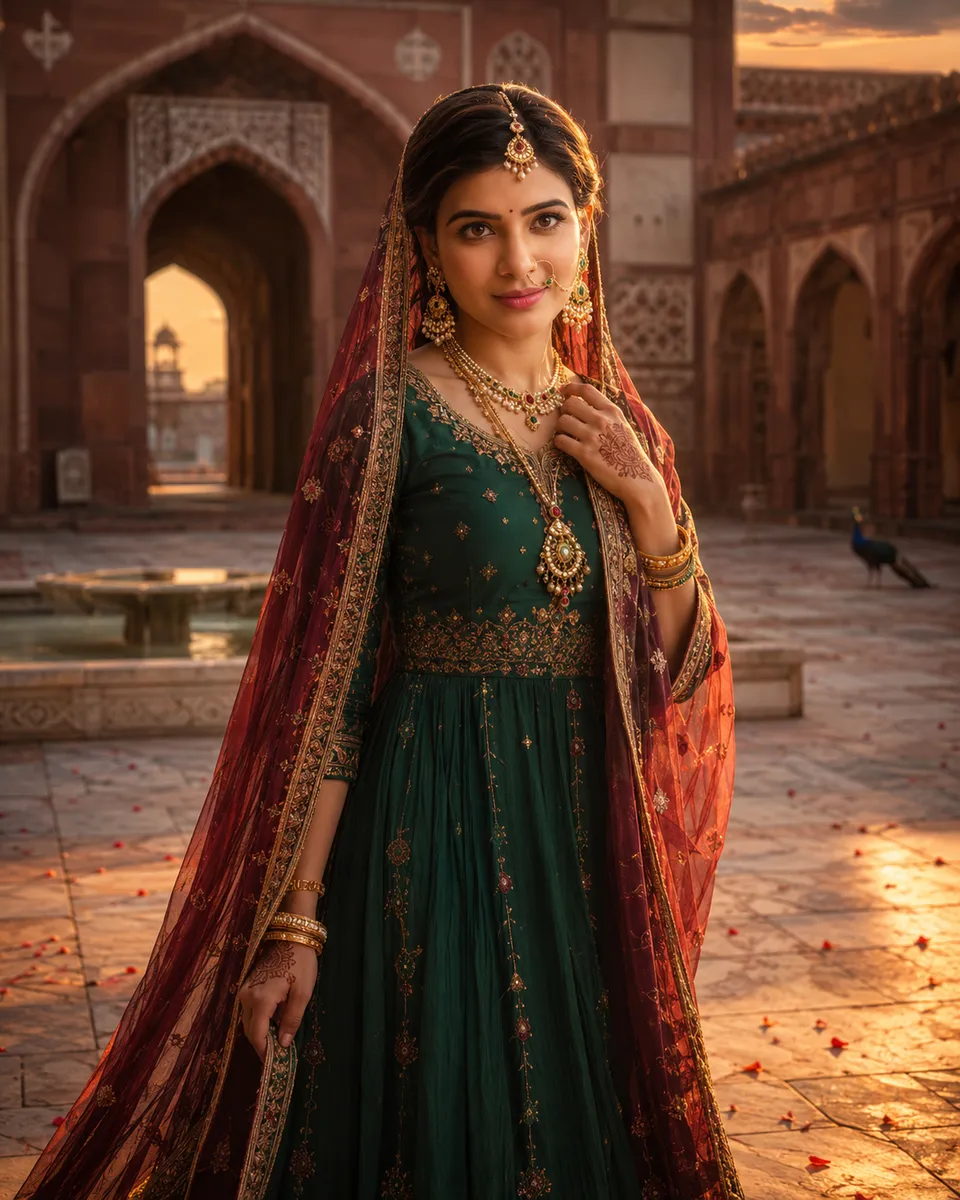
Mughal Garden, Anarkali at Dusk
In the serene inner courtyard of a Mughal-era garden, a woman stands gracefully at dusk, surrounded by intricate sandstone arches and soft floral details. Dressed in a luxurious anarkali, she embodies elegance with a poised expression, evoking the rich heritage of Mughal aesthetics during the golden hour.
A single 4:5 vertical photograph captured at dusk (around 6:15 p.m. in November) in the inner courtyard of a Mughal-era garden tomb or palace — specifically a setting like Humayun's Tomb in Delhi, the inner courtyard of the Taj Mahal complex in Agra, or a heritage hotel built in the Mughal architectural style (Umaid Bhawan, Rambagh Palace). The subject is the person in the uploaded photograph, photographed alone in the courtyard.

LOCK from the upload: the entire face — eye shape and spacing, exact eye colour, nose bridge profile and tip, lip shape and natural fullness, eyebrow shape, jawline, chin shape, hairline (the natural hairline including any small irregularities), ear shape, skin tone, and every visible mole, freckle, scar, fine line, or beauty mark. Also the natural hair — exact colour, texture, length, density. Hair will be styled for the scene; the underlying hair is hers. Render imperfections that are in the upload; do not invent. Critically: do not slim the face into a 'royal' aesthetic, do not enlarge the eyes, do not idealise. The whole power of the image is *her* face in this historic setting.

REPLACE from upload: any earrings, necklaces, nose pins, rings, bangles, bracelets, hair ornaments, or other jewelry visible in the uploaded photograph are NOT carried over. They are entirely removed and replaced with the scene-appropriate Mughal-Indo-Persian jewelry described below. The upload's jewelry has no influence on the rendered image's jewelry; the scene's specifications are absolute.

Wardrobe — couture anarkali at heritage scale:
A floor-length flowing anarkali — the gathered-from-the-bodice, full-bottomed silhouette of the classic Anarkali. Pick ONE specific colour: deep emerald green silk, deep wine-burgundy silk, midnight navy silk, or deep oxblood silk with subtle gold thread work. The fabric is real silk-blend with visible weight and drape — not the synthetic shine of cheap costume. The bodice is fitted, embroidered with fine zardozi or aari work in matching-tone or gold threads, with subtle pearl beading at the neckline. The skirt portion is fully gathered with substantial volume — when she stands still, it falls in soft folds around her; when she moves, it has weight. The sleeves are elbow-length or three-quarter, fitted at the upper arm with subtle embroidery at the cuffs.

Over the anarkali: a long chiffon or net dupatta in a contrasting jewel tone (if the anarkali is emerald, the dupatta is wine or gold; if wine, the dupatta is emerald or cream) — sheer enough to drape elegantly, with fine gold zari at the borders. The dupatta is draped over the head in a soft veil with the corners falling forward over both shoulders, OR draped over one shoulder with the other end held in one hand, the model's choice depending on which complements the upload's face shape.

Scene jewelry (this entirely replaces anything in the upload):
— Earrings: a pair of long Mughal-style *jhumar* earrings or *karanphool* — multi-tiered, dropping below the jawline, in antique gold with small uncut polki stones, ruby or emerald accents matched to the anarkali colour, ending in pearl drops. The earrings are visible and dramatic but not crossing into Theatre territory.
— Maang tikka: a delicate gold maang tikka at the centre parting, with a central uncut polki stone and small pearl drops, the chain disappearing into the hairline. A small piece, refined.
— Necklace: ONE statement necklace — a layered Mughal *jugni* with multiple thin chains and a central pendant with uncut polki and small ruby/emerald accents matching the anarkali colour, falling to mid-chest.
— Bangles: a small set of gold bangles on each wrist — four or five per side — in antique-gold finish, some plain and some with delicate work. No glass bangles for this prompt; the register is heritage-couture.
— Nath (nose ring): a delicate gold *nath* on the left nostril — a small ring with a thin chain extending to the ear's earring (a *naqaab* style) or a simple small ring with a tiny pearl drop. (Note: only include nath if the upload's face supports this addition naturally — for users uncomfortable with rendered nose piercings, this can be omitted as a knob.)
— Hands: subtle mehndi visible — not bridal-dense, but a few elegant motifs at the back of the hands and the fingers, in dark red-brown, as if applied for an upcoming family wedding.
— No rings or only one or two simple ones.

Hair styling (using the natural hair from the upload):
The natural hair pulled back smoothly, centre-parted, and gathered at the back into either:
(a) a low elegant braid (the chestnut-thick *parandi* braid of Mughal-era women) decorated with a small string of pearls or small gold beads woven through, the braid falling down the back; or
(b) a low chignon at the nape with a small fresh gardenia or jasmine flower tucked in.
The hair is smooth and shines slightly with the suggestion of natural hair-oil — not greasy, just the lustrous quality of well-cared-for traditional hair.

Pose and composition:
The subject stands in the centre of the frame, slightly off to camera-right, in the open arched courtyard. Body angled approximately thirty degrees to the camera, head turned slightly back toward the lens. The body language is *graceful stillness* — one hand at the side holding the loose end of the dupatta, the other hand at the waist or resting lightly at the throat near a piece of jewelry. The pose is neither stiff nor fashion-modelled — it is the natural elegant stillness of someone in a beautiful place who has been asked to pose for one moment.

If the model prefers more motion, alternative pose: walking slowly toward the camera, the anarkali skirt visible in soft natural motion, one hand lifting the dupatta away from the body slightly to keep the chiffon moving. The expression and gaze remain the same.

Expression — restrained royal grace:
A small contemplative smile or a serene closed-mouth expression — read the upload. The face holds an interior contentment, not performed warmth and not theatrical drama. The eyes are direct on the camera with the steadiness of someone unhurried. There is the trace of an ancestor's bearing in the face — the calm of someone who knows where she comes from. No teeth-showing smile. No smoulder. The expression is *poised*.

Setting — the Mughal courtyard:
The architectural backdrop is what makes this image work:
— Behind the subject: a large arched sandstone doorway or *iwan*, the elaborate ogee-arch silhouetted against a paler interior beyond it. The sandstone is the rich red-pink of Mughal architecture — not yellow, not orange, the specific Mughal sandstone.
— To one side of the subject: an open colonnade of similar arched doorways receding into the soft-focus distance. The repeating pattern of the arches creates a strong compositional rhythm.
— The floor: a marble or red sandstone tiled courtyard with a geometric pattern, slightly worn from centuries of footfall, with small areas of warmer sandstone-coloured staining where the marble meets the sandstone.
— In the middle distance, slightly out of focus: a small central marble *chahar bagh* fountain feature, with the water surface visible, or a small marble platform.
— Visible at the edges of the frame: small details that ground the architecture — carved lattice screens (jalis), inlaid floral motifs in marble, perhaps a glimpse of an old Persian-style miniature painting or a tile detail.
— In the background: a sliver of evening sky visible above the arches in a deep amber-gold (the dusk sky).

Atmospheric details:
— A few peacock feathers drifting in the air from somewhere out of frame, or a single full peacock visible in the deep background at the edge of the courtyard (small enough to be a detail, not a focal point).
— Soft warm dust drifting in the angled light from the courtyard's open side.
— A few rose petals scattered on the marble floor near the subject.
— The faint scent of incense suggested by a small thin column of smoke rising from somewhere out of frame.

Light — Mughal-courtyard golden hour:
— The primary light source is the late-evening sun coming through the open archways or from the central courtyard's open sky — warm directional at around 3000K (very warm golden hour), at a low angle (about 15 degrees above horizon). The light is *amber* — saturated warm, the colour of the last hour before sunset.
— The light catches the side of the subject closer to the open archway — painting the right cheek, the right shoulder, the front of the anarkali in warm gold. The shadow side falls into rich deep warm shadow with detail still visible.
— A secondary contribution from the warm sandstone bouncing soft warm light onto the underside of the chin and the lower jaw — the architecture itself acts as a giant warm reflector.
— Catchlights in the eyes from the courtyard's open sky — large, warm, slightly elongated.
— The shadows on the marble floor are long and warm — the long shadows of golden hour, falling away from the subject.
— Where the light hits the gold of the jewelry, the anarkali's embroidery, and the dupatta's zari border, those elements *catch fire* in the warm light.

Camera language: an 85mm prime lens at f/2.0, shot on a full-frame digital body, processed for warm filmic skin tones — the colour science of *Vogue India*'s heritage features or Sabyasachi's campaign photography. ISO 400, available light only. Subject distance roughly three metres. Full-length or three-quarter framing — the model picks based on what the upload's face supports best, but generally include enough of the anarkali to show its volume and the architectural setting.

Colour treatment: rich, warm, jewel-toned. The anarkali's deep colour holds full saturation. The sandstone's red-pink reads truly. The gold of the jewelry and embroidery glows warm. Skin tones true to the upload, warmed slightly by the golden hour. The shadows fall warm rather than cool. The colour palette is unified — warm gold, jewel anarkali colour, warm sandstone, deep amber sky.

Skin handling: pores visible across the face — the warm directional light reveals texture beautifully. Individual eyelashes resolved. Fine peach fuzz at the cheek catching the warm rim. The slight natural sheen at the cheekbone, lifted by the warm light. The jasmine flower or pearl in the hair beside the face individually rendered. Mehndi pattern on the back of the hand crisp and visible. The dupatta's chiffon shows its translucent texture with the warm light coming through it.

Aspect ratio 4:5 vertical. No text, no caption, no border, no watermark.
This image was generated with AI.
About this look
Surrounded by the architectural beauty of a Mughal courtyard, the scene captures intricate sandstone arches and a softly lit ambiance as dusk settles. The rich red-pink hues of the Mughal sandstone create a stunning backdrop, while the marble courtyard floor features geometrical patterns, adding depth to the composition. Every detail, from the delicate jhumar earrings to the flowing anarkali, emphasizes heritage and elegance, making the subject the focal point in this cinematic portrayal.
Ideal for personal celebrations, this imagery suits occasions like weddings, anniversaries, or cultural events, providing a timeless representation of grace. It’s perfect for sharing on social media or as a keepsake for families wanting to highlight their heritage or special moments. The blend of history and personal storytelling makes it especially meaningful for those who appreciate cultural richness in their imagery.
How to use this prompt
Upload a clear front-facing photo of the subject, ensuring their facial features are unobstructed and well-lit. The prompt will retain every detail of their face while expecting natural hair styling to be included. Specify a color for the anarkali from the prompt, and be sure to adjust the dupatta style based on the subject's face shape. If the final image looks off, check the lighting and adjust for clarity and richness.
Tips to customize it
- Choose a deep emerald green for a regal look or a deep wine-burgundy for a warm, rich feel.
- Select a low elegant braid adorned with pearls for a traditional Mughal hairstyle.
- Opt for a contrasting dupatta in cream to complement a deep oxblood anarkali.
- Set the aspect ratio to 4:5 for an ideal vertical portrait composition.
More like this

Prompt Deck
Free on Google Play
Take the whole deck with you
Browse thousands of AI image prompts, customise them with your own details, and create — all from the Prompt Deck app.
- Tap to customise & copy
- Save your favourites
- Fresh prompts daily