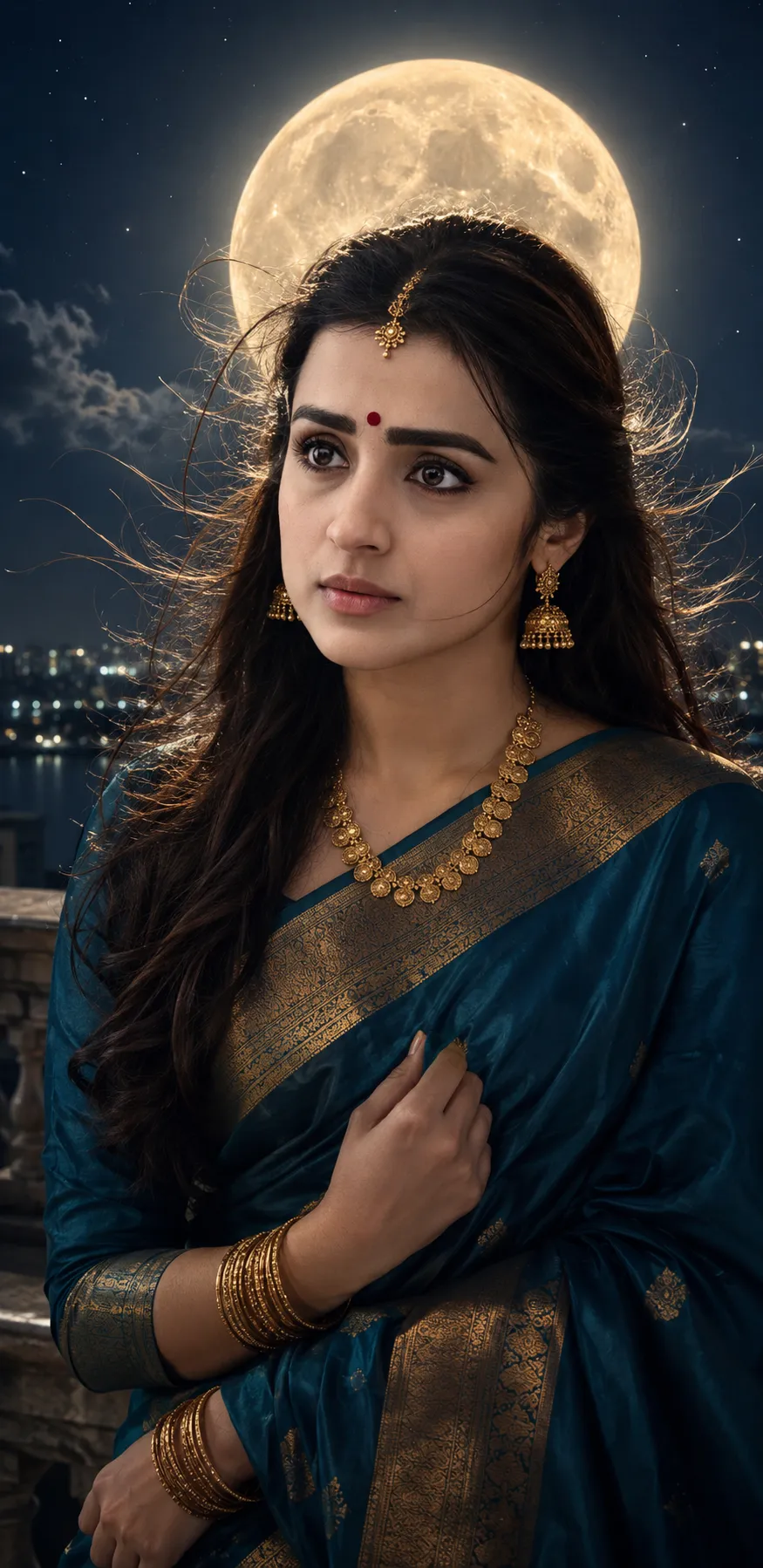
 AI-generated
AI image prompt
Moonlit Goddess, Blue Saree
A serene figure stands against the backdrop of a full moon, embodying the essence of a moonlit goddess in a flowing blue saree. The soft illumination highlights her features while the silk fabric reflects the mystical night atmosphere, evoking a sense of calm and grace.
A single 4:5 vertical photograph in the "moonlit goddess" aesthetic — the subject is the person in the uploaded photograph, captured at night with a full moon positioned directly behind her head (creating a halo composition). The setting is an outdoor location at night — could be a rooftop terrace, an open balcony, a hillside vantage point, or a coastal cliff. The time is around 9 p.m. on a clear full-moon night.

LOCK from the upload: the entire face — eye shape and spacing, exact eye colour, nose bridge profile and tip, lip shape and natural fullness, eyebrow shape, jawline, chin shape, hairline, ear shape, skin tone, and every visible mole, freckle, scar, fine line, or beauty mark. Also the natural hair — actual colour, texture, length, density. The hair will be windswept and lifted by the night air. Render imperfections that are in the upload; do not invent. The moonlit-goddess portrait is most powerful when the face is *real* — render the actual person, just bathed in moonlight.

REPLACE from upload: any earrings, necklaces, bangles, rings, nose pins, or other jewelry visible in the uploaded photograph are NOT carried over. They are removed entirely and replaced with the moonlit-portrait scene jewelry described below.

Wardrobe — moonlit-goddess saree:
A traditional silk saree in deep saturated colour that reads beautifully against the night sky and the moonlight. Pick ONE:

— Deep teal-blue Kanjeevaram silk with deep gold zari border (the most viral colour combination for this genre — teal reads stunningly against the cool-warm moonlight).
— Deep midnight-blue silk saree with silver zari border.
— Deep oxblood-burgundy silk with gold border.
— Deep emerald-green silk with deep red and gold border.
— Deep wine-purple silk with antique-gold border.

The blouse: a matching deep-colour silk blouse with three-quarter sleeves and a modest round neckline. The saree drapes traditionally — pallu pinned at the LEFT shoulder.

The fabric is *real silk* with visible weight and the natural slight lustre that catches the moonlight. The pallu may be in slight motion from the night wind.

Scene jewelry (replaces anything in the upload — moonlit-goddess heritage):
— Earrings: heritage Indian gold jhumkas — moderate size, the kind that catch the moonlight subtly. Or large antique-gold drop earrings. The earrings catch the cool moonlight beautifully.
— Necklace: ONE statement piece — a heritage gold *kasu mala* (coin necklace), or a single substantial gold pendant, or a layered set of two gold chains. The mystical-goddess register calls for present-but-not-overwhelming jewelry.
— Bangles: a moderate stack on each wrist — four to six per side — heritage gold.
— Maang tikka: a heritage gold maang tikka at the centre parting with a small uncut stone — the *moon-tikka* echoing the moon behind the head.
— Bindi: a large round red bindi at the centre of the forehead.
— No nose ring (Tamil tradition).

The register is *moonlit Indian goddess* — heritage substantial, mystical.

Hair styling (using natural hair from upload):
The natural hair worn LOOSE and LIFTED by the night wind:
— Long flowing hair behind and around the shoulders, with substantial wind-motion (the night air has caught it).
— Some strands lifted upward and outward, framing the face and the head.
— A few strands across the cheek or the corner of the mouth — the cinematic windswept detail.
— The hair shows individual strands catching the moonlight (rim-lit by the moon behind).
— The natural texture and colour preserved.

The hair has *motion and presence* — not styled-still, but caught-in-the-night-wind.

Pose and composition — moonlit halo:
The subject is positioned so the full moon is directly behind her head. The model picks ONE moment:

(a) Body angled three-quarter to camera, head turned to camera with the moon perfectly haloed behind the head. The classic "moonlit goddess direct gaze" composition.

(b) Body slightly turned away, head turned back over the shoulder to camera — the dramatic over-the-shoulder moonlit moment.

(c) Body facing camera straight-on, head slightly tilted upward toward the moon (looking up at it), eyes closed in a serene mystical expression. The "communing with the moon" moment.

(d) Body in slight three-quarter, both hands gathered at the chest holding the loose end of the pallu, head turned to camera with the moon directly behind. The traditional-feminine-with-divine-halo composition.

The body language is *grounded grace* — settled, present, with the slight mystical-spiritual quality of standing in moonlight. NOT theatrical, NOT performed.

Expression — moonlit serenity:
A serene direct gaze or a calm closed-mouth expression with a small inward warmth. Read the upload's face — render its most mystical-calm version. The face has the *quiet of being looked at by the moon*.

Eyes either meeting the camera with a steady warm gaze (option a/b/d) or closed/half-closed (option c). Mouth softly closed. The expression is *interior* — the moon's quiet has settled into the face.

Setting — outdoor night:
The environmental anchors:
— The setting is outdoor at night — could be:
  • A rooftop terrace overlooking a quiet city skyline at night (the lights of the city visible far below as small twinkling points).
  • An open balcony or veranda with a sea or river visible behind.
  • A hillside vantage point at night, with the surrounding hills barely visible.
  • A coastal cliff with the moonlit sea visible behind.
— Above and behind the subject: the FULL MOON — large in the composition, positioned directly behind the head as a halo. The moon is bright, cream-pale-gold, with the visible cratered texture (the moon's actual surface). The moon's diameter is large in the frame (about 1.5-2x the size of the subject's head).
— The night sky around the moon — deep navy-blue with a few visible stars and possibly a faint cloud or two near the moon (which would catch the moonlight and glow soft warm).
— Possibly visible: a distant city skyline at the lower edge of the frame, a glimmering body of water reflecting moonlight, a small temple silhouette in the deep background, palm trees as silhouettes against the moonlit sky.
— The ground or terrace surface near the subject — perhaps slightly visible in the lower edge of frame.

Atmospheric details:
— A slight visible breeze in the hair and the pallu.
— Faint mist or atmospheric haze around the moon — the warm halo of moonlight in the night air.
— The slight smell-suggestion of jasmine or sandalwood, conveyed visually through the soft warm atmosphere.
— Possibly a small night-bird visible silhouetted against the moon.

Light — moonlight as halo:
The most important technical element. The lighting is *exclusively moonlight*:
— Primary key: the FULL MOON behind the subject, providing the rim/halo light. The moonlight catches the entire silhouette of the head and shoulders, painting a warm-cool rim along the edge of the hair, the shoulder, the side of the cheek. The moonlight is *bright but cool-warm* — around 4500-5000K (the actual colour of moonlight, which is slightly cool-warm white).
— A secondary fill from the ambient sky — soft cool light filling the front of the face from above. The face is *lit by the open night sky* — not in deep shadow, but softly illuminated by the moonlight scattered in the sky.
— Optional: a small warm contribution from a city's distant lights below or a small lamp out of frame — providing a tiny warm accent on the side of the face for *temperature contrast*.
— The eyes catch the moon directly — large bright cool catchlights from the moon behind the camera-side.
— The skin reads cool-warm — the moonlight tints the skin with the slight blue-cream-pale of moon-light, but the underlying skin tone is preserved.
— The saree's silk catches the moonlight — the silk's surface glows softly where the moonlight catches it.

The light has the *moonlit-goddess* signature quality — cool-warm rim from behind, soft sky-fill from above, the face mystically illuminated.

Camera language: an 85mm prime lens at f/1.8, shot on a full-frame digital body with low-light performance, processed for the cool-warm-mystical colour science of contemporary Indian editorial-cinematic photography. ISO 1600-3200 (the moonlight-only scene requires high ISO), 1/100 shutter (slow enough for the low-light, fast enough to freeze the face).

Subject distance roughly three metres. Three-quarter framing — top of head with small headroom (and the moon visible above) to the upper body, the moon-halo composition centred.

Slight cinematic grain from the high ISO — the noise *contributes* to the mystical-atmospheric quality (do not over-correct).

Colour treatment: deep night palette — saturated navy sky, cool-warm moonlit subject, deep saturated saree colour, deep warm-gold of the jewelry and the moon. Skin tones true to the upload but mystically lit. The image is *night-mystical*.

Skin handling: pores visible. The slight cool-warm rim from the moonlight on the cheekbones. Individual eyelashes resolved. The slight glow on the lit areas. Eyes alive with the bright moonlight catchlights. The natural-looking moonlit skin (slight pale-cool tint, with preserved underlying tone).

Aspect ratio 4:5 vertical. No text, no caption, no border, no watermark.
This image was generated with AI.
About this look
Positioned with the full moon haloing her head, the subject exudes an ethereal quality characteristic of a goddess. The composition captures her in a graceful three-quarter pose, with her head gently turned to the camera, accentuating the delicate draping of her silk saree. The moonlight beautifully illuminates her silhouette, casting a cool-warm glow that enhances the natural texture of her hair and the intricate details of her attire, while the surrounding night sky adds depth with its deep navy hue. The image encapsulates the serene mood of a tranquil night, with wisps of wind lending motion to her hair and saree, further enhancing the dreamlike quality of the scene.
How to use this prompt
Begin with a clear, high-quality photo of the subject’s face, ensuring all facial details and hair are visible. The prompt requires a vertical 4:5 aspect ratio and will transform the background into a moonlit night scene, so the user should choose a suitable outdoor image for the setting. Expect the final result to maintain the subject's unique features while incorporating the moonlit goddess aesthetic, including a silk saree and carefully selected jewelry. If the image lacks clarity or feels flat, adjust the brightness or contrast settings in the editing tool to enhance the moonlight effect.
Tips to customize it
- Choose a deep teal-blue saree for a vibrant contrast with the moonlight.
- Opt for an over-the-shoulder pose to create a dramatic effect with the moon behind.
- Adjust the background to include a coastal cliff to enhance the overall mood.
- Use a three-quarter angle for the face to capture the perfect moonlit halo.
More like this

Prompt Deck
Free on Google Play
Take the whole deck with you
Browse thousands of AI image prompts, customise them with your own details, and create — all from the Prompt Deck app.
- Tap to customise & copy
- Save your favourites
- Fresh prompts daily