 AI-generated
AI image prompt
Kerala Backwaters, the Houseboat Honeymoon
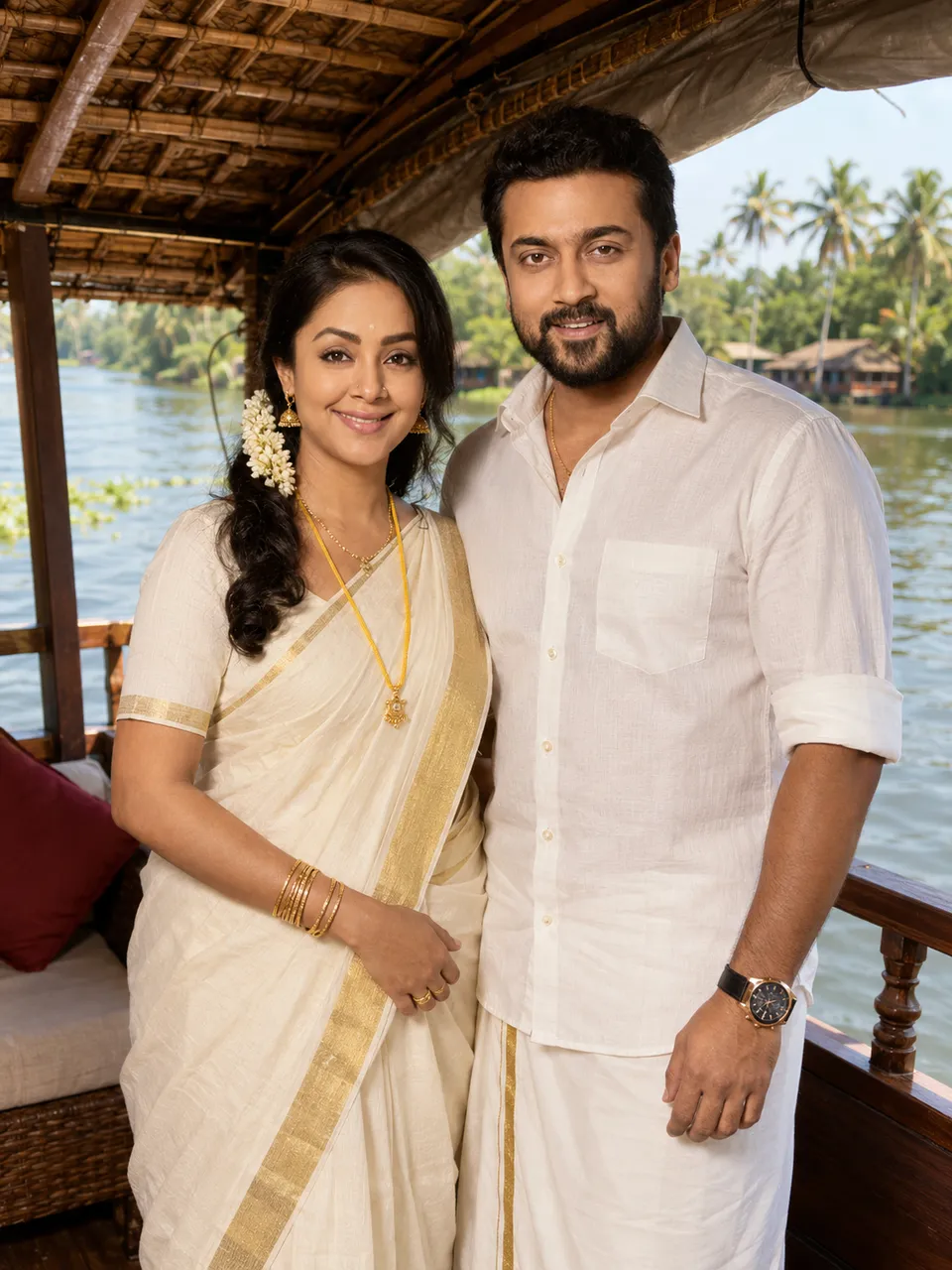
A warm and intimate portrait of a couple enjoying a leisurely moment aboard a Kerala houseboat, surrounded by lush backwater scenery. The soft morning light enhances their traditional attire, creating a serene and romantic atmosphere, perfect for capturing the essence of a honeymoon.
A single 4:5 vertical photograph of a couple aboard a traditional Kerala houseboat (kettuvallam) drifting slowly through the Alleppey (Alappuzha) or Kumarakom backwaters, captured in the late morning around 10:30 a.m. — the soft warm hour before the midday haze. The visual register is contemporary Kerala-backwater travel photography — slow, warm, with the unmistakable cream-and-gold Malayali aesthetic.

There are TWO uploaded photographs — Partner A (female) and Partner B (male).

LOCK Partner A: full face structure, eyes, eyebrows, nose, lip shape, jawline, ear shape, hairline, skin tone (the natural Malayali warm-brown range — DO NOT lighten), all marks. Natural hair texture preserved.

LOCK Partner B: same complete checklist. Hairline preserved EXACTLY. Facial hair preserved exactly.

ANTI-BLEND CLAUSE: each partner's face exclusively from their own upload.

LOCK IDENTITY, RE-LIGHT THE REST (both partners): lock each partner's identity — bone structure, features and their spacing, permanent marks, and true relative complexion (the natural South Indian range — never lightened, never fairness-treated). Do NOT lock either upload's lighting or absolute skin tone — both faces are RE-LIT by THIS scene.

FACE-BODY INTEGRATION & REALISM (mandatory — applies to BOTH partners):

1. ONE CONTINUOUS PHOTOGRAPH, NOT A FACE-GRAFT. For each partner, the head, neck, and body are one person in a single exposure — no visible seam, edge, halo, or pasted-on boundary at the jaw, chin, hairline, or neck; the face is not sharper or brighter than the body. Both partners belong to the SAME photograph — one light, one grain, one grade — not two cut-outs placed side by side.

2. SKIN-TONE CONTINUITY (no two-tone problem). For each partner, the complexion of face, ears, neck, shoulders, and hands is ONE consistent skin tone — their true South Indian complexion everywhere, never lightened, with no tonal step at the jawline or neckline. Each partner keeps their OWN complexion; the two are not averaged toward each other.

3. SCENE-MATCHED LIGHTING. Both faces are RE-LIT by THIS scene — the same key-light direction, colour temperature, intensity, and shadow pattern fall on both partners' faces AND bodies, consistent with where each one stands. Catchlights and skin highlights match the environment for both.

4. CORRECT HEAD-TO-BODY PROPORTION. Each head is anatomically sized to its own body (about one-seventh to one-eighth of standing height). Do NOT enlarge either head. The two partners are in correct relative scale to each other (natural height/build difference from the uploads).

5. HEAD POSE FOLLOWS THE BODY. Each head sits naturally on its neck, consistent with that partner's posture and the camera angle — no front-facing face on a turned body. Where the partners touch (cheek-to-cheek, leaning, an arm around a shoulder), the contact is physically real and correctly occluded.

6. NATURAL NECK & HAIRLINE TRANSITION. For each partner, jaw flows into neck, neck into shoulders, hairline into scalp — soft natural anatomy, real shadow under the chin, no abrupt mask-edge.

ANTI-GRAFT CLAUSE: faces do not drift toward Malayali cinema actors — not Dulquer, Fahadh Faasil, Nivin Pauly, or Tovino on the male side; not Manju Warrier, Nazriya, Parvathy Thiruvothu, or Aishwarya Lekshmi on the female side. Faces are exclusively from uploads.

REPLACE from both uploads: any jewelry — replaced with the Kerala-couple accessories below.

The bride/woman's wardrobe — kasavu set-mundu:
- The traditional Malayali kasavu — a cream/off-white cotton set (a two-piece saree style consisting of a *mundu* below and a *neriyathu* above as a draped upper cloth). The cream cotton with a gold zari border (the kasavu border) — about 2-3 inches wide along all edges.
- The neriyathu drapes over the left shoulder, the mundu wrapped at the waist below.
- The blouse beneath is matching cream cotton with a small gold border at the sleeve hem.
- Real handloom cotton — visible weave, the slight wrinkles, the soft drape of true Kerala kasavu.
- Alternative wardrobe knob: a simple Kerala cotton saree in pale colour with kasavu border (also acceptable).

The bride's jewelry — Malayali simple:
- Small gold jhumka earrings (small, simple chandelier style).
- A simple gold chain at the neck — possibly with a small pendant.
- The thali necklace (the sacred wedding pendant) on the yellow turmeric-dyed thread visible.
- A small *mookuthi* nose stud — small gold with a tiny stone.
- A few simple gold bangles (4-6 per wrist).
- A simple gold ring.
- A small bindi at the centre of the forehead.
- No elaborate temple-jewelry — the Kerala register is more austere than Tamil.

The bride's hair styling:
- Hair plaited in a single braid (jadai), with a string of fresh jasmine (mullappoo) tied at the base.
- OR hair pulled into a low bun with jasmine.
- Natural Malayali hair texture preserved (often wavy, often with the slight curl).
- Hairline preserved.

The bride's makeup:
- Minimal — natural skin, a soft natural lip, kohl-lined eyes.
- Skin tone exactly from upload, the natural Malayali range.

The groom/man's wardrobe — simple Kerala male:
- A plain white cotton mundu (dhoti) — pleated, pinned at the waist. The Kerala male wears the mundu plain, with the simple kasavu border at the bottom (about 1 inch gold border).
- Above: a plain white short-sleeve cotton shirt OR a plain cream cotton shirt, simple, slightly oversized. Real cotton with visible weave.
- Alternative: shirtless above the mundu (the Kerala traditional everyday attire for some men) — but for the honeymoon-travel register, the shirt is more typical.
- Optional: a cream cotton angavastram or shawl across one shoulder.

The groom's appearance:
- A simple gold chain at the neck.
- A simple watch.
- Hairline preserved exactly.
- Facial hair preserved exactly.

Pose and composition — slow houseboat moment:
The couple is on the open deck of the houseboat (the bamboo-and-coir deck with the curved roof above). Pick ONE pose:

(a) Both seated on the wooden bench/floor of the deck, side by side, slightly facing each other. The bride's hand on the groom's arm or both holding a small green coconut each (with bamboo straws). Both with soft warm expressions, looking at each other OR looking out at the backwater. The intimate honeymoon-moment.

(b) Standing at the front of the houseboat, the groom standing behind the bride with his hands gently on her shoulders, both looking out at the backwater. The pallu/neriyathu fluttering slightly in the breeze.

(c) Sitting at a small wooden table on the deck with traditional Kerala lunch on banana leaves between them — sambar, avial, rice, papadam, payasam. Both with soft warm expressions, sharing the meal. The Kerala-honeymoon-feast moment.

(d) The bride seated on the deck with the groom standing beside her, the two coconuts on a small wooden tray. The bride is reading a small book or looking out at the water, the groom looking at her with soft warm affection.

Default to pose (a) — the side-by-side coconut moment.

Setting — Kerala backwaters from the houseboat deck:
The environmental anchors:
- The houseboat deck — bamboo matting, coir rope, dark teak wooden frame, the curved coconut-thatch roof above visible.
- The backwater visible all around — still water reflecting the sky in pale gold-and-blue, with small ripples from the houseboat's slow movement.
- Banana plantations on the distant banks — bright green broad leaves, the heavy banana clusters hanging.
- Coconut palms tilting over the water, their reflections visible.
- Small Kerala fishing boats (smaller vallam) visible in the deep distance — fishermen at work.
- A small Kerala village visible on the bank — red-tiled roofs, white-washed walls, the slight smoke of cooking fires.
- A small kingfisher or crane visible perched on a tree or on the water's edge.
- Lotus / water hyacinth visible on the water surface in patches.

Atmospheric details:
- Soft warm morning haze rising from the water — visible in the deep distance.
- The slight breeze in the bride's pallu, the groom's hair.
- Slow ripples on the water surface.
- The slight smell of coconut-cooking from the houseboat's kitchen implied (small wisp of cooking smoke).
- Small dragonflies visible above the water.

Light — soft warm backwater morning:
- Primary key: warm late-morning sun coming from the open sky at around 4500K — soft, slightly diffused by the atmospheric haze.
- The light catches both partners from above-side, modeling them softly.
- A secondary contribution from the bright sky overhead — providing soft cool fill.
- A tertiary contribution from the water's reflection — providing subtle cool upward bounce.
- Catchlights in all four eyes — warm from the sky.
- The cream kasavu wardrobe catches the light beautifully, the gold border glinting.

Camera language: 35mm prime at f/4 (deep focus for the houseboat and the backwater), full-frame digital, processed for warm Kerala-travel colour science. ISO 200.

Three-quarter or full-length framing — including substantial portion of the backwater and the houseboat deck context.

Slight handheld feel — the natural travel-photography composition.

Colour treatment: warm Kerala-backwater palette — cream-and-gold wardrobe, bright green banana plantations, pale-gold water, blue sky reflecting. Skin tones natural Malayali. The image has the *Kerala-honeymoon-warm* tonal register.

Skin handling: pores visible. The slight warmth on both partners. Hair slightly tousled by the breeze. Eyes alive with the morning. Facial hair (Partner B) preserved.

Aspect ratio 4:5 vertical. No text, no caption, no border, no watermark.
This image was generated with AI.
About this look
This artwork captures a tender moment between partners on a traditional Kerala houseboat, set against the picturesque backwaters of Alleppey. The composition makes use of soft, diffused lighting that bathes the couple in a warm glow, enhancing the rich textures of their kasavu attire and the natural elements surrounding them. The framing emphasizes their connection, with the couple seated side by side and gently leaning into each other, while the lush greenery and tranquil water reflect the serene environment of Kerala’s landscape.
Ideal for celebrating newlyweds or commemorating special milestones, this piece is perfect for sharing on social media or displaying in a personal gallery. It evokes the warmth of intimacy and the beauty of traditional Kerala culture, making it a cherished keepsake for couples looking to preserve the memories of their honeymoon. Suitable for personal use or as a gift for loved ones, it encapsulates the romance and adventure of life together.
How to use this prompt
Select two clear photographs of each partner, ensuring good lighting and a natural background. The prompt expects full faces from each upload, preserving unique features while allowing for environmental lighting to be adjusted. Aim for a vertical aspect ratio of 4:5, with both partners integrated seamlessly into the scene. If the result appears too bright or unnatural, adjust the lighting settings to better match the warm tones of the specified scene.
Tips to customize it
- Try varying the backdrop to include more lush greenery or reflections in the water.
- Experiment with the couple's pose — consider the intimate side-by-side or the romantic standing pose.
- Adjust the time of day in the prompt for different lighting effects, like a sunset or early morning.
- Incorporate subtle details like a floating lotus flower or a distant fishing boat for added context.
More like this

Prompt Deck
Free on Google Play
Take the whole deck with you
Browse thousands of AI image prompts, customise them with your own details, and create — all from the Prompt Deck app.
- Tap to customise & copy
- Save your favourites
- Fresh prompts daily