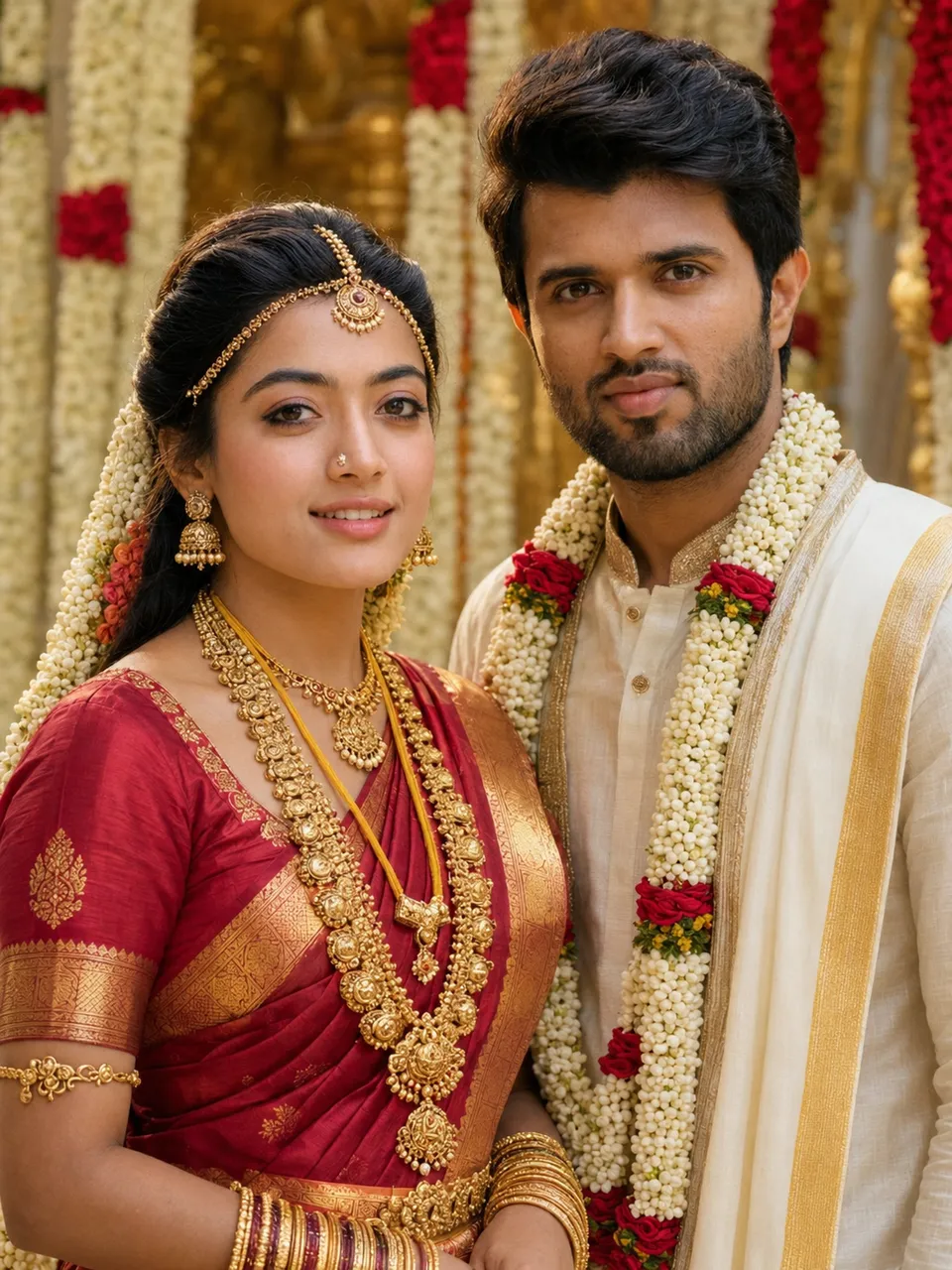
 AI-generated
AI image prompt
Kanjivaram Wedding, the Classical Tamil Portrait
Captured in soft, natural light, a Tamil-Hindu couple stands elegantly within the wedding mandap, radiating warmth and tradition. The rich colors of the bride's Kanjivaram saree and the groom's cream veshti complement the joyous atmosphere, creating a cinematic portrait that embodies the essence of a classical South Indian wedding.
A single 4:5 vertical photograph of a Tamil-Hindu couple on their wedding day — captured in the late morning around 11 a.m. inside the mandapam (wedding hall pavilion) or just outside it in soft window-light. The visual register is the classical South Indian wedding portrait — the kind that becomes the framed picture on the living-room wall.

There are TWO uploaded photographs — Partner A (the bride, female) and Partner B (the groom, male).

LOCK Partner A: complete face structure, eyes, eyebrows, nose, lip shape, jawline, ear shape, hairline, skin tone (preserve the natural South Indian warm-brown to umber range — DO NOT lighten), all visible marks. Natural hair texture preserved (the often-wavy South Indian hair).

LOCK Partner B: same complete face checklist. Hairline preserved EXACTLY (do not add hair, do not subtract). Facial hair preserved exactly — if he has a moustache or stubble in the upload, render it identically. Skin tone preserved in the natural South Indian range.

ANTI-BLEND CLAUSE: the bride's face is rendered exclusively from her upload, the groom's face exclusively from his. They are two distinct individuals, not "an averaged Tamil couple." Friends should recognise both partners independently.

LOCK IDENTITY, RE-LIGHT THE REST (both partners): lock each partner's identity — bone structure, features and their spacing, permanent marks, and true relative complexion (the natural South Indian range — never lightened, never fairness-treated). Do NOT lock either upload's lighting or absolute skin tone — both faces are RE-LIT by THIS scene.

FACE-BODY INTEGRATION & REALISM (mandatory — applies to BOTH partners):

1. ONE CONTINUOUS PHOTOGRAPH, NOT A FACE-GRAFT. For each partner, the head, neck, and body are one person in a single exposure — no visible seam, edge, halo, or pasted-on boundary at the jaw, chin, hairline, or neck; the face is not sharper or brighter than the body. Both partners belong to the SAME photograph — one light, one grain, one grade — not two cut-outs placed side by side.

2. SKIN-TONE CONTINUITY (no two-tone problem). For each partner, the complexion of face, ears, neck, shoulders, and hands is ONE consistent skin tone — their true South Indian complexion everywhere, never lightened, with no tonal step at the jawline or neckline. Each partner keeps their OWN complexion; the two are not averaged toward each other.

3. SCENE-MATCHED LIGHTING. Both faces are RE-LIT by THIS scene — the same key-light direction, colour temperature, intensity, and shadow pattern fall on both partners' faces AND bodies, consistent with where each one stands. Catchlights and skin highlights match the environment for both.

4. CORRECT HEAD-TO-BODY PROPORTION. Each head is anatomically sized to its own body (about one-seventh to one-eighth of standing height). Do NOT enlarge either head. The two partners are in correct relative scale to each other (natural height/build difference from the uploads).

5. HEAD POSE FOLLOWS THE BODY. Each head sits naturally on its neck, consistent with that partner's posture and the camera angle — no front-facing face on a turned body. Where the partners touch (cheek-to-cheek, leaning, an arm around a shoulder), the contact is physically real and correctly occluded.

6. NATURAL NECK & HAIRLINE TRANSITION. For each partner, jaw flows into neck, neck into shoulders, hairline into scalp — soft natural anatomy, real shadow under the chin, no abrupt mask-edge.

ANTI-GRAFT CLAUSE: the bride's face does not drift toward Trisha, Nayanthara, Sai Pallavi, Aishwarya Rajesh, or Keerthy Suresh. The groom's face does not drift toward Vijay, Suriya, Sivakarthikeyan, Karthi, or Vijay Sethupathi. Both partners' faces come from their own uploads and nowhere else.

REPLACE from both uploads: any jewelry — replaced with the traditional Tamil wedding jewelry below.

The bride's wardrobe — Kanjivaram silk:
- A traditional Kanjivaram silk saree in deep arakku (maroon-red) OR deep rani-pink OR deep mustard-gold. The saree is the deep colour traditional for Tamil weddings.
- The saree is real woven Kanjivaram silk — visible heavy weight, the slight stiffness of silk, the deep saturated colour. The pallu (the end-piece) is heavily brocaded with gold zari — woven peacocks, mango motifs, and temple-tower borders.
- The saree is draped in the Madisar or pin-pleat Iyer/Iyengar style as appropriate, with the pallu over the left shoulder, cascading down.
- The blouse (ravikkai) is matching deep colour with gold zari embroidery, with three-quarter sleeves.

The bride's jewelry — full traditional Tamil-Brahmin bridal:
- A heavy gold haram (long necklace) reaching her waist with intricate temple-jewelry motifs.
- A shorter gold necklace with a thaali (the wedding pendant) — the actual sacred wedding-pendant on a yellow turmeric-dyed thread.
- Large temple-jewelry jhumkas (chandelier earrings) — gold with small ruby/emerald inlays.
- A maang-tikka resembling the South Indian style: the *netti chutti* — a forehead ornament that sits along the parting of the hair down to the centre forehead, with the chandra-sun motif at the centre.
- A *mookuthi* (nose ring) — a small gold nose stud with a single small ruby or diamond. Real and visible.
- Multiple gold bangles on both wrists (about 8-10 thin bangles per wrist), with one or two thicker bangles called *vanki* near the upper arm.
- The *kalanjali* — small gold ornament at the back of the head securing the braid.
- Toe rings (*metti*) — if visible below the saree.

The bride's hair styling:
- The hair is plaited into a single long braid (jadai), heavily decorated with strings of jasmine (mallipoo) cascading down the braid from the crown to past the waist.
- A small ornamental *jadanagam* (hair ornament) at the centre of the braid — a small gold piece in the shape of a snake.
- A few orange kanakambaram flowers interspersed with the jasmine.
- The hairline is preserved exactly as in the upload — no Western hairstyles, no curls added.

The bride's bridal makeup:
- A small red kumkum bindi at the centre of the forehead.
- Subtle traditional eyeliner (kohl), no Western contouring.
- A natural pink-red lip colour.
- The skin tone is preserved exactly from the upload — natural South Indian glow, NOT lightened.
- Small dots of sandalwood paste at the temples if traditional.

The groom's wardrobe — cream veshti with angavastram:
- A traditional white-and-gold veshti (dhoti) — fine cotton or pattu (silk) in cream or white with a gold zari border at the bottom. The veshti is pleated and pinned at the waist.
- An ANGAVASTRAM (the upper-body cloth) — matching cream/white pattu silk with gold zari border, draped across the chest, going over the left shoulder.
- Below the chest, the groom is bare-skinned (traditional Tamil-Brahmin wedding style) OR wearing a simple cream banian (sleeveless undershirt). The model picks based on the family register — Iyer/Iyengar tradition leans toward bare-chested.

The groom's jewelry:
- The sacred thread (poonal / yajnopaveetha) across the left shoulder to right hip — the cotton sacred thread for Brahmins.
- A simple gold chain at the neck.
- A vibhooti (sandalwood paste) tilak on the forehead — three horizontal lines with kumkum at the centre, OR the namam (vertical mark) depending on Iyer / Iyengar tradition.
- A few simple gold rings on his fingers.
- A small gold bracelet on his right wrist if appropriate.

The groom's hair styling:
- Natural hair, slightly oiled (the wedding-day grooming). Hairline preserved.
- Facial hair preserved exactly from his upload.

Pose and composition — formal classical wedding portrait:
The couple is positioned slightly off-centre. Pick ONE pose:

(a) Both standing side by side facing the camera in a formal pose. The bride on the groom's left (the traditional position). Both with soft warm expressions — the slight smile of dignity. Their hands hold a small ceremonial item — a coconut on a banana leaf, a small *poo-koodai* (flower basket), or a small mango leaf garland.

(b) Both seated on small wedding chairs (Tirupati-style temple chairs), the bride with her hands in her lap holding a small posy of flowers, the groom beside her. Both in the formal posture, looking at the camera with dignified soft expressions.

(c) Mid-ceremony candid — the groom tying the thaali around the bride's neck, both with soft warm expressions of the sacred moment. Family members visible in soft focus around them (in the deep blur).

Default to pose (a).

Setting — wedding mandapam:
The environmental anchors:
- The traditional wedding pavilion (mandapam) — wooden pillars, banana-leaf and mango-leaf decorations garlanded across the top.
- The *thoranam* (door garland) of mango leaves visible in the deep background.
- *Kolam* (rice-flour rangoli) visible on the floor in soft focus.
- Brass lamps (*nilavilakku* or *kuthu-vilakku*) burning at the corners — visible warm small flames.
- Banana plants placed beside the mandapam pillars.
- A small *kalasam* (sacred pot decorated with coconut and mango leaves) on a small wooden stand.
- The floor is bright with the patterns of *poo-kolam* (flower rangoli).
- Family members in soft focus in the deep background — saree colours, the slight visible warmth of the gathering.

Atmospheric details:
- Slight visible incense smoke (sandal/jasmine agarbatti) curling in the air.
- Soft scattered jasmine and rose petals on the floor and on the seated chairs.
- The slight warmth of the wedding-day air.

Light — soft warm wedding-morning:
- Primary key: soft warm light from a large window or open mandapam side — at around 4000K (warm late-morning).
- The light catches the silk saree (the deep red glows), the gold ornaments shimmer, the bride's eyes glow.
- A secondary contribution from the brass lamps (nilavilakku) — small warm flames adding atmospheric fire-light.
- Catchlights in all four eyes — warm.
- The bride's pallu (gold zari) catches the light beautifully.

Camera language: 85mm prime at f/2.8, full-frame digital, processed for warm filmic colour science. ISO 400.

The composition is a classical formal couple portrait — three-quarter framing (waist up) capturing the saree's pallu, the angavastram, the jewelry. The two faces are clearly the focus.

Colour treatment: warm traditional Tamil-wedding palette — deep arakku saree, cream-and-gold groom wardrobe, the warm wood of the mandapam, the bright kolam, the gold jewelry. Skin tones natural South Indian. The image has the *classical-Tamil-wedding-portrait* tonal register.

Skin handling: pores visible on both faces. Natural soft skin texture preserved. The slight wedding-day glow on both (the soft warmth of the day). Eyes alive with the moment. Both partners' faces clearly rendered with their own features.

Aspect ratio 4:5 vertical. No text, no caption, no border, no watermark.
This image was generated with AI.
About this look
Gentle morning light pours into the mandap, casting a soft glow that highlights the vibrant hues of the couple's attire. The rich maroon-red or deep mustard silk of the bride's saree, adorned with intricate gold zari, contrasts beautifully with the groom's cream veshti, enhancing their natural South Indian complexions. The formal pose, with the bride slightly to the left, creates a sense of balance and harmony, while the careful integration of their features ensures that each partner remains distinct yet united in this significant moment.
How to use this prompt
To create this portrait, upload clear, well-lit photographs of both partners, ensuring their faces are frontal and unobstructed. The prompt will maintain their unique features while integrating them seamlessly into a traditional wedding setting. Pay attention to the couple's outfits and jewelry, as these details are vital for accurate rendering. If the lighting appears off, adjust the brightness settings in your photo before re-running the prompt to achieve a more cohesive look.
Tips to customize it
- Choose a deep arakku or mustard-gold saree for the bride to enhance richness.
- Adjust the backdrop to include traditional brass lamps or floral decorations for added authenticity.
- Consider using a 4:5 aspect ratio to emphasize the couple's vertical pose and attire.
- Select a ceremonial item like a coconut or flower basket for the couple to hold, enhancing the narrative of the image.
More like this

Prompt Deck
Free on Google Play
Take the whole deck with you
Browse thousands of AI image prompts, customise them with your own details, and create — all from the Prompt Deck app.
- Tap to customise & copy
- Save your favourites
- Fresh prompts daily