 AI-generated
AI image prompt
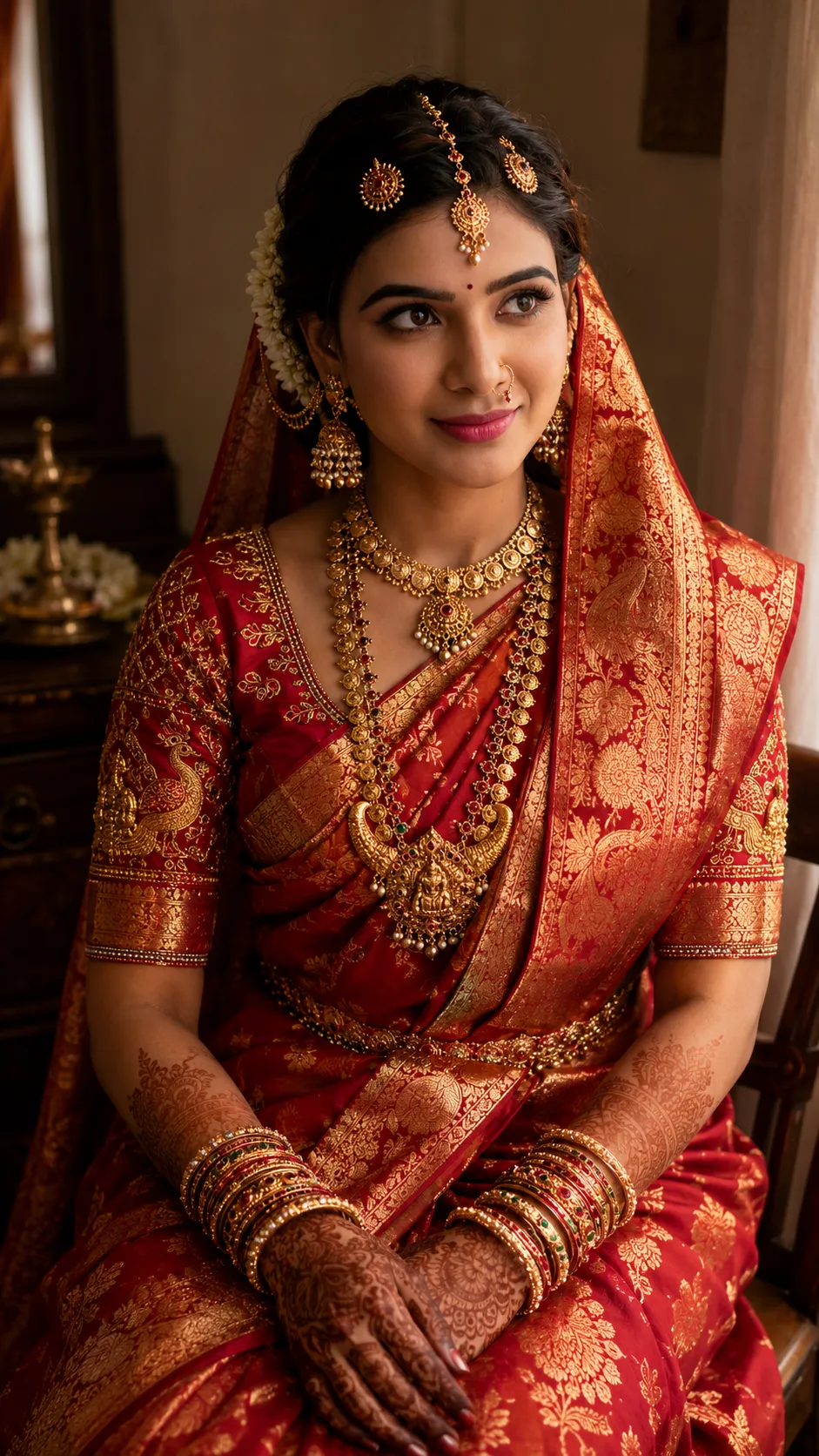
Indian Bridal, The Hour Before
A deep red Kanjeevaram saree drapes elegantly around the bride, showcasing intricate gold zari motifs. Captured in soft, natural light, the image radiates a cinematic quality filled with anticipation, reflecting the quiet moment before the wedding ceremony.
A single 4:5 vertical photograph, captured in the quiet hour just before a South Indian wedding ceremony begins — the bride is fully dressed, all jewelry on, mehndi set, makeup complete, and is alone in a small room at her family home or at the wedding venue's bridal suite. The photographer is one trusted family friend who has been given permission to stay; the photographer is using available light only and has stepped back to leave the bride alone with herself. The subject is the person in the uploaded photograph.

Face — the foundation of the whole image. Carry over from the upload with no modification: the exact eye shape and spacing, the actual eye colour, the nose bridge profile and tip, the lip shape and natural fullness, the eyebrow shape and density, the jawline, the chin, the hairline, the skin tone, and every visible mole, freckle, scar, or beauty mark. The bridal makeup sits ON the face — it does not change the face. Importantly: do not slim the face, do not enlarge or alter the eyes (Indian bridal photography has a specific failure mode where AI gives every bride the same "doll" face — explicitly resist this), do not idealise the features. The whole emotional weight of the image is that *this specific person* is becoming a wife. The viewer must recognise her.

Bridal styling — the full elaborate South Indian/Tamil bridal look (the prompt provides specific South Indian conventions; see knobs for North Indian variant):

— Wardrobe: a Kanjeevaram silk saree in deep red (the colour of pure vermilion or *kunkumam*, not orange-red, not maroon — the specific bridal red), draped in the *Madisar* style for a traditional Tamil Brahmin wedding OR in the simpler Nivi style with the pallu prominently displayed for a contemporary bride. The saree has heavy gold zari brocade across the entire body — peacocks, mango motifs (*paisleys*), temple borders (*temple kondai*) — woven gold throughout, not printed. The pallu is draped over the head, falling forward over the right shoulder, partially covering the upper jewelry. The pleats at the waist are crisp and unwrinkled — this is the first hour of wearing.

— Blouse: a matching deep red silk blouse with elbow-length sleeves, fully embroidered in gold zari with peacock and floral motifs at the back, with a deep round neckline at the front. The blouse is fitted and structured.

— Bridal jewelry (the South Indian wedding set, all gold, all heirloom-quality):
  • A heavy *netti chutti* (forehead ornament) on the centre parting of the hair, with a long *tikka* chain hanging down between the eyes ending in a pendant resting on the upper forehead. To either side of the centre tikka: the *suryakala* (sun-shaped ornament) on the right side of the parting and the *chandrakala* (moon-shaped ornament) on the left, both gold with uncut polki stones.
  • A *maatal* (chain from the earring to the hair) on each side, gold delicate chain.
  • Large *jhumka* earrings, the traditional bell-shape with multiple small bells hanging at the bottom.
  • A *nath* (nose ring) on the left nostril — for a Tamil bride, a small gold ring with a tiny pearl drop, or for a more elaborate look, a hoop with a chain extending to the ear.
  • Multiple necklaces layered down the chest: closest to the throat, a *kasu malai* (gold coin necklace); below that, a *mango haaram* (longer chain with mango-shaped pendants in gold and red stones); below that, a *vanki* (the heavy curved bridal necklace with a central pendant).
  • At each upper arm, a *vanki* (V-shaped armlet) in gold.
  • At each wrist, multiple gold bangles (*kappu* and *valayal*) layered together — at least eight on each wrist, in a mix of plain gold and stone-set styles. The bangles make a small sound when she moves.
  • An *odiyanam* (gold waist belt) at the waist — visible only if framing includes the waist.
  • On each ankle, gold anklets (*kolusu*) and *metti* (silver toe rings) — visible only if the framing includes the feet.
  • A heavy *jadai* (long braided hair extension decorated with gold ornaments) running down the back from the crown — but only the upper visible parts of this if the framing is from the front.

— Mehndi: dark red-brown intricate henna patterns visible on the hands, dense and fully developed (this is the morning after application — the colour is at its peak). The patterns are traditional South Indian — paisleys, floral motifs, lotus, with the groom's name woven discreetly into the design on one palm (a Tamil tradition).

— Hair: smoothly oiled and centre-parted, drawn back into a long single plait (*jadai*) decorated with gold ornaments running down its length. A garland of jasmine flowers (*malli poo*) woven around the upper part of the plait at the crown. Several individual strands of jasmine fall loose at the back of the neck.

— Makeup: South Indian bridal makeup, slightly heavier than everyday but never crossing into stage makeup territory.
  • Skin: an even smooth foundation matched to the natural skin tone (not lightened), set with translucent powder. The natural luminosity of the skin is preserved — this is not the matte-flat heavy makeup of the older bridal generation, but the contemporary "real skin enhanced" approach.
  • Eyes: kohl-lined on both upper and lower lash lines, extended slightly at the outer corner. Eye shadow in warm earth tones — gold near the inner corner, soft brown in the crease, with a touch of red-bronze near the outer corner. Lashes are dramatic — mascara plus light false lashes, but not overpowering. Brows defined and slightly shaped.
  • Lips: a deep red lipstick matching the saree, applied to the natural lip shape with a slight darker outline. Not glossy — matte to soft satin finish.
  • Bindi: a large red bindi at the centre of the forehead, slightly larger than everyday, sometimes with small surrounding white dots in a traditional pattern.
  • Cheeks: a soft natural-looking blush in dusty rose, very subtle.

Pose and composition — the quiet moment:
The bride is seated, perhaps on the edge of a bed or on a low traditional wooden chair, the heavy saree pleats fanned out around her. Her hands are visible: either folded in her lap (the position the heavy mehndi-laden hands naturally take when at rest), or one hand lifted slightly to touch a piece of jewelry — adjusting a bangle, brushing the tikka chain on the forehead — the unconscious small movements of someone wearing all this for the first time. The other hand at rest. The body angled slightly off-axis from the camera, three-quarter view. The head slightly bowed, looking at the hands or the lap or middle-distance, with the pallu falling forward and slightly veiling the face from one side. The shoulders are relaxed; the spine is upright but not held. The body language is *receptive stillness* — she is not posing for the photograph; she is simply being herself in this moment.

Expression — the most emotionally specific direction in the prompt: the face holds the complex mixture of emotions that bridal portraiture exists to capture — quiet anticipation, mild apprehension, a kind of inward observation of herself, perhaps a small smile at one corner of the mouth that comes from something she has just remembered, perhaps a small dampness at the lower lash line that the eye is trying not to acknowledge. Crucial: this is not a single emotion. It is the specific overlay of several at once — happy, scared, proud, sad, ready. Read the upload's resting face and let the bridal moment add to it rather than replace it. No wide smile (the wedding-photographer-cliché smile-for-the-camera). No theatrical sadness. The expression is the unguarded face of a young woman alone with herself before the most documented day of her life.

Setting — the small private room:
A small intimate space, lit by available light. The room contains: an old wooden traditional carved chair or a low bed with a richly embroidered bedcover, a single wooden side table with a few personal items (a small photograph of her parents, a tilak-applied silver puja bowl, a single open jewelry box still showing some of the unused pieces, a clear glass of water with a few rose petals floating in it), an old vintage mirror on the wall (gold-edged, slightly tarnished), and a window to one side. The walls are a soft cream or pale rose colour, possibly with traditional carved wooden details around door frames. A few brass *kuthuvilakku* (oil lamps) glow softly somewhere just out of the central frame. On the floor near her feet, a small offering of flowers and a coconut, suggesting the upcoming ceremony.

Light — soft, warm, available, never staged:
— A single soft window light from camera-left at forty-five degrees, the warm afternoon sun filtered through a thin sheer curtain. Colour temperature around 3800K — warm but not golden hour yet.
— The light catches the right side of the face (the side facing the window), the gold jewelry on the chest and the hands, and the gold zari pattern on the saree pallu. The metalwork in the jewelry glints and reflects the warm light.
— The shadow side of the face falls into soft warm shadow, not deep — there is ambient bounce in the room from the cream-coloured walls.
— A secondary warm contribution from the brass oil lamps that are just out of frame — adding a faint flickering warmth to the lower edges and the shadow side. Not dramatic, just present.
— No fill light from the photographer. No flash. The photograph is a single available-light exposure.
— The brightest highlights are on the gold ornaments and the saree pallu, allowed to read as fully bright (close to clipped) where the window light hits them directly — this is what makes the gold *sing* in the image.

Camera language: a 50mm prime lens at f/1.8, shot on a full-frame digital body, processed for warm filmic skin tones (the colour profile of Kodak Portra 400 or Cinestill 50D), ISO 800, available light only, no flash. Subject distance roughly two metres. Slight handheld feel — the photographer is shooting from the hip discreetly, not from a tripod. Three-quarter framing — from the top of the head with a small headroom, ending at mid-thigh, showing the lap and the hands. The depth of field is shallow enough that the background details (the photograph, the lamps, the mirror) are softly out of focus, the bride is fully sharp.

Colour treatment: warm filmic, with the red of the saree singing without going hot, the gold reading as true heritage gold (not yellow, not orange — the specific warm metallic), the skin true to the upload, the room's cream walls reading as a soft warm cream. The colour palette is unified — everything in shades of red, gold, cream, and warm shadow. The unity of the palette is the photographer's signature.

Skin and texture handling: pores visible across the face despite the bridal makeup — the makeup is enhancing, not erasing. Eyelashes individually visible, including any subtle false-lash detail. The slight texture where lipstick meets the natural lip edge. The small detail of the mehndi pattern on the hands, dense and intricate, the colour pulled fully developed. The gold of the jewelry has the warm matte glow of real heritage gold, with the slight tarnish at the edges of older pieces. The dark hair has the slight oil-sheen of having just been freshly braided. A few small fine hairs visible at the temple and at the hairline — the imperfections that make the image real.

Aspect ratio 4:5 vertical. No text, no caption, no wedding date overlay, no border, no watermark.
This image was generated with AI.
About this look
The focus on the Kanjeevaram saree, with its rich deep red hue symbolizing marital bliss, contributes to the image's emotional weight. Draped in the traditional Madisar style, the saree is adorned with elaborate gold zari work, which adds texture and depth. The bride's pose, slightly off-axis and with her head bowed, enhances the sense of introspection, allowing the viewer to connect with her quiet moment of reflection. The available light subtly illuminates her features, accentuating the intricate mehndi patterns on her hands and her delicate bridal jewelry, creating a harmonious blend of color and detail.
This portrait is ideal for sharing moments of personal significance, such as pre-wedding celebrations or bridal rituals, making it perfect for family albums or social media announcements. Capturing the bride in this intimate setting emphasizes her individuality and the gravity of the occasion, celebrating not just the wedding itself but this poignant transition in her life. It resonates with those who appreciate traditional customs and the beauty of personal stories, serving as a cherished memory for years to come.
How to use this prompt
Select a photo of the bride that clearly showcases her face, ensuring that the facial details are distinct and representative. The prompt expects a vertical composition with a focus on her traditional attire and jewelry, so choose an image where these elements are well-defined. The framing should allow for the saree and intricate jewelry to be visible, and you may want to adjust the lighting if the image appears too dark or flat. If the final image does not capture the desired emotional nuance, consider refining the lighting settings or adjusting the angle to enhance the subject's expression and posture.
Tips to customize it
- Use a specific shade of deep red for the saree, avoiding orange-red or maroon.
- Include jasmine flowers in the hair for authentic South Indian bridal styling.
- Opt for warm earth tones in the eye makeup to enhance the bridal look.
- Ensure the photo is framed to include the intricate details of the jewelry.
More like this

Prompt Deck
Free on Google Play
Take the whole deck with you
Browse thousands of AI image prompts, customise them with your own details, and create — all from the Prompt Deck app.
- Tap to customise & copy
- Save your favourites
- Fresh prompts daily