 AI-generated
AI image prompt
Hampi at Golden Hour
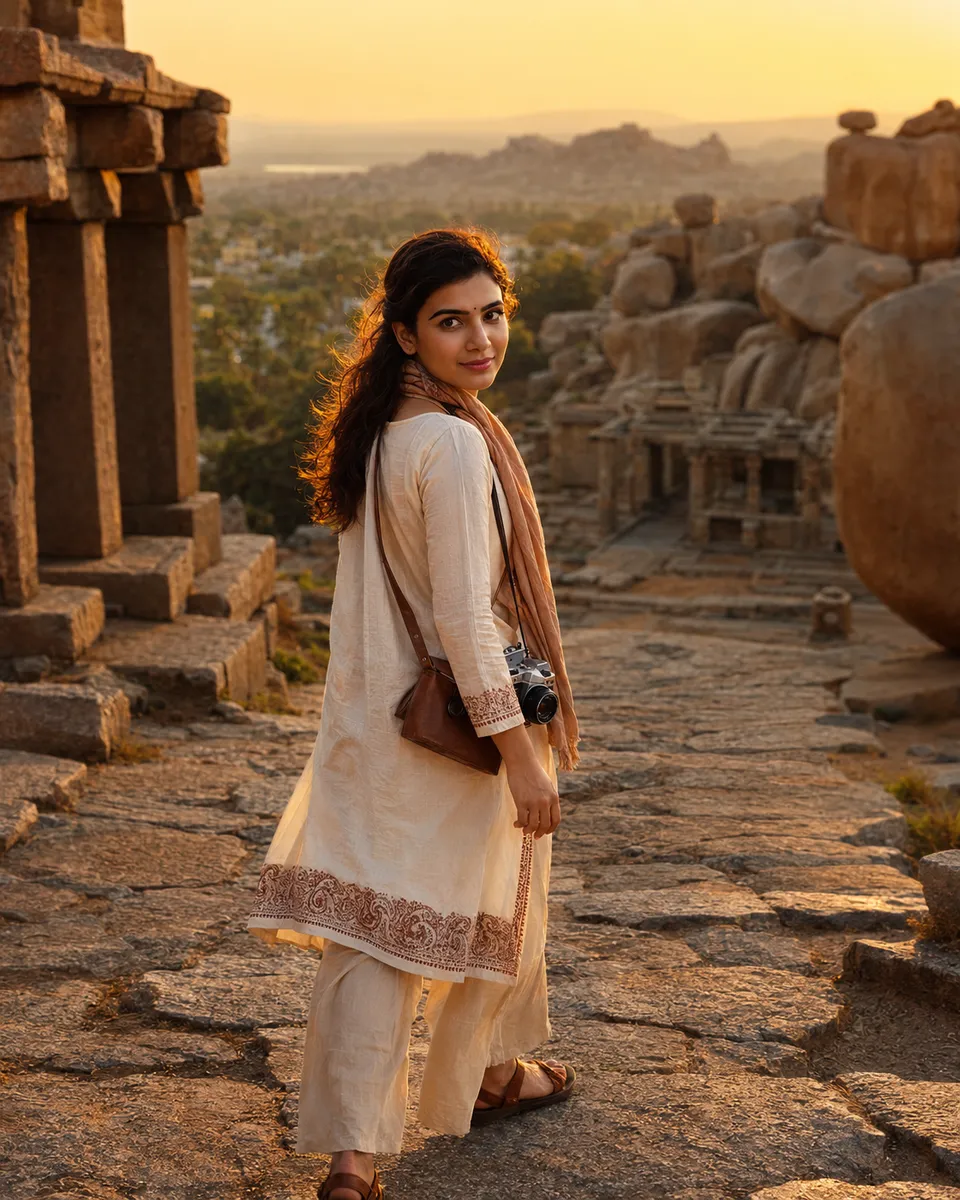
Copper-orange hues illuminate Hampi's ancient ruins during golden hour, capturing a moment of serene exploration. The photograph features a traveler in thoughtful attire, framed by massive granite boulders and weathered temples, embodying the essence of heritage travel in a contemporary style.
A single 4:5 vertical photograph captured at Hampi, the UNESCO World Heritage Site in Karnataka, around 5:45 p.m. in the dry season (November-February) — the last hour before sunset when the granite boulders glow copper-orange. The subject is the person in the uploaded photograph, photographed walking through or pausing among the ancient ruins. The visual register is contemporary Indian heritage travel photography.

LOCK from the upload: the entire face — eye shape and spacing, exact eye colour, nose bridge profile and tip, lip shape and natural fullness, eyebrow shape, jawline, chin shape, hairline, ear shape, skin tone, and every visible mole, freckle, scar, fine line, or beauty mark. Also the natural hair — actual colour, texture, length, density. The hair will be loose or simply tied for the heat; the underlying hair is hers. Render imperfections that are in the upload; do not invent.

REPLACE from upload: any earrings, necklaces, bangles, rings, nose pins, or other jewelry visible in the uploaded photograph are NOT carried over. They are removed entirely and replaced with the simple traveler-appropriate jewelry described below.

Wardrobe — thoughtful Indian traveler:

Option A (cotton kurta-set): a soft off-white or cream cotton kurta with three-quarter sleeves, mid-thigh length, with subtle hand-block printing or simple embroidery in earth tones (terracotta, ochre, indigo) at the cuffs or hem. Paired with comfortable cotton palazzo pants or wide-leg trousers in matching off-white or in a complementary earth tone (terracotta, mustard, or sage).

Option B (linen midi dress): a sleeveless or short-sleeved linen midi dress in earth tones — terracotta, sage green, oatmeal, or muted ochre — with a small leather belt at the waist. Practical, breathable, beautiful in golden hour.

Option C (kurta-shirt and jeans): a slightly more cosmopolitan look — a soft linen or cotton-blend kurta-shirt (open at the throat, sleeves rolled to forearm) over fitted dark jeans, with leather walking sandals or simple ankle boots.

The fabric in all options is *real cotton or linen* — visible weave, real weight, the natural wrinkles of a day's wear in heat. There may be small dust marks on the cuffs and the hem from the walking — the slight evidence of having explored.

Accessories:
— A long thin cotton scarf or stole loosely around the neck or shoulders, perhaps draped over the head to shield from sun if the framing supports — in a natural earth tone or with subtle traditional Indian print.
— A small leather sling bag across the body — practical, lived-in, the kind of bag a real traveler carries.
— A vintage film camera around the neck on a leather strap — perhaps a Pentax K1000, a Leica M, or an old Olympus OM — adds visual character and signals the *thoughtful documentarian* register of the subject.
— Leather walking sandals or ankle boots in tan or dark brown — practical for ruins-walking.
— Optional: a wide-brimmed straw or felt sun hat, either being worn or held in one hand.

Scene jewelry (replaces anything in the upload — traveler-simple):
— Earrings: small simple silver or oxidised silver studs, OR a pair of small Indian-traditional jhumkas in oxidised silver — modest, not statement. Or no earrings.
— Necklace: either none, or a single thin silver chain with a small pendant (perhaps a small antique coin, a small turquoise, a small Indian-tribal piece). Or a long single string of small silver beads tied at the back.
— Bracelets: a small stack of two or three thin oxidised silver bangles on one wrist, or a single thicker silver cuff. The oxidised-silver palette suits the heritage-travel register.
— Rings: minimal — perhaps a single silver ring with a turquoise or moonstone, perhaps none.
— Hair: no formal hair ornament. A simple cotton band or a small clip if needed practically.
— No gold jewelry. No bridal pieces. No formal-event jewelry. The aesthetic is *quiet ethnic-traveler*.

Hair styling (using natural hair from upload):
The natural hair worn loose and slightly tousled by the dry Hampi air, OR tied back into a low loose ponytail or knot — practical for walking. A few wisps at the hairline. A slight golden-hour catch on the hair where it has lifted away from the head. There's a small natural disheveled quality — the day's walking has worked the hair slightly.

Pose and composition — exploration mid-moment:
The subject is in or among the Hampi ruins. The model picks ONE of these moments:

(a) Walking through a stone-paved ruin pathway, body in mid-stride, head turned partially back to the camera. Stone temple architecture rising on either side. The walking-traveler classic shot.

(b) Pausing at a vast granite boulder formation, body angled toward the boulder with one hand resting on its surface, head turned to look at the camera with a slight smile. Scale: the boulder is many times the subject's size.

(c) Seated on a low stone wall or fallen pillar, body relaxed, the camera held loosely in her hands, gaze either at the camera or out at the landscape. The travel-portrait classic moment.

(d) Standing at the top of a small hill or temple plinth with the broader ruin landscape visible behind — the establishing-vista moment. Body turned partially away from the camera to take in the view, head turned back over the shoulder.

(e) Mid-photograph: the subject has her film camera lifted to her eye, taking a photograph of something out of frame. Her body is engaged with her own act of photography. The photographer-of-the-photographer moment.

The body language is *engaged exploration* — present in the place, unhurried, the gait of someone who has been walking for hours and is into it.

Expression — quiet wonder:
A small contemplative expression, perhaps a small natural smile from the joy of being in a place this old. Not a posed smile. Not theatrical wonder. The genuine quiet of being among ruins. Read the upload — if warm resting face, render warmth lifted by curiosity; if more reserved, render quiet focus. Eyes alive with attention.

Setting — the Hampi ruin landscape:
The environmental anchors:
— Massive granite boulders — Hampi's famous balanced boulders, ranging from house-sized to multi-storey, in warm copper-orange and pinkish grey, glowing in the golden light. Some boulders look impossibly balanced on smaller ones.
— Ancient temple ruins — partially-ruined stone pillars, weathered carved Vijayanagara-era stone columns, sections of fallen wall. Specific recognisable Hampi monuments may be implied: the Vittala Temple's stone chariot, the Lotus Mahal, the Elephant Stables, the Hazara Rama Temple, the Virupaksha Temple, or the Achyutaraya Temple's pillared bazaar street.
— Banyan trees and tamarind trees scattered through the landscape — large old trees with massive root systems and broad canopies.
— The Tungabhadra river visible in the deep distance — a thin glittering line of water.
— Coconut palms and small palm groves nestled between the boulders.
— Wild scrubland: dry grass, small thorn bushes, the dusty earth of the Hampi region.
— Small wildflowers — perhaps a few mahua or marigold blooms at the path edges.
— A small detail or two of the cultural-archaeological context: a fallen carving of a Hindu deity, an inscription on a wall, a small votive shrine, a *kolam* still visible at a temple entrance.

Atmospheric details:
— Warm dust in the air — the Hampi region is dry and the late afternoon air carries fine dust that catches the warm light.
— The slight visible breath if the air is cool by evening.
— Slow drifting heat-haze in the distance, especially near the horizon.
— A few birds — sparrows, mynas, perhaps a parakeet — visible in the deep distance or perched on a boulder.
— The slight smell-suggestion of warm stone and dry grass, conveyed visually through the colour palette.

Light — Hampi golden hour, fully committed:
— The primary light is the last-hour sun from camera-back-right or back-left, at a low angle (about 10-15 degrees above horizon), warm gold at 2900K. The directional gold of the deep golden hour.
— The light catches the granite boulders and they *glow copper-orange* — the colour of the boulders at this hour is unmistakable, the visual signature of Hampi.
— The light hits the subject from behind — a strong rim along the back of the head, the shoulder, the back of the body, the edge of the kurta or dress. The hair catches the light intensely, individual strands glowing.
— The front of the face is in soft warm shadow — lit by the bounce from the warm boulders and warm dust in the air. The shadow side is a stop down from the rim-lit edge, but full of warm reflected light.
— A long warm shadow falls behind the subject across the stone ground.
— The shadows have warmth, never coolness. The whole image is bathed in deep golden tones.
— Catchlights in the eyes from the warm sky and the warm boulder bounce — large, warm, alive.

Camera language: an 85mm prime lens at f/2.8, shot on a full-frame digital body, processed for warm filmic skin tones with slight desaturation in the greens (the natural muted greens of dry-season vegetation) and saturated warm tones on the stone. ISO 200, available light. Subject distance roughly four metres. Three-quarter to full-length framing — full-length captures the landscape's scale, three-quarter focuses on the subject. The model picks based on what the upload's face and the chosen pose support.

Slight motion blur on any moving elements (wind-lifted scarf, walking foot). The face is sharp.

Colour treatment: deeply saturated warm-earth tones — the unmistakable Hampi golden-hour palette. Coppers, oranges, deep ochres, warm cream, deep warm shadows. Skin tones true to the upload, warmed substantially by the gold. The off-white kurta or cream dress reads as warmly-lit cream. No cool tones in the image. The colours of the landscape (boulders, vegetation, sky) all share the warm gold palette.

Skin handling: pores visible across the face. The warm bounce from the boulders illuminates the shadow side of the face beautifully. A slight golden glow on the skin — natural lighting result, not over-applied. Individual eyelashes resolved. The slight natural pinkness in the cheeks from a long day's walking and the warm climate. Hair catches the back-light with golden rim. Small fine dust visible at the hairline or on the cuffs of the kurta — the truth of a heritage-site day.

Aspect ratio 4:5 vertical. No text on the image, no caption, no Hampi labels, no border, no watermark.
This image was generated with AI.
About this look
Golden hour casts a warm, copper-orange glow over the iconic granite boulders and ancient temple ruins of Hampi, creating a captivating visual palette. The subject is framed within this landscape, engaging with the environment, whether walking among the ruins or capturing the moment with a vintage film camera. The low-angle light emphasizes the textures of her cotton or linen attire, highlighting the natural wrinkles and earthy tones that resonate with the surrounding scenery, enhancing the overall authenticity of the travel experience.
How to use this prompt
To create a stunning portrait capturing the essence of Hampi, upload a clear photograph that showcases the subject's face, ensuring all features are visible. The prompt expects details like the natural hair texture and color while locking in the subject’s unique facial characteristics. Select a pose that reflects engagement with the environment, and ensure the background features Hampi’s iconic ruins or boulders. If the colors appear dull, increase the warmth setting in your image editor.
Tips to customize it
- Use a terracotta or sage green wardrobe option for an earthy aesthetic.
- Opt for a low-angle light direction to enhance the golden hour effect.
- Incorporate a vintage film camera as a prop for a thoughtful traveler vibe.
- Select a relaxed pose like seated on a pillar to convey tranquility in exploration.
More like this

Prompt Deck
Free on Google Play
Take the whole deck with you
Browse thousands of AI image prompts, customise them with your own details, and create — all from the Prompt Deck app.
- Tap to customise & copy
- Save your favourites
- Fresh prompts daily