 AI-generated
AI image prompt
Chettinad Mansion, Inner Courtyard
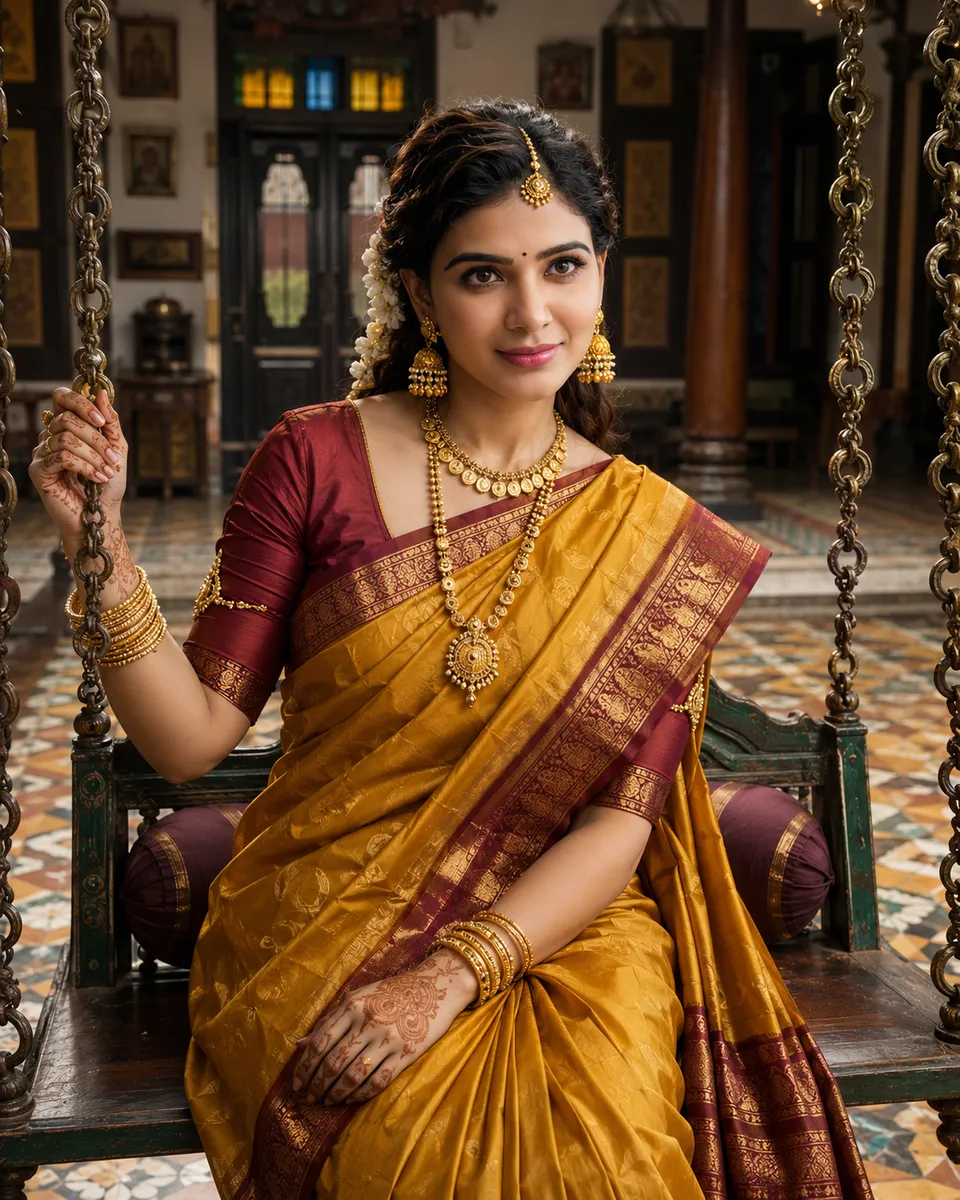
Captured in the serene inner courtyard of a Chettinad mansion, a woman embodies traditional Tamil grace, dressed in a vibrant Kanjeevaram saree. The warm afternoon light enhances her calm expression, emphasizing her connection to heritage architecture adorned with intricate details.
A single 4:5 vertical photograph captured in the inner *nadumuttam* (central courtyard) of a heritage Chettinad mansion in the Karaikudi region of Tamil Nadu — specifically a mansion of the kind found in Athangudi, Pallathur, Kanadukathan, or Karaikudi villages. The time is around 4 p.m. on a quiet weekday in the cooler months (November-February). The subject is the person in the uploaded photograph, photographed in the courtyard.

LOCK from the upload: the entire face — eye shape and spacing, exact eye colour, nose bridge profile and tip, lip shape and natural fullness, eyebrow shape, jawline, chin shape, hairline, ear shape, skin tone, and every visible mole, freckle, scar, fine line, or beauty mark. Also the natural hair — actual colour, texture, length, density. Hair will be styled for the heritage moment. Render imperfections that are in the upload; do not invent. The Chettinad heritage moment is best when the face is the real person — heritage interiors and traditional women have always been photographed with the subject simply being herself.

REPLACE from upload: any earrings, necklaces, bangles, rings, nose pins, or other jewelry visible in the uploaded photograph are NOT carried over. They are removed entirely and replaced with the Chettinad-traditional Tamil heritage jewelry described below.

Wardrobe — Chettinad heritage saree:
A traditional South Indian silk saree appropriate to a Chettiar home — substantial heritage, but lived-in (this is not a wedding). Pick ONE:

Option A: a deep mustard-yellow Kanjeevaram silk with a contrasting deep maroon-and-gold border, with the body of the saree showing traditional South Indian weave (mango motifs, temple patterns). The mustard reads beautifully against the Athangudi tile floor.

Option B: a deep peacock-blue Kanjeevaram silk with a contrasting saffron-and-gold border — a classical Chettinad-aesthetic colour.

Option C: a deep oxblood-red Kanjeevaram silk with broad gold zari border — the most formal of the options.

Option D: a deep emerald-green Kanjeevaram with a deep wine border — the rarer colour combination.

Option E: the famous *Chettinad Cotton* saree — a handloom cotton in deep saturated colour (mustard, oxblood, deep wine, peacock) with a hand-woven simple border. The Chettinad cotton is less famous than Kanjeevaram silk but is distinctively Chettiar — handloom cotton with the slightly heavier weave the community is known for.

The blouse: a matching deep-colour silk or cotton blouse with three-quarter sleeves and a modest neckline. The saree drapes in traditional Tamil-Brahmin style — pallu pinned at left shoulder, falling down the back.

Scene jewelry (replaces anything in the upload — Chettinad heritage Tamil):
— Earrings: substantial heritage Tamil *jhumkas* in antique-gold with multi-tier bell construction and small pearl drops. These would be family-heirloom pieces.
— Necklace: layered Tamil heritage set — a *kasu mala* (gold coin necklace) close to the throat, plus a longer *manga malai* (mango pendant necklace). Two layered pieces.
— Maang tikka: a substantial gold maang tikka at the centre parting.
— Bangles: a moderate stack on each wrist — six gold bangles per side — heritage-style.
— *Vanki* (V-shaped armlet) on each upper arm — Chettiar heritage tradition.
— Bindi: a large round red bindi at the centre of the forehead.
— Hair: fresh jasmine garland (*malli poo*) woven through the bun at the back.
— Hands: subtle elegant mehndi (not bridal-elaborate).
— NO nose ring (Tamil Brahmin / Chettiar tradition typically excludes nose rings).

The jewelry register is *Chettinad heritage Tamil* — substantial heirloom pieces, the kind passed down for four generations.

Hair styling (using natural hair from upload):
The natural hair smoothly oiled, centre-parted, gathered into a low traditional bun (*kondai*) at the nape with the jasmine garland woven around it. The hairline is clean. The hair has the smooth Tamil traditional styling.

Pose and composition — Chettinad heritage portrait:
The subject is in the courtyard. The model picks ONE moment:

(a) Standing in the centre of the courtyard with the architecture rising on all four sides — body angled three-quarter to camera, hands joined together in front of her in *vanakkam*, head slightly bowed but eyes meeting the camera. The classical heritage portrait pose.

(b) Standing or leaning against one of the heritage Burmese teak pillars — body slightly to one side, one hand resting on the pillar, the other at her side or holding the loose pallu end. The pillar-heritage composition.

(c) Walking through the courtyard — body in mid-stride, the saree's pallu in slight motion, head turned partially back to camera. The mid-step heritage moment.

(d) Seated on a low traditional wooden swing (*oonjal* — the painted wooden swing found in Chettinad mansions) — body relaxed, the saree pleats arranged around her, one hand resting on the swing's chain. The heritage-furniture composition. This is one of the most iconic Chettinad-mansion poses.

The body language is *settled heritage grace* — the natural carriage of a woman in her ancestral home or visiting one. Spine upright, shoulders open, the calm presence of being where one belongs.

Expression — Chettinad serenity:
A serene calm expression — the slight inward smile of being in a beautiful old place at a beautiful old hour. Eyes meeting the camera with quiet warmth. Read the upload's face and render its most settled version. Not a wide smile, not theatrical — the *Chettinad-calm*.

Setting — the heritage Chettinad mansion courtyard:
The architectural anchors that distinguish Chettinad architecture:
— The central courtyard (*nadumuttam*): a square open-air space in the middle of the mansion, with the surrounding rooms opening onto it via pillared verandas. The courtyard is open to the sky at its top — providing natural light to the centre of the house.
— Burmese teak pillars: substantial dark teak wooden pillars rising from the floor to support the surrounding veranda's roof. The pillars are carved at the top with decorative motifs (lotus, peacocks, geometric patterns). They have the patina of decades — smooth at the base from being touched.
— The floor: the famous Athangudi tiles — handmade clay tiles in geometric patterns of green, cream, deep red, ochre, and indigo. The tiles have the slightly uneven hand-pressed quality of Athangudi work, with intricate floral and geometric repeat patterns. The floor is the most photogenic feature of any Chettinad mansion.
— The painted ceiling: above the surrounding veranda, the wooden ceiling beams show painted decorative motifs (flowers, geometric patterns, sometimes scenes) in red, blue, green, and gold — partially faded from age but visible.
— Tall carved wooden doors leading to the inner rooms — heavy teak with elaborate carvings (lotus, peacocks, Hindu deities, geometric patterns), painted in subtle colours (mostly natural wood with painted accents).
— The walls: the lower portion of the walls is the polished red lateritic plaster (the same as Kerala homes, slightly different shade), the upper portion is plain plastered cream.
— Stone bench (*thinnai*) along one wall — for sitting and conversing.
— A carved wooden *oonjal* (swing) hanging from substantial chains in one corner of the courtyard.
— Brass *kuthuvilakku* (oil lamps) on small platforms near the doorways.
— A small carved wooden cradle or a brass *uruli* (ceremonial bowl) with floating jasmine and rose petals.
— The architectural detail of the deep eaves overhead — visible at the upper edge of the frame, with their carved beams.

Atmospheric details:
— Soft afternoon light coming down from the open courtyard sky above — directional but diffused.
— Soft warm dust catching the directional light.
— A faint slow drift of *agarbatti* (incense) smoke rising from somewhere — the heritage home's ritual incense.
— Marigold or jasmine petals scattered on the Athangudi floor near a doorway.
— The slight cool of the courtyard's natural shade — the courtyards stay cool by design.

Light — Chettinad afternoon courtyard:
— The primary light is the natural afternoon sun coming through the open courtyard ceiling above — soft diffused warm-white at around 4500K. The light falls down into the courtyard, illuminating the centre while the surrounding verandas remain in soft shadow.
— A directional component — the sun's actual angle creates a slight directional pull to camera-left or back-left, giving the face some modeling rather than flat-overhead light.
— The Athangudi tile floor reflects warm light upward — the colourful tiles act as a giant ground-reflector, throwing warm-coloured bounce light into the underside of the subject's chin and the lower face.
— A secondary contribution from the warm wooden pillars and beams — the warm wood throws warm fill into the shadow areas.
— The shadow side of the face is in soft warm shadow — about three-quarter stop down from the lit side.
— Catchlights in the eyes from the open sky above — large soft catchlights.

The light has the *grand-heritage-interior* quality — warm, directional, atmospheric.

Camera language: an 85mm prime lens at f/2.5, shot on a full-frame digital body, processed for warm filmic skin tones with the deep saturation of contemporary Indian heritage editorial photography. ISO 400, available light. Subject distance roughly three metres. Three-quarter framing — from above the head with small headroom to mid-thigh.

Slight low-angle camera position — the photographer slightly below the subject, looking up slightly to capture the architectural verticals (the pillars and the upper ceiling).

Colour treatment: deeply saturated heritage Tamil palette. The deep saree colour fully saturated. The Athangudi tiles' green-cream-red-ochre palette holding full saturation. The warm teak wood golden-brown. The cream-and-red oxide walls warm. Skin tones true to the upload, warmly lit by the courtyard light. The entire image sits in *heritage Indian warm tonality*.

Skin handling: pores visible across the face. The slight natural sheen at the cheekbones from the warm climate. Individual eyelashes resolved. The fresh jasmine flowers individually rendered. The mehndi pattern crisp on the hands. The natural slight pinkness from the afternoon warmth.

Aspect ratio 4:5 vertical. No text, no caption, no border, no watermark.
This image was generated with AI.
About this look
Standing gracefully in the central courtyard, the subject strikes a classic pose, her body angled three-quarters to the camera with hands joined in a respectful *vanakkam*. The atmospheric afternoon light filters softly through the open sky above, illuminating the Burmese teak pillars and the detailed Athangudi tile floor beneath her. This composition captures the intricate heritage of the Chettinad mansion, with decorative motifs and faded colors creating a rich backdrop that enhances the subject's elegance and calmness.
Ideal for celebrating cultural heritage or special occasions, this portrait suits events like family reunions, festivals, or personal milestones where tradition is honored. It can be shared on social media or displayed in family homes to evoke pride in Tamil heritage. The serene expression and traditional attire make it a cherished keepsake, perfect for those wishing to highlight their lineage and cultural roots.
How to use this prompt
To create a stunning portrait, provide a clear photo of the subject's face, ensuring that all facial features and natural hair texture are visible. The prompt will maintain these characteristics while replacing any visible jewelry with traditional Chettinad pieces. Choose a specific pose from the options provided to capture the essence of the heritage moment. If the lighting appears too harsh, adjust the brightness settings to achieve a softer look that complements the warm ambiance of the courtyard.
Tips to customize it
- Select a saree color that contrasts beautifully with the warm tones of Athangudi tiles, like deep mustard or peacock blue.
- Consider using a three-quarter sleeve blouse for a classic look that enhances the traditional drape.
- Incorporate natural light during the afternoon to achieve a soft, diffused glow around the subject.
- Opt for a pose that showcases the architectural details of the Chettinad mansion for a more immersive heritage experience.
More like this

Prompt Deck
Free on Google Play
Take the whole deck with you
Browse thousands of AI image prompts, customise them with your own details, and create — all from the Prompt Deck app.
- Tap to customise & copy
- Save your favourites
- Fresh prompts daily