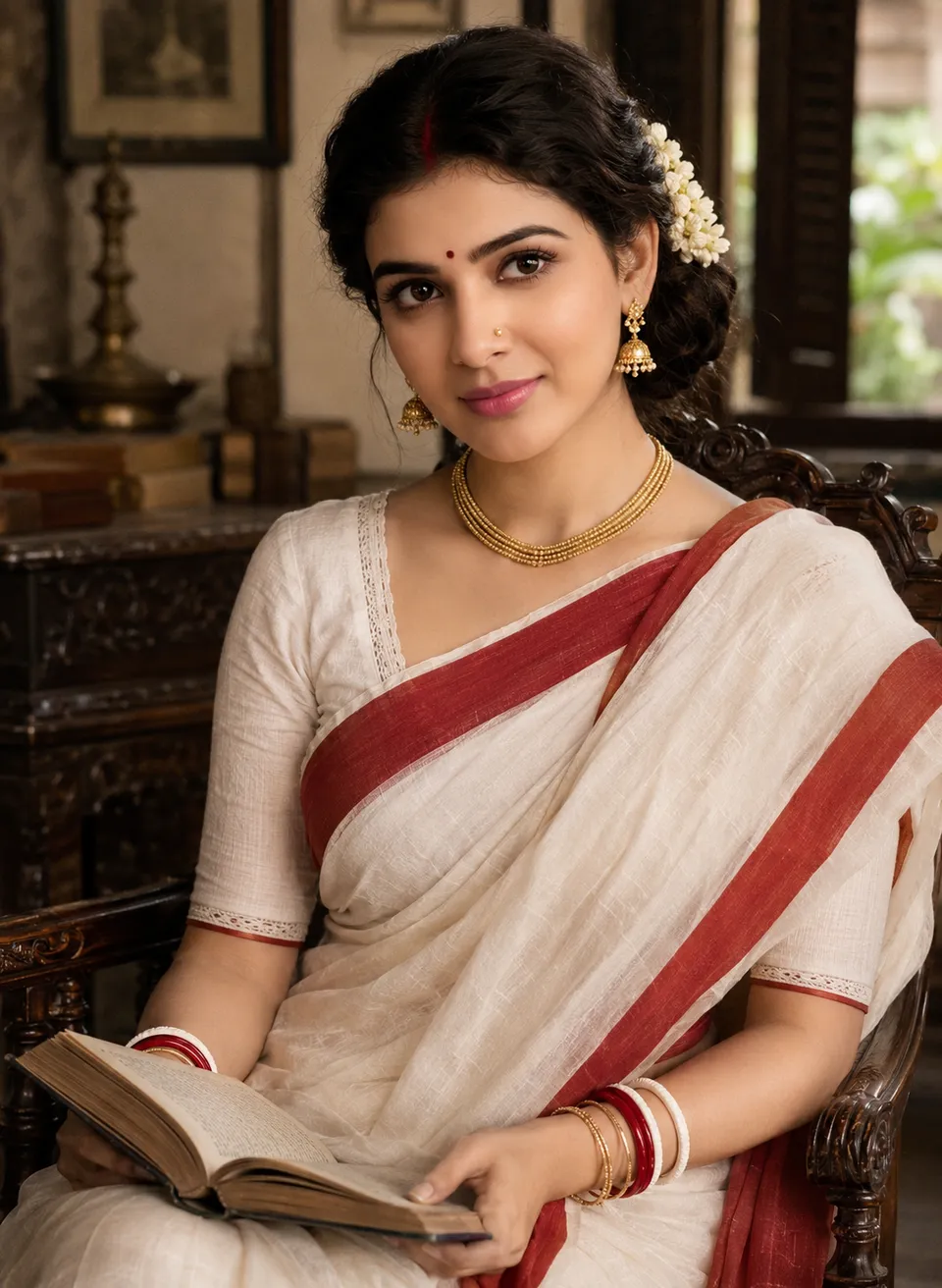
 AI-generated
AI image prompt
Calcutta, Tagore-era, the Bengali Aristocrat
A Bengali woman, elegantly draped in a traditional *Lalpaar saree*, embodies the grace of the Tagore era within a heritage home. The warm afternoon light illuminates her serene expression, highlighting the rich cultural details of the setting and attire, evoking an atmosphere of intellectual contemplation.
A single 4:5 vertical photograph in the visual register of 1925 Calcutta — the *Bengali Renaissance* aesthetic. The setting is a heritage Bengali aristocratic home interior — could be in the elite North Calcutta neighbourhood (Shyambazar, Bagbazar, Jorasanko — the Tagore-family neighbourhood) or South Calcutta heritage. The subject is the person in the uploaded photograph, captured in the heritage Bengali aristocratic styling.

LOCK from the upload: the entire face — eye shape and spacing, exact eye colour, nose bridge profile and tip, lip shape and natural fullness, eyebrow shape, jawline, chin shape, hairline, ear shape, skin tone, and every visible mole, freckle, scar, fine line, or beauty mark. Also the natural hair — actual colour, texture, length, density. Render imperfections that are in the upload; do not invent. The Bengali aristocratic woman of the Tagore era is known for distinctive Indian features rendered with seriousness and intelligence — preserve all character.

REPLACE from upload: any earrings, necklaces, bangles, rings, nose pins, or other jewelry visible in the uploaded photograph are NOT carried over. They are removed entirely and replaced with the Bengali-traditional jewelry described below.

Wardrobe — Bengali Lalpaar saree:
The signature Bengali aristocratic saree of the era — the *Lalpaar saree*. The specific construction:
— A pure white or off-white cotton or silk saree with a substantial deep red border (the *paar*) at the lower edge.
— The red border is approximately 4-5 inches wide, in deep saturated red.
— The pallu also has the deep red border with the same width.
— The body of the saree may be plain white or have very subtle small motifs woven in white-on-white (the heritage Bengali handloom tradition).

The saree is draped in the traditional *atpoure* Bengali style — the distinctive Bengali drape:
— The saree wraps around the waist with the pleats arranged at the back (NOT in the front like other Indian saree drapes).
— The pallu comes around from behind, over the LEFT shoulder, then is draped across the chest from left to right (the reverse direction from Tamil), and the loose end is tucked or held at the right side.
— The traditional Bengali drape is distinctive and signals immediate cultural heritage.

The blouse: a simple white or cream cotton or silk blouse with short sleeves and a modest round neckline, often with a small lace trim or a thin red border at the cuffs and neckline.

The fabric is *real handloom cotton or fine silk* — visible weave, the slight crispness of well-worn heritage fabric.

Scene jewelry (replaces anything in the upload — Bengali aristocratic):
— Earrings: traditional Bengali heritage gold drop earrings (*kanbala* or *karnaphul*) — substantial heritage style, often with small pearls or pale stones.
— Necklace: the iconic Bengali *sat-nori* (seven-stranded gold necklace) close to the throat, OR a single heavy gold pendant on a fine chain. Alternatively, a heritage *kanthi-haar* (broad gold collar necklace).
— Bangles (*shankha-pola*): the SIGNATURE Bengali Hindu married-woman bangles — two distinctive bangles on each wrist: the *shaakhaa* (white conch shell bangle) and the *polaa* (red lacquer bangle). The shaakhaa-pola is the Bengali married-woman's most recognizable visual signal. ADD ONLY if the user is married; otherwise omit.
— Other bangles: in addition to shaakhaa-pola, a few thin gold bangles may be worn.
— Hair: a fresh white tuberose (*rajanigandha*) tucked into the bun at the back, or a small string of small white flowers.
— Sindoor: red *sindoor* (vermillion powder) in the centre parting (the Bengali Hindu married-woman tradition). ADD ONLY if married.
— Bindi: a small round red bindi at the centre of the forehead.
— Nose: a small nose pin (*nath-er-phul*) — small heritage gold piece in the left nostril (traditional Bengali aristocratic style).
— No mehndi (Bengali tradition doesn't emphasise mehndi).

The jewelry register is *Bengali aristocratic heritage* — distinct from Tamil, North Indian, or other regional traditions.

Hair styling (using natural hair from upload):
The natural hair styled in the traditional Bengali aristocratic style:
— Centre-parted, smoothly oiled with coconut or mustard oil (the slight sheen visible at the parting).
— Pulled back into a substantial LOW BUN (*khopa*) at the nape of the neck.
— The bun decorated with the fresh tuberose flowers.
— A few small wisps at the temples — the natural slight imperfection.

The hair has the traditional Bengali grace — substantial, controlled, slightly oiled.

Pose and composition — Bengali aristocratic interior:
The subject is in a heritage Bengali aristocratic home. The model picks ONE moment:

(a) Seated in a heritage carved wooden chair or a *baithak* (low traditional Bengali seating) with a book of poetry open in her lap, head turned to camera with a quiet expression. The Tagore-era-intellectual moment.

(b) Standing beside a heritage carved wooden door or a Persian-carpet-floor, body angled, head turned with a soft direct gaze. The formal-portrait moment.

(c) Reading a hand-written letter — the letter held in one hand, the other hand at the chest, head bent slightly toward the letter, gaze just lifted to the camera. The literary-moment.

(d) Standing near a heritage gramophone (visible as the era-specific musical apparatus), one hand at the gramophone's horn or the spinning record. The Tagore-era-music moment.

(e) Seated in a verandah with the open windows visible (showing Calcutta's red-brick architecture or a green Calcutta courtyard outside), body angled, looking out the window. The contemplative-verandah moment.

The body language is *Bengali-aristocratic-quiet* — settled, intellectual, with the gravity of someone in the cultural heart of India.

Expression — Tagore-era intellectual:
A serene reflective expression — the *Bengali bhadramahila* (gentlewoman) signature. Read the upload's face — render the version with intellectual weight and quiet warmth. The eyes carry *interior thought*; the mouth is closed in a soft line.

NOT a wide smile. NOT theatrical. The Bengali aristocratic register is *understated quiet intelligence*.

Setting — 1925 Bengali aristocratic home:
The environmental anchors:
— A heritage Bengali home interior — could be the inner rooms (*antarmahal*) or a more formal sitting room of a substantial 1920s Calcutta house.
— Architecture: high ceilings with carved wooden beams, large ornate windows with shutters (often with the iconic green Calcutta window-shutters), tall doors with carved wooden frames, walls in cream or warm pastel painted plaster.
— Furniture: a mix of European Victorian/Edwardian and Indian heritage — a heavy carved wooden writing desk, a Victorian sofa upholstered in deep velvet, a small marble-topped table, a Persian carpet on the floor.
— Books: visible bookshelves with heritage leather-bound books — clearly an intellectual home. Books in Bengali, English, perhaps Sanskrit and Urdu.
— A gramophone in one corner of the room — the era-specific musical apparatus with the iconic horn shape.
— A small framed photograph of Rabindranath Tagore on the wall (subtle cultural reference), or a framed image of Goddess Saraswati (the patron of learning).
— A small carved wooden cradle or family heirloom visible.
— A small *kalash* (water pot) or brass diya at a small puja corner.
— Heavy fabric curtains — deep velvet in saturated colour (deep wine, deep green, deep navy).
— The floor: either polished wood or red-oxide-tiled floor with the Persian carpet.

Atmospheric details:
— Warm afternoon light filtering through the window shutters — visible shafts of soft warm light catching dust.
— A thin column of *agarbatti* (incense) smoke rising — the cultural-spiritual atmosphere.
— The slight smell-suggestion of old books, sandalwood incense, jasmine, and warm tea, conveyed through the warm visual atmosphere.
— Slight movement in the heavy curtains from a breeze.

Light — Calcutta heritage afternoon:
— Primary light: warm directional afternoon light coming through the open window or window-shutters from camera-left at 30-45 degrees. Colour temperature around 3800K — warm afternoon.
— A secondary contribution from the warm wood and warm carpet — the heritage interior bounces warm light.
— A tertiary subtle contribution from a small electric lamp (the era-correct table lamp with a soft fabric shade) if visible — providing a warm point-accent.
— The face is *warmly modeling lit* — clear lit side and shadow side, with the heritage interior providing warm fill.
— Catchlights in the eyes — warm rectangular from the window.

The light has the *Bengali-Calcutta-heritage-afternoon* quality — warm, layered, atmospheric-historical.

Camera language: an 85mm prime lens at f/2.5, shot on a full-frame digital body, processed for the warm filmic colour science of historical Indian editorial photography — slight warm tone with the desaturation of the deeper shadows that suggests period-photography. ISO 400, available light.

The image has the *slight period-photography quality* — slight desaturation, slight grain, the suggestion of a vintage photograph reproduced clearly.

Subject distance roughly two metres. Three-quarter framing — including the heritage interior context and the period-correct details.

Colour treatment: warm heritage Bengali palette — the white-and-red of the Lalpaar saree, the warm wood and red-oxide floor, the deep velvet and Persian carpet colours. Skin tones true to the upload, warmed by the heritage interior. The image has the *historical-Indian-heritage* tonal register.

Skin handling: pores visible. The slight natural sheen at the cheekbones from the warm afternoon. Individual eyelashes resolved. The shaakhaa-pola bangles distinct on the wrists. The sindoor in the parting visible (if married). The flowers in the hair real.

Aspect ratio 4:5 vertical. No text, no caption, no border, no watermark.
This image was generated with AI.
About this look
The *Lalpaar saree* is central to this portrait, showcasing its signature pure white fabric and deep red border, which conveys both elegance and cultural heritage. Draped in the traditional *atpoure* style, the saree emphasizes the subject's poised demeanor, while the intricate background of a vintage Bengali home enhances the narrative. High ceilings and ornate wooden features complement the warmth of the afternoon light streaming through the windows, creating a serene and reflective mood.
How to use this prompt
To create this image, start with a clear, vertical upload of the subject's face that captures their natural features. Ensure the background reflects a heritage Bengali home, either through personal photographs or by using placeholders for classic elements like ornate wooden furniture and bookshelves. Aim for a warm light effect to replicate the soft afternoon ambiance. If the colors seem off, adjust the lighting settings to enhance warmth and reduce shadows.
Tips to customize it
- Opt for a warm light setting to replicate the afternoon glow.
- Select a detailed backdrop that includes elements like carved wooden furniture or ornate windows.
- Ensure the saree is styled correctly with deep red borders and a white base for authenticity.
- Incorporate props like books or a gramophone to enrich the cultural context.
More like this

Prompt Deck
Free on Google Play
Take the whole deck with you
Browse thousands of AI image prompts, customise them with your own details, and create — all from the Prompt Deck app.
- Tap to customise & copy
- Save your favourites
- Fresh prompts daily