 AI-generated
AI image prompt
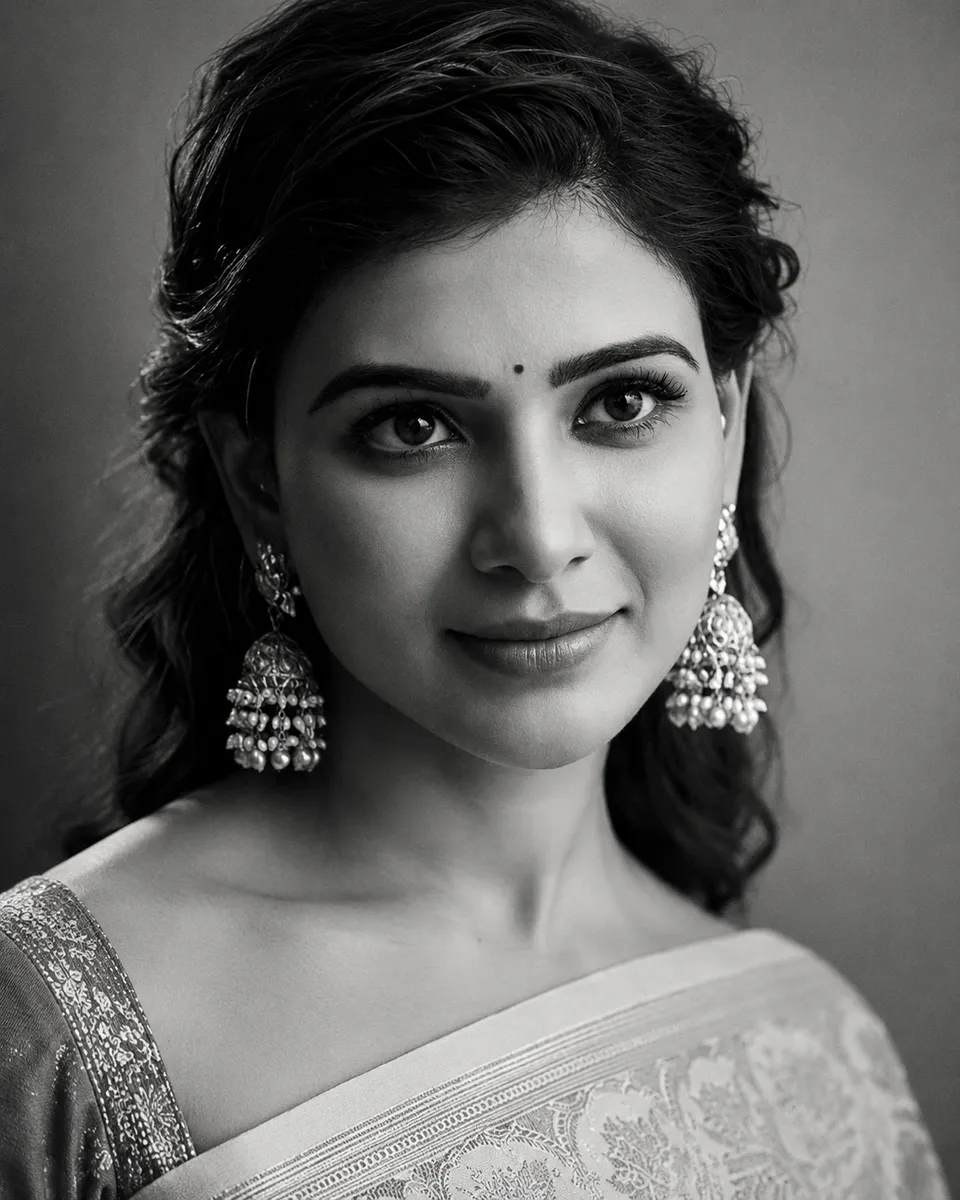
Black & White High-Fashion Editorial
Set against a seamless mid-grey backdrop, the editorial portrait captures the model in striking monochrome, emphasizing every detail of her face. The soft, diffused light highlights the texture and shadows, creating a sophisticated yet natural high-fashion vibe that feels both timeless and contemporary.
A single 4:5 black-and-white editorial portrait, the kind that would run as a full-page tear-out in Vogue India or Harper's Bazaar India. The subject is the person in the uploaded photograph and the entire image is built around their actual face.

Identity contract — the upload is the brief: every facial feature is to be carried over without modification. The eyes (with their actual shape, set, and any subtle asymmetry between left and right), the nose (bridge profile, tip, nostril width), the lips (cupid's bow, fullness, natural definition), the eyebrows (thickness, arch, any sparse patches at the inner edge), the jawline and chin shape, the hairline, the ear shape, the skin tone as it will translate into monochrome, and every mole, freckle, beauty mark, scar, or fine line that is visible in the upload. Render imperfections that are there; do not invent ones that aren't. The face is allowed to look like a real face, because that is what makes editorial portraiture editorial — not the absence of texture, but the presence of it.

Wardrobe — oversized and severe: a single piece, no layering, no jewelry. Either a sharp black wool blazer worn off one shoulder with nothing underneath visible at the collarbone, or a high-necked ivory cotton shirt buttoned to the throat with the cuffs falling past the wrists — pick whichever the model judges to read stronger against this face and lighting. The garment is well-tailored but worn naturally — slight wrinkle at the elbow, fabric that has gravity, not the smooth digital perfection of CGI clothing. No belt visible, no accessories, no watch, no rings, no necklace.

Pose: three-quarter angle, the subject facing forty-five degrees from the camera, head turned ten degrees back toward the lens — the classic Avedon stance. One shoulder closer to the camera than the other. Hands either not in frame or one hand resting near the throat with the index finger barely touching the jawline (the model decides). Spine straight, chin level, the kind of stillness that comes from not performing for the camera.

Expression: read the upload. If the resting face carries a faint smile or warmth at the corner of the mouth, keep it. If the resting face is neutral, render it neutral — the still, level-eyed gaze of someone who has nothing to prove. No performed seriousness, no fashion-model pout, no contrived smoulder. Direct gaze into the lens, mouth softly closed, the small asymmetries of a real resting mouth preserved.

Setting: a seamless mid-grey backdrop (which, in monochrome, reads as a soft graduated grey). The backdrop is plain, no patterns, no texture. The subject stands roughly half a metre off the backdrop so there is a soft shadow falling behind them — not a hard cast shadow, but a presence of separation.

Light — this is the heart of the image: a single large diffused source from camera-left at roughly forty-five degrees, slightly above the eye line. Think of a 1.5m × 1.5m diffusion frame with one Joker-Bug 800W bouncing through it. The light is soft enough that the shadow under the nose is gradual rather than knife-edged, but directional enough that the right side of the face falls one to one-and-a-half stops below the left. No fill. No reflector. The shadow side is allowed to be deep without being lost. The catchlight in the left eye is a large soft rectangle. The catchlight in the right eye is a small dim version of the same shape.

Monochrome treatment — and this is where most AI fails, so be precise: render this as if shot on Kodak Tri-X 400 film, processed normally, scanned and minimally graded. Specifically:
— Mid-tones carry the image. The face should sit in a range of greys from roughly Zone V to Zone VII, with the brightest highlight on the cheekbone reaching Zone VIII and the deepest shadow under the jaw sitting at Zone III. Nothing pure black, nothing pure white. The image should breathe.
— Grain visible but not coarse — the controlled grain of medium-format Tri-X at box speed, not the heavy grain of pushed film.
— Tonal contrast firm but not crushed — the kind of contrast that says "fashion editorial" without saying "Instagram preset."
— Skin in monochrome reads through luminance, not through hue — pale skin sits one or two zones higher than darker skin, but the *texture* (pores, peach fuzz, eyelash detail) is what carries the realism, not the tone.

Camera and lens: a Hasselblad 500CM with an 80mm Carl Zeiss Planar f/2.8 lens, on Tri-X 400 medium format film. Or its digital equivalent — Fujifilm GFX 100S with the GF 80mm f/1.7, processed for Acros II film simulation. Subject distance roughly two metres. Slight medium-format compression of features. Framing is three-quarter portrait — top of the head with a finger's width of headroom, frame ends mid-chest. The face occupies the central two-thirds of the composition.

Skin texture clause: pores visible across the face — the slightly different texture of forehead vs. cheek vs. nose. Eyelashes individually rendered. The fine hair at the eyebrow's inner edge visible. The thin shadow under the lower lash line preserved. No retouching, no frequency-separation smoothing, no AI-clean texture. If the upload shows under-eye darkness, render it. The image must read as photographed, not as constructed.

Aspect ratio 4:5. No text, no logos, no magazine masthead, no caption, no border, no watermark. The image is the unframed photograph, not the page it would be printed on.
This image was generated with AI.
About this look
A seamless mid-grey backdrop provides a neutral canvas that allows the subject's features to take center stage, casting a soft shadow behind her for depth. The lighting plays a crucial role, with a large diffused source to the left of the camera, creating a gentle gradient on the face. This careful manipulation of light ensures that every contour and texture is faithfully rendered, from the subtle asymmetry of the eyes to the fine lines and freckles, allowing the portrait to breathe with life and authenticity. The pose, reminiscent of classic fashion photography, conveys a sense of calm confidence, positioning the model at a three-quarter angle that enhances the contours of her face.
How to use this prompt
Upload a high-quality photograph of the subject's face, ensuring it captures all the fine details such as skin texture and unique facial features. The prompt expects a single full portrait with a 4:5 aspect ratio, featuring the subject in either a tailored black blazer or ivory shirt, with no accessories. Aim for a natural pose, ideally with a neutral expression, and make sure shadows and light fall as described. If the image lacks detail or appears too smooth, adjust the lighting settings or ensure the upload is sharp and clear.
Tips to customize it
- Use a high-contrast black wool blazer for a bold look.
- Opt for an ivory shirt to create a softer, elegant appearance.
- Ensure the lighting source is diffused and positioned to the left at a 45-degree angle.
- Keep the backdrop a simple mid-grey to emphasize the subject's features.
More like this

Prompt Deck
Free on Google Play
Take the whole deck with you
Browse thousands of AI image prompts, customise them with your own details, and create — all from the Prompt Deck app.
- Tap to customise & copy
- Save your favourites
- Fresh prompts daily