 AI-generated
AI image prompt
Banana Leaf Sadya, Onam Afternoon
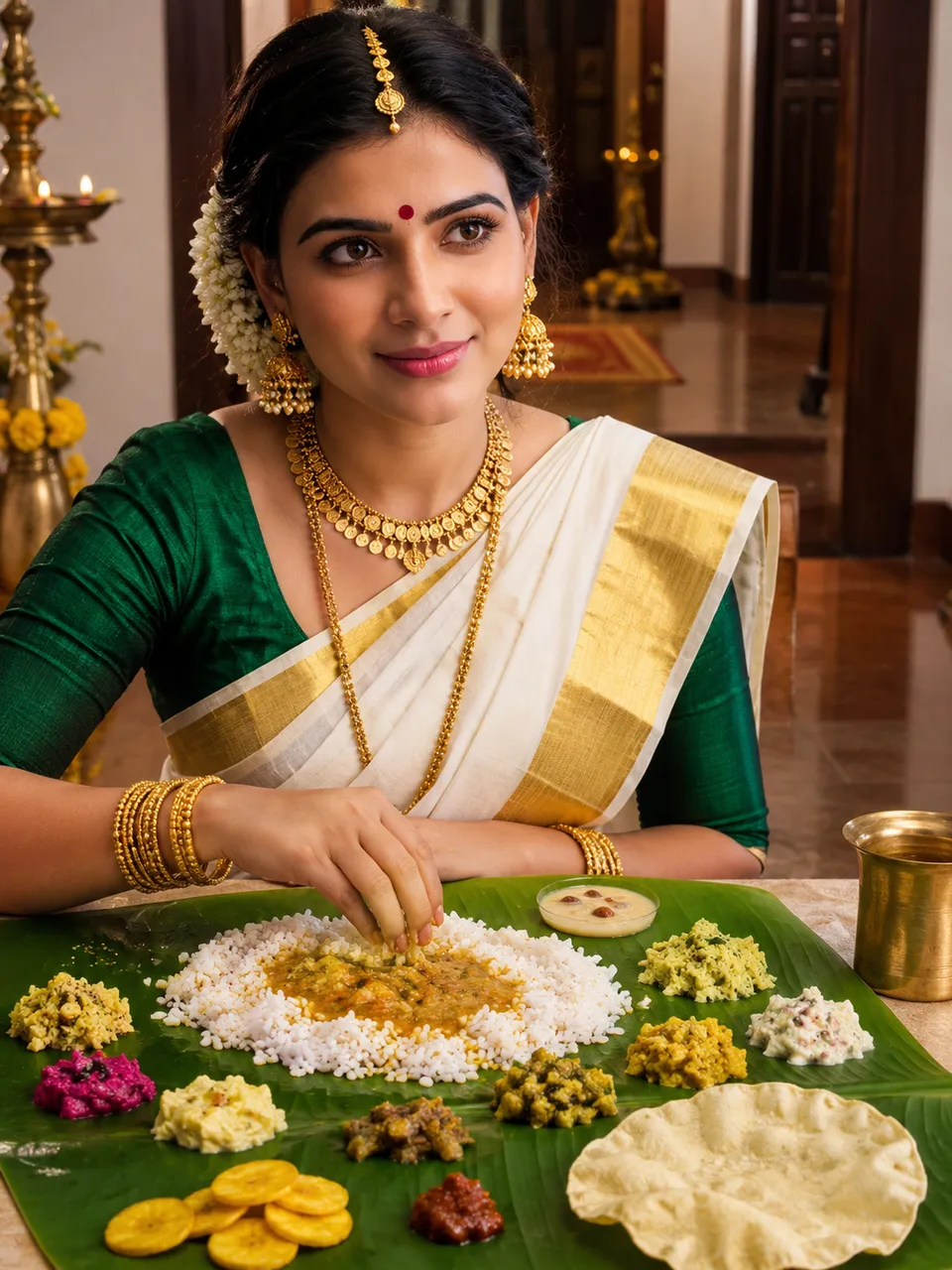
A traditional Kerala Sadya scene features a woman gracefully seated with her banana leaf meal spread before her. This photorealistic portrait captures the warmth of the Onam festival through intricate details like a kasavu saree and the vibrant arrangement of dishes, evoking a sense of communal celebration.
A single 4:5 vertical photograph captured during a traditional Kerala or Tamil Brahmin Sadya — the South Indian feast served on a banana leaf. The time is around 1 p.m. on the day of Onam (specifically Thiruvonam) or on a Tamil festival Sunday lunch. The setting is a traditional South Indian home dining area or a sadya-hall (a community feast space). The subject is the person in the uploaded photograph, captured at her place setting.

LOCK from the upload: the entire face — eye shape and spacing, exact eye colour, nose bridge profile and tip, lip shape and natural fullness, eyebrow shape, jawline, chin shape, hairline, ear shape, skin tone, and every visible mole, freckle, scar, fine line, or beauty mark. Also the natural hair — actual colour, texture, length, density. Render imperfections that are in the upload; do not invent.

REPLACE from upload: any earrings, necklaces, bangles, rings, nose pins, or other jewelry visible in the uploaded photograph are NOT carried over. They are removed entirely and replaced with the sadya-appropriate festive jewelry described below.

Wardrobe — Sadya day saree:
A traditional South Indian saree appropriate to the Sadya day. Pick ONE based on the cultural variant:

If Kerala Onam Sadya:
— The traditional Kerala kasavu saree — pure cream-white handloom cotton with a broad pure-gold zari border. The Onam-traditional Kerala two-piece saree.

If Tamil Brahmin festival Sadya:
— A traditional Kanjeevaram silk in a festive jewel-tone (saffron-orange, deep peacock-blue, deep emerald) with contrasting border.
— Or a fine cotton-silk with traditional Tamil-Brahmin border.

The blouse: a matching deep-colour silk or cotton blouse with three-quarter sleeves. The saree is draped traditionally — pallu pinned at LEFT shoulder. The pallu is arranged to not interfere with the meal (the pallu pinned securely).

Scene jewelry (replaces anything in the upload — sadya-day appropriate):
— Earrings: traditional South Indian *jhumkas* in antique gold (heritage Tamil or Kerala-style depending on cultural variant) with small pearl drops.
— Necklace: a *kasu mala* (gold coin necklace) close to the throat, possibly with a longer simple chain. The South Indian classical two-piece layering.
— Bangles: a moderate stack on each wrist — five to six gold bangles per side. The bangles need to allow the eating hand free movement.
— Maang tikka: a small gold maang tikka at the centre parting.
— Bindi: a large round red bindi at the centre of the forehead.
— Hands: a fresh strand of jasmine in the hair (*malli poo* / *mallipoo*).
— Hands: no mehndi or subtle (eating with the hand is the cultural practice, mehndi might transfer).
— NO nose ring (Tamil Brahmin/Kerala traditional).

The jewelry register is *festive South Indian heritage* — substantial but mealtime-appropriate.

Hair styling (using natural hair from upload):
The natural hair smoothly oiled, centre-parted, gathered into a low bun (*kondai*) at the nape with the jasmine garland woven around it. The hair has the festive-precision of the meal day.

The banana leaf — the visual centrepiece:
A large fresh-green banana leaf — about 60-70 cm in length — laid out in front of the subject on the dining table or low traditional dining setup. The banana leaf has its slight natural shine, the visible leaf veins, the slight unfurling at the edges.

The Sadya items arranged in the traditional positions:
The traditional Sadya arrangement is specific — different items in specific positions:

At the centre (rice area):
- A mound of cooked white rice (often more than once-replenished by the server) — the centerpiece.

Around the rice (in clockwise positions from the upper portion of the leaf):
- *Sambar* (lentil-vegetable stew) — at the upper-right of the rice.
- *Rasam* (spicy thin soup) — at the upper-left of the rice.
- *Kalan* or *Pulisseri* (yogurt-based curry) — in a small portion.
- *Erissery* (pumpkin-and-bean curry) — another position.
- *Avial* (mixed vegetable in coconut curry) — at one side.
- *Thoran* (stir-fried vegetable with coconut) — another small portion.
- *Pachadi* (yogurt-based with raw vegetable) — a small portion.
- *Kichadi* (yogurt-based with cooked vegetable) — a small portion.

At the upper edge of the leaf (the auspicious upper-side):
- A small portion of *payasam* (sweet rice pudding) — the dessert is placed at the upper side as the auspicious item.
- The dessert is typically *Paal Payasam* (milk-based) for Kerala, or *Sakkarai Pongal* for Tamil.

At the lower edge of the leaf (the eating-side):
- A small portion of *upperi* (banana fries / chips).
- A *papadam* (papad) at the lower-right.
- A *naranga curry* (lemon pickle) at one corner.

A small brass tumbler of water to the side of the leaf.

The arrangement is *traditional and correct* — not random.

Pose and composition — the meal moment:
The subject is at the banana leaf. The model picks ONE moment:

(a) Seated cross-legged on the floor on a small mat or directly on the floor (the Kerala traditional dining position), the banana leaf in front, body facing the leaf, head turned to camera with a soft welcoming smile. The "before the meal begins" moment.

(b) Seated on a chair at a table with the banana leaf in front — body slightly leaning forward, head looking at the camera, the right hand poised near the food (the traditional eating-with-hand technique). The mid-meal pause.

(c) The right hand actually working with the food — mixing the rice with the sambar, the natural meal-eating motion captured. The eating moment.

(d) About to start — the hand washed (the brass tumbler of water just used), body facing the leaf with the slight forward posture of about-to-eat. The pre-meal ritual moment.

The body language is *settled meal-engagement* — focused on the leaf, present in the meal, the slight forward-engagement of about-to-eat or eating.

Expression — sadya warmth:
A genuine warm expression — the soft contentment of the cultural festival meal. Read the upload's face and render its most settled-festive-meal version. A small natural smile if the resting face supports it, otherwise calm presence. The expression is *cultural-meal-warmth* — happy to be at this meal, with this family, on this day.

Eyes meeting the camera with the soft warmth of someone caught mid-meal.

Setting — the Sadya hall or home:
The environmental anchors:
— The dining area: traditional South Indian home dining (Kerala or Tamil), or a community sadya hall (during Onam, communal sadyas are common).
— The flooring: red-oxide polished floor (Kerala) or Athangudi tiles or wooden floor.
— Other diners visible in the soft-focus background — also at their banana leaves, in similar festive sarees and traditional men's wear. The multigenerational meal community.
— Brass *kuthuvilakku* (oil lamps) lit at the edges of the dining area.
— The cook or server visible (in soft focus) — perhaps with a large pot of rice, pouring more sambar, the active serving aspect.
— Possibly a small *kolam* / *pookalam* visible at the entrance of the room.
— Wooden benches or chairs along the edges.

Atmospheric details:
— Warm haze in the room from the food and the lamps.
— Steam rising from the hot rice and the hot sambar — visible thin warm columns.
— A few floating dust particles in warm light.
— The slight smell-suggestion of *ghee*, fresh coconut, hot sambar, banana leaf, conveyed visually through the warm tonality.

Light — Sadya-feast warm interior:
— Primary: warm afternoon light coming through windows or open doorways — warm directional at around 3800K.
— Secondary contribution from the lit brass lamps — small warm point-sources.
— Possibly a pendant lamp overhead.
— Catchlights in the eyes from multiple warm sources.
— The brass lamps and the gold of the jewelry catch and reflect.

Camera language: a 35mm prime lens at f/2.8 (wider for the meal context), shot on a full-frame digital body, processed for warm filmic skin tones with the documentary register of contemporary Indian food/culture photography. ISO 800, available light. Subject distance roughly 1.5 metres.

Three-quarter framing — including the banana leaf prominently in the lower frame, the subject's upper body and face in the upper frame.

The camera angle is slightly above the seated subject — looking down slightly at the leaf and the subject. This shows the banana leaf arrangement clearly.

Colour treatment: warm Sadya-festive palette. The deep green of the banana leaf, the colourful Sadya items in their traditional arrangement (yellow lentils, brown curries, white rice, deep red pickle, golden ghee). The deep saree colour. The warm interior. Skin tones true to the upload. The image is rich with the visual abundance of the Sadya.

Skin handling: pores visible. The slight natural sheen from the warm room and the meal. Individual eyelashes resolved. The hand visible (if eating-mid-motion) with its natural texture. The food items rendered with culinary realism — the steam, the wet of the curries, the texture of the rice.

Aspect ratio 4:5 vertical. No text, no caption, no border, no watermark.
This image was generated with AI.
About this look
The focus on the kasavu saree, with its cream-white cotton and bold gold zari border, beautifully frames the subject and emphasizes the cultural significance of the attire during the Sadya. The photograph captures warm afternoon light filtering through the dining area, illuminating the rich textures of the food on the banana leaf, while the carefully composed arrangement of dishes showcases the traditional feast. The inclusion of subtle elements like the jasmine garland in the hair and the brass lamps in the background enhance the authenticity of the scene, inviting viewers into the heart of the celebration.
How to use this prompt
To create this portrait, provide a clear photo of the subject's face, ensuring all facial features are visible. The prompt expects the subject to be dressed in traditional attire appropriate for a Sadya meal. The final result should depict the subject seated at a banana leaf meal with specified Sadya items arranged correctly. If the image does not align with the traditional aspects, consider adjusting the pose or the arrangement of dishes to better reflect the Sadya culture.
Tips to customize it
- Choose a rich jewel tone for the saree if depicting a Tamil Brahmin version.
- Ensure the banana leaf is fresh and prominently displayed for authenticity.
- Select a warm afternoon lighting condition to enhance the meal's inviting atmosphere.
- Adjust the aspect ratio to 4:5 for a portrait orientation that captures the seated pose.
More like this

Prompt Deck
Free on Google Play
Take the whole deck with you
Browse thousands of AI image prompts, customise them with your own details, and create — all from the Prompt Deck app.
- Tap to customise & copy
- Save your favourites
- Fresh prompts daily