 AI-generated
AI image prompt
1976 Bombay, Actress Between Takes
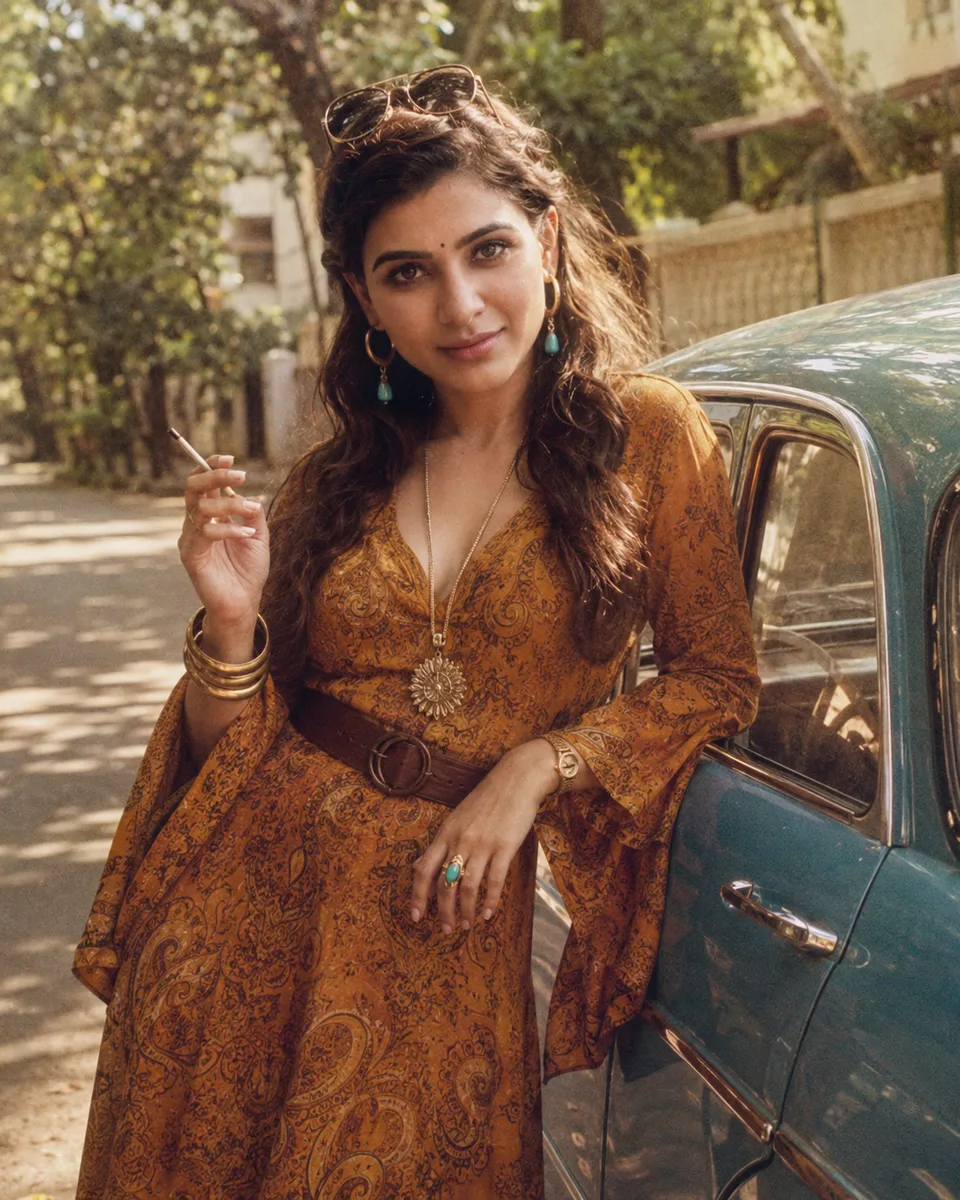
A candid shot captures a 1970s actress between takes, leaning against a vintage Fiat on a tree-lined road in suburban Bombay. The relaxed pose and nostalgic details evoke the charm of Hindi cinema, showcasing the actress’s effortless style amidst the warm afternoon light.
A single 4:5 vertical photograph captured in 1976, presented as a candid shot of an actress between takes on a Hindi-cinema film set — taken by the production stills photographer on the location for a film shoot in suburban Bombay (likely Pali Hill, Bandra, or a similar leafy residential area). The time is mid-afternoon, around 3:30 p.m. The subject is the person in the uploaded photograph, photographed leaning against (or seated on the edge of) a vintage Fiat 1100 or Ambassador car parked at the side of a tree-lined road.

LOCK from the upload: the entire face — eye shape and spacing, exact eye colour, nose bridge profile and tip, lip shape and natural fullness, eyebrow shape, jawline, chin shape, hairline, ear shape, skin tone, and every visible mole, freckle, scar, fine line, or beauty mark. Also the natural hair — its actual colour, texture, length, density. The hair will be styled in the 1970s register but the hair itself is hers. Render imperfections that are in the upload; do not invent. Critically: do not impose the "Bollywood actress face" archetype on the upload — the subject is *the user, photographed in the 1970s aesthetic*, not a generic 1970s actress lookalike.

REPLACE from upload: any earrings, necklaces, bangles, nose pins, rings, or other jewelry visible in the uploaded photograph are NOT carried over. They are removed entirely and replaced with the scene-appropriate 1970s jewelry described below. The upload's accessories are irrelevant to the rendered image; the scene's specifications win.

Wardrobe — 1970s Bombay heroine, on-set casual:
A wide-bell-sleeve maxi dress or jumpsuit in the 1970s palette — pick ONE: a deep mustard-yellow Indo-Western maxi dress with subtle paisley print and a structured V-neckline; a burnt-orange jumpsuit with a tied waist and wide bell-sleeves; a cream silk shirt with deep bell-sleeves paired with high-waisted wide-leg burnt-sienna bell-bottom trousers; or a fitted-bodice empire-waist maxi dress in deep coral with white piping. The fabric is real 1970s textile — slight body, real weight, subtle wrinkles where it has been worn for several hours.

The 1970s details to commit to:
— Bell-sleeves (a hallmark of the decade) — flared from the elbow.
— A wide belt at the waist or empire-waist seaming.
— Either a maxi length, or wide-legged trousers visible.
— Some print or texture — paisley, geometric, or a tied-batik pattern, in the saturated decade-appropriate palette (mustard, oxblood, burnt orange, deep coral, cream, brown, olive). No pastel-modern colours.

Scene jewelry (this replaces anything in the upload):
— Earrings: a pair of large 1970s statement gold hoops, or alternatively, long gold drop earrings ending in a small turquoise or coral stone. The earrings are visible and bold but worn casually — not the formal jhumkas of traditional Indian, but the modern-cosmopolitan-1970s register.
— Necklace: a long single gold chain falling to the chest with a single large medallion-style pendant — perhaps a sun motif, a peacock, or a stylised lotus. Long and unfussy.
— Bangles: a stack of three or four wider gold bangles on one wrist — chunky 70s style, not the thin traditional Indian bangles.
— Wristwatch: a small gold mechanical watch on the other wrist.
— Hands: a single statement gold ring on one finger — chunky, perhaps with a turquoise or coral stone matching the earring drops.
— No nose ring, no maang tikka, no mehndi — this is a modern 1970s urban Indian woman, not a traditional one.

Accessories — completing the look:
— A large pair of oversized round or aviator sunglasses pushed up onto the top of the head (visible nesting in the hair) OR worn on the face if it suits the moment. The frames are dark tortoiseshell or gold metal, the lenses smoky.
— A small leather handbag (a vintage 1970s Indian leather satchel-style, deep brown or tan) over one shoulder or set on the car bonnet beside her.
— A cigarette held loosely between two fingers but unlit (the era's signature prop — but absolutely not lit, suggested rather than performed) — OR a small leather-bound book / film script held instead, for users uncomfortable with the cigarette.

Hair styling (using the natural hair from the upload):
The natural hair styled in the 1970s register:
— If the natural hair is long: loose at shoulder-length or below with subtle natural waves (the result of the era's barrel curl or the slight curl that 1970s humid-Bombay days produced), centre-parted, with both sides falling forward over the shoulders. The hair has body and texture — not flat-ironed-modern but lived-in-soft.
— If shorter: a 1970s graduated bob or a side-parted layered cut, slightly tousled at the ends.
The hair is loose, natural, not stiffly styled. A few strands move with any breeze. There may be slight evidence of having been put up and let down — a small kink in the hair texture suggesting that.

Pose and composition — between-takes candid:
The subject is in a relaxed candid moment:
(a) leaning against the side of the vintage Fiat 1100 car (parked diagonally to the road), one shoulder against the car door, one foot crossed over the other in a relaxed stance, the cigarette / script held in one hand at chest level;
(b) seated on the car bonnet, weight on one hand pressed to the bonnet, the other arm draped loose across the knee, gaze out across the road or directly to the camera with mild bemusement;
(c) walking back toward the camera from the car, mid-step, sunglasses pushed up on the head, the bag held in one hand, hair lifting slightly from the movement.

The model picks based on the upload's face. The body language is *unhurried 70s* — the cosmopolitan ease that the era's stars had.

Expression — 1976 cool, not 2026 social-media:
A slight inward smile, the kind of expression that's *almost* but not quite a smirk — the look of someone who is amused by being photographed but going along with it. Eyes meeting the camera with steadiness — not the wide-eyed intensity of modern fashion photography, the *settled* gaze of someone who knows they're being looked at. Mouth softly closed, the resting lip shape preserved. There is a small confidence in the face that is *not* performed — it is just there.

Setting — Bombay 1976, location:
The architectural and environmental anchors:
— The vintage Fiat 1100 (or Ambassador) parked beside the subject — period-correct, in a deep teal-blue, cream, or rust-red colour. The metal has visible wear — not battered, but lived-in, the small scratches and natural patina of a five-year-old car in 1976.
— The road is a quiet residential lane in suburban Bombay — narrow, tree-lined with old gulmohars or mango trees, no other modern cars in the frame.
— A low compound wall or hedge behind the subject, with hints of an old colonial-style bungalow visible beyond — the kind of independent bungalow Pali Hill or Bandra still had in the 70s.
— A small visible film-set element if appropriate — perhaps a folding director's chair partially visible in the deep background, or a film camera on a tripod (covered with a cloth between takes), or a clapper-board resting on the car bonnet — but subtle, suggesting the film-set context without overwhelming it.
— A few details that anchor the year: a milk crate on the road, a hand-painted shop sign in the deep background in Devanagari script, a vintage milk bottle on a low wall.

Atmospheric details:
— Soft warm dust catching the afternoon light coming through the trees overhead — dappled light across the road and across one half of the subject.
— A few fallen gulmohar petals on the road (if it's the right season — orange-red blooms).
— The hint of Bombay's coastal humidity in the air — slight warm haze in the middle distance.

Light — afternoon dappled through trees:
— The primary light is mid-afternoon sun filtered through the canopy of trees above the road — dappled directional warm light at around 4500K. The patterns of light and shadow across the subject and the car are uneven but soft, the way leaf-shadow always falls.
— A patch of brighter sunlight may fall directly on one side of the face — let it. The contrast is slightly higher than studio portrait but gentler than full-sun direct.
— A warm bounce contribution from the road surface and the car's body — adding warm fill in the lower areas.
— The catchlights in the eyes are bright complex shapes — multiple small bright spots from the dappled overhead light, rather than a single clean catchlight.

Camera language — and this is critical to the era authenticity:
A 50mm prime lens at f/2.0, shot on Eastman colour negative film (the stock used in Indian cinema of the era) processed and scanned with the colour science of 1970s Indian print. Or the digital equivalent — a full-frame digital body with the colour graded specifically for 1976 Indian-cinema-print: slightly warm cyan-yellow tonal axis, saturated reds and oranges, slightly muted greens, the specific way Eastman film rendered skin under tropical sun.

ISO 200, available light. Subject distance roughly three metres. Three-quarter framing — from above the head with a small headroom to just above the knee. Slight handheld feel — the production photographer was leaning out for the shot, not perfectly steady.

Visible Eastman film grain — moderate, more visible in the shadow areas than in the highlights, with a slight colour-grain pattern that's different from modern digital noise. A slight overall softness from the era's lens coatings — not blur, but a gentle bloom in the highlights.

Colour treatment — 1976 Eastman colour:
The era-specific palette: deep saturated warms (mustard, burnt orange, oxblood), the slight green-yellow cast in the shadows that older Eastman colour produced, skin tones that read slightly warmer than digital-natural, the muted blues of the era's print stock. No teal-orange modern grading. No 2020s saturation.

Skin handling under dappled afternoon light: pores visible in the patches of direct light. The slight sheen on the cheekbones from Bombay's humidity. Individual eyelashes resolved. The slight cast of the Bombay afternoon — a warmth that the skin picks up from the bounced light. Soft natural texture, no retouching.

Aspect ratio 4:5 vertical. No text on the image, no film title overlay, no caption, no border, no watermark. The image is the candid still as it would have appeared in a 1976 Filmfare magazine spread — but without the magazine framing itself.
This image was generated with AI.
About this look
The scene is rich with 1970s flair, from the actress's wide-bell-sleeve maxi dress in deep mustard-yellow to the vintage Fiat 1100 parked beside her. Dappled sunlight filters through the leafy trees, casting warm patterns across her relaxed form and allowing the nuances of the fabric's texture to shine. Accessories like bold gold hoop earrings and oversized sunglasses contribute to the leisurely yet stylish ambiance, while the slight wrinkles in the dress suggest hours of wear, enhancing the authenticity of this candid moment.
This imagery is perfect for celebrating personal milestones or artistic projects that highlight vintage aesthetics. Ideal for social media sharing or as a part of a themed event, it resonates with those who appreciate the glamour and simplicity of past eras. Whether commemorating a birthday, a wedding anniversary, or simply a love for vintage cinema, this portrait-style homage captures a unique blend of nostalgia and personal expression, making it suitable for a diverse audience.
How to use this prompt
To achieve the desired result, supply a clear portrait of yourself that showcases your facial features accurately. Expect the prompt to lock in your facial characteristics, including eye shape and hair texture, while requiring the inclusion of a vintage-inspired background scene. A good outcome will feature you styled in 1970s fashion, with appropriate accessories and props. If the image doesn't reflect the intended 1970s aesthetic, consider adjusting the color palette or ensuring the hair is styled with natural waves to enhance the vintage effect.
Tips to customize it
- Choose a garment in a deep mustard or burnt-orange hue to capture that authentic 70s vibe.
- Opt for a backdrop featuring tree-lined streets typical of suburban Bombay to set the scene.
- Adjust the lighting to mimic warm afternoon sunlight for a nostalgic atmosphere.
- Include accessories like large gold hoop earrings for a bold vintage statement.
More like this

Prompt Deck
Free on Google Play
Take the whole deck with you
Browse thousands of AI image prompts, customise them with your own details, and create — all from the Prompt Deck app.
- Tap to customise & copy
- Save your favourites
- Fresh prompts daily